Clear Sky Science · en
Urban environmental determinants and their effects on mental health, physical function, and quality of life in older adults: a multidimensional study in Shiraz, Iran
Why city design matters for growing older
As more people live longer in cities, questions arise about how streets, parks, and even trash collection influence our later years. This study from Shiraz, a large city in southern Iran, looks at how everyday features of the urban environment—like access to green spaces, crowded neighborhoods, and the amount of garbage produced—shape the bodies, minds, and overall happiness of older adults. It also tests modern computer tools to predict who is most at risk when city conditions are poor.
Life in three kinds of neighborhoods
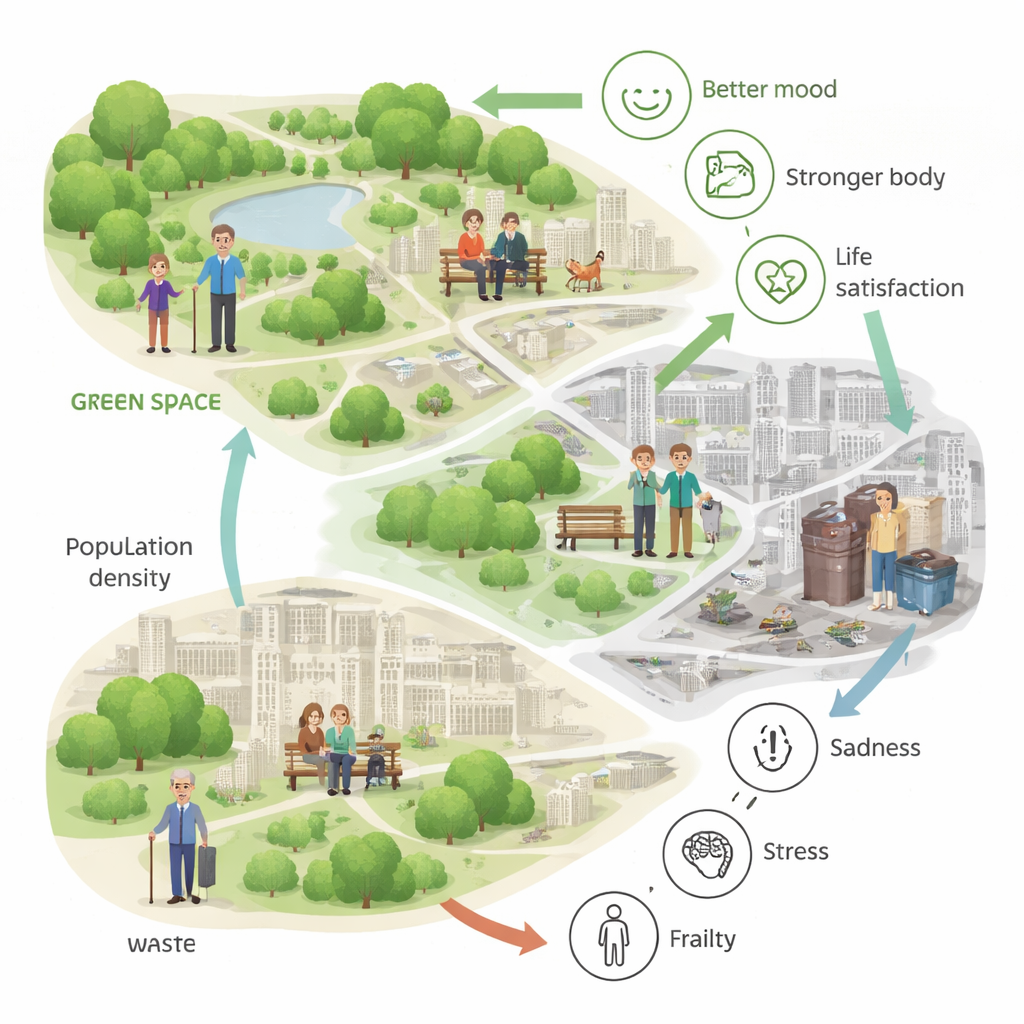
The researchers focused on three basic ingredients of city life: how many people live in each area (population density), how much parkland and tree cover there is for each resident (green space per person), and how much household waste each person generates. They studied 3,000 men and women aged 60 and above across 11 municipal zones of Shiraz, each with its own mix of crowded streets, quiet corners, and cleanliness. Some zones had generous parks and moderate density, others had average conditions, and a few combined very limited greenery with high crowding and heavy trash loads. This variety allowed the team to see how different combinations of environmental conditions were linked to health.
Taking the pulse of older residents
To understand health in a broad way, the team measured far more than just weight or illness. They recorded body mass index, a frailty index that reflects weakness and vulnerability to falls, and simple checklists for depression and anxiety. They also looked at a standard scale of overall psychological distress, tests for early cognitive problems, and a widely used measure of life satisfaction. Participants were randomly sampled from city records, and trained interviewers helped those who could not read or write complete the questionnaires. This careful design ensured that the results reflected the experience of ordinary older residents, not just a select few who are healthier or wealthier.
Green oases versus gray, crowded zones
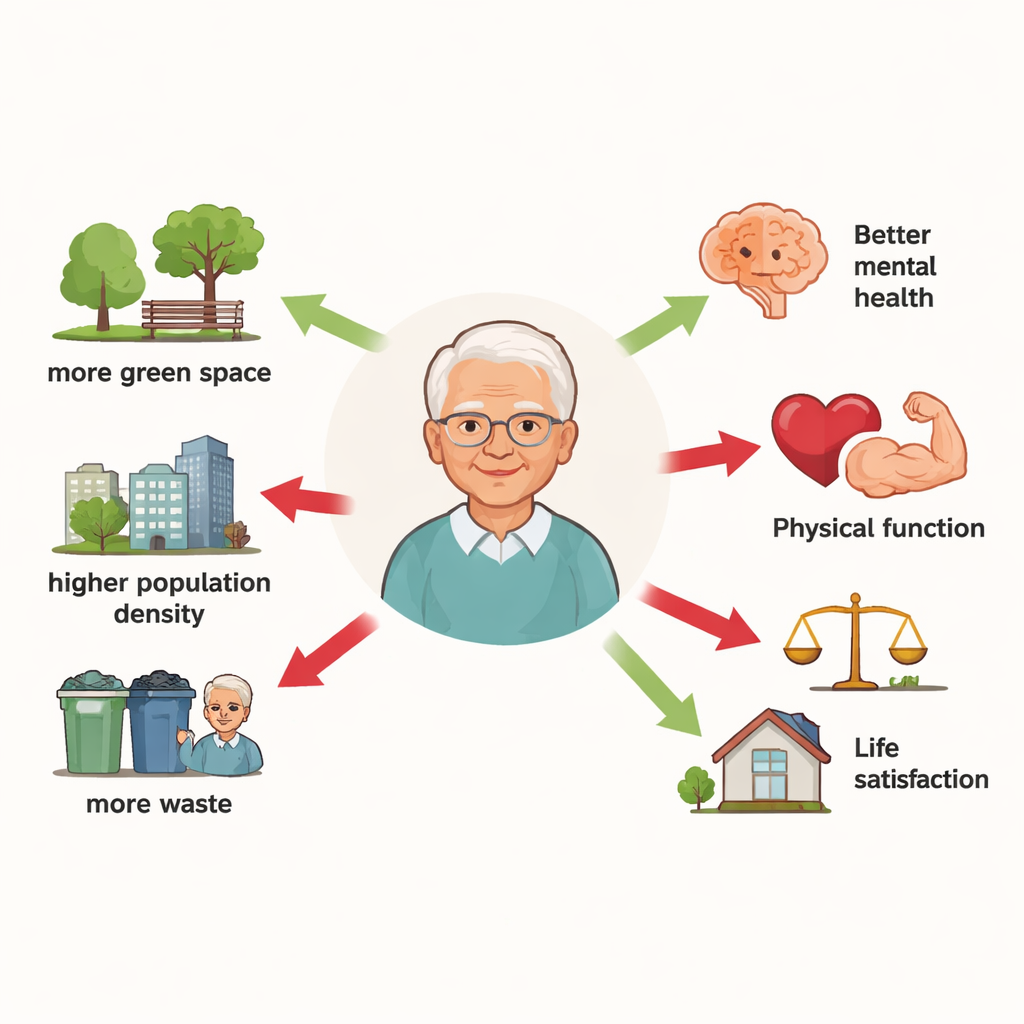
Patterns across the city were clear. Neighborhoods with more parks and trees tended to have older adults with fewer symptoms of depression and anxiety, less frailty, and higher life satisfaction. The study found that even a modest increase in green space—one extra square meter per person—was linked to a measurable drop in depression scores and a small reduction in frailty. In contrast, areas with heavier waste production and higher density had more falls, more emotional distress, and lower satisfaction with life. Zones with scarce greenery, many residents packed into a small area, and large amounts of trash formed a distinct “high-risk” cluster, where older adults showed the worst mental and physical health.
What computers reveal about risk
Beyond simple comparisons, the researchers used machine learning methods—Decision Trees and Support Vector Machines—to see whether city data alone could predict health outcomes. These models learned how green space, crowding, and waste levels combined to shape residents’ risks. They found easy-to-understand thresholds: for example, when green space per person fell below about seven square meters, depression and frailty rose sharply; when waste per person exceeded roughly 250 kilograms a year, the risk of falls and low life satisfaction increased. The more advanced model captured subtler, curving relationships and was especially accurate at predicting frailty, showing that older adults’ health responds in complex ways to their surroundings.
What this means for city dwellers
For non-specialists, the message is straightforward: the health of older adults is not only about medicine or personal habits; it is also about trees, benches, clean streets, and how tightly people are packed together. In this study, green areas acted like a protective blanket, linked to calmer moods, stronger bodies, and a greater sense of contentment, while overcrowding and unmanaged waste nudged people toward frailty, fear of falling, and sadness. The authors argue that city officials who expand parks, add small “pocket” green spaces, and improve waste systems are not just beautifying neighborhoods—they are helping older residents stay healthier, more independent, and more satisfied with their lives.
Citation: Asadollahi, A., Błachnio, A., Tomas, J.M. et al. Urban environmental determinants and their effects on mental health, physical function, and quality of life in older adults: a multidimensional study in Shiraz, Iran. Sci Rep 16, 7694 (2026). https://doi.org/10.1038/s41598-026-38857-1
Keywords: urban green space, older adults, mental health, frailty, healthy aging