Clear Sky Science · en
Pharmacogenomic profiling of ABCB1 and CES1 in atrial fibrillation patients on dabigatran from a multiethnic Malaysian cohort
Why your genes might matter for blood thinners
Many people with an irregular heartbeat called atrial fibrillation take blood-thinning pills to prevent stroke. These drugs, including one called dabigatran, are usually given in the same dose to most adults. Yet some people end up with too much or too little drug in their system, which can increase the risk of dangerous bleeding or clotting. This study asks a simple but important question: can a person’s genes help explain why dabigatran works differently from one patient to another in a real-world Malaysian clinic?
A common heart rhythm problem and a widely used pill
Atrial fibrillation is one of the most common heart rhythm disorders worldwide and raises the chance of stroke several-fold. To lower this risk, patients are prescribed blood thinners. In Malaysia, doctors increasingly use newer drugs known as direct oral anticoagulants instead of the older drug warfarin. Dabigatran is one of these newer options and is popular because it does not usually require regular blood tests for dose adjustment. However, doctors still notice large differences in how much dabigatran shows up in patients’ blood and how strongly it thins their blood, even when they receive the same dose.
Looking inside blood and DNA
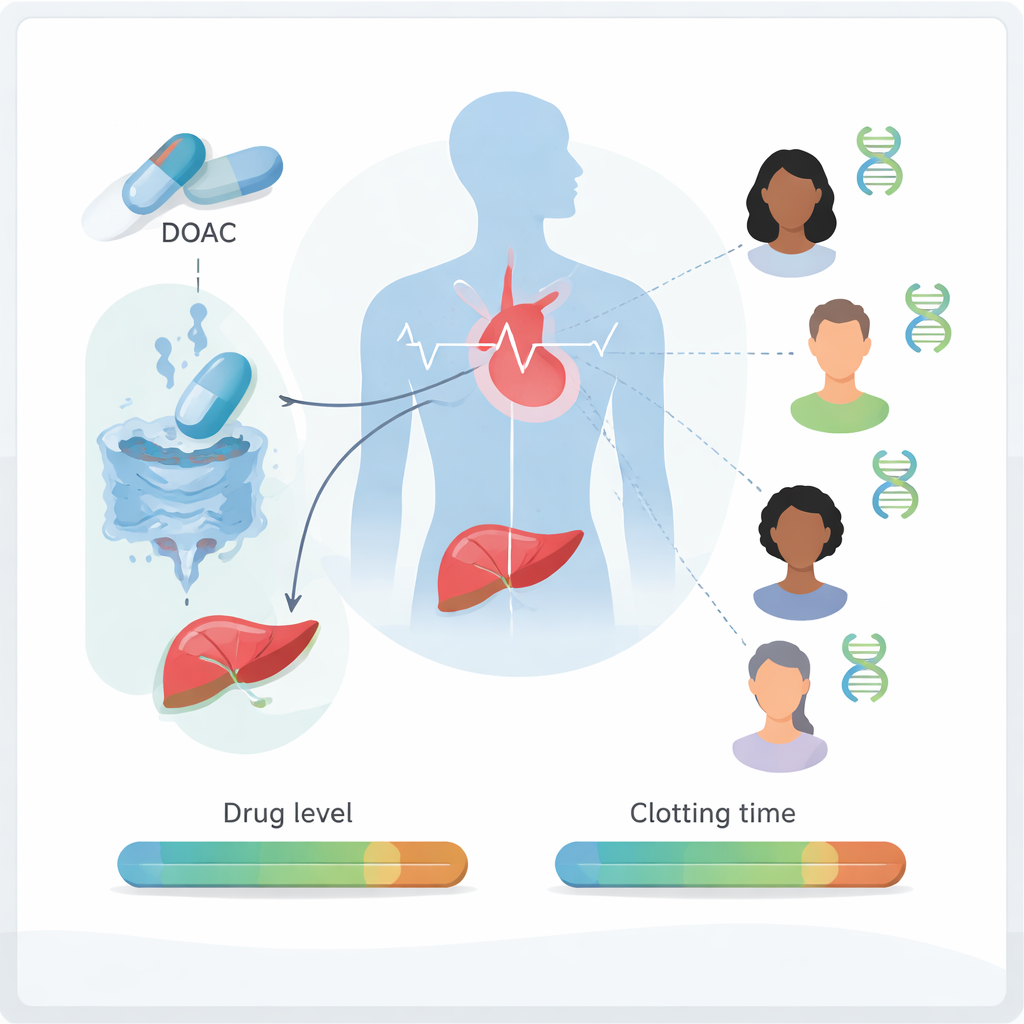
To probe these differences, researchers recruited 180 Malaysian patients with atrial fibrillation who were taking dabigatran. The group reflected the country’s multiethnic mix, including Chinese, Malay, and Indigenous communities. At a clinic visit, blood was drawn just before the next dose, when dabigatran levels are at their lowest, known as the trough level. One part of the sample was used to precisely measure how much drug was in the blood, and another part was used to measure how long the blood took to clot, a practical readout of how strongly the drug was working. At the same time, the team extracted DNA and used modern sequencing technology to scan the full length of two genes, ABCB1 and CES1, that help control how dabigatran is transported and broken down in the body.
Big differences in levels, modest clues from genes
The patients showed striking variation in dabigatran levels: some had almost no detectable drug, while others had nearly 300 units in their blood. Clotting times also varied widely, and as expected, higher drug levels went hand in hand with longer clotting times. Older age, poorer kidney function, and being female tended to be linked with higher drug levels and more prolonged clotting. Surprisingly, the prescribed dose—whether patients took the standard 150 mg twice daily or the lower 110 mg twice daily—did not clearly separate patients into high- and low-level groups in this real-world setting.
What the gene scan did and did not show
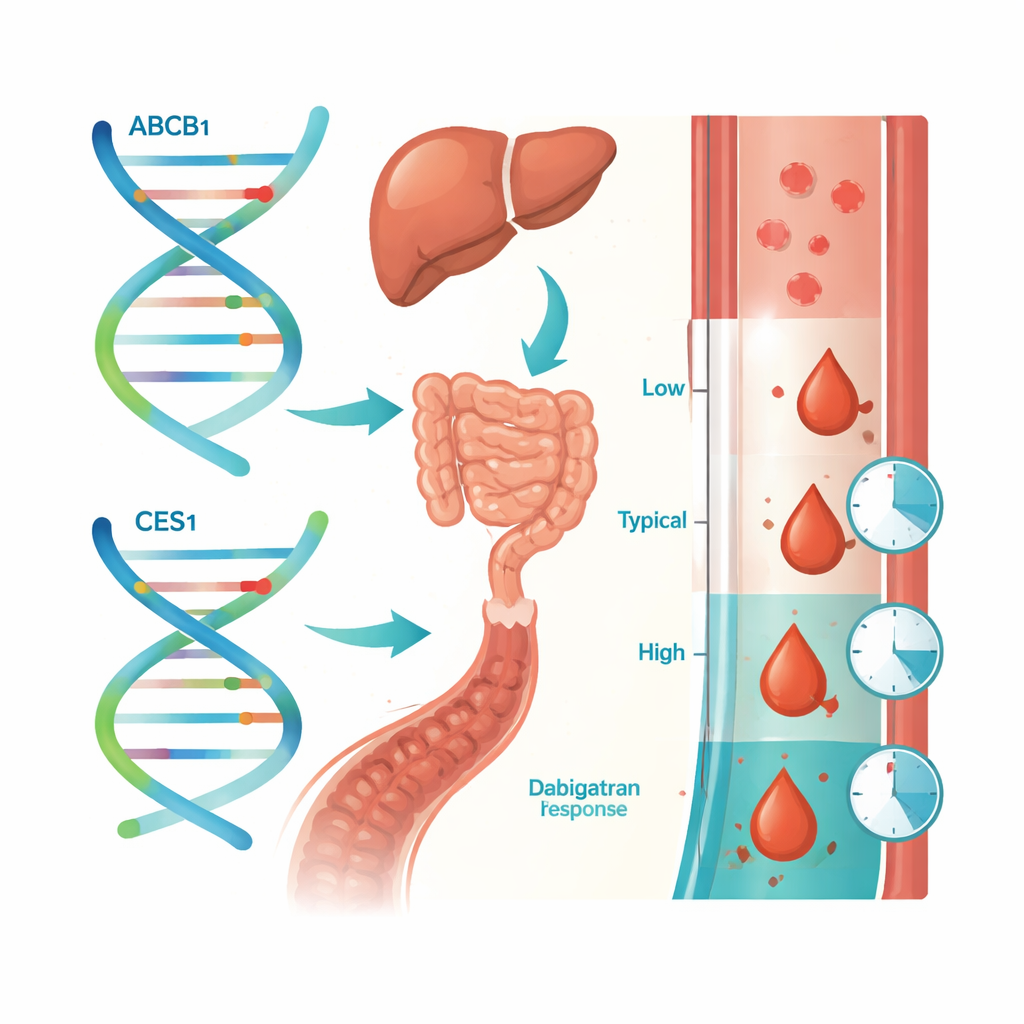
When the scientists examined hundreds of subtle spelling differences in the ABCB1 and CES1 genes, they found dozens of sites that seemed, at first glance, to be linked with either dabigatran levels or clotting time. Most of these changes were in non-coding regions of DNA that help control how genes are switched on or off, rather than in the protein-coding parts themselves. Seventeen sites overlapped, hinting at shared switches that might influence both how much dabigatran enters the bloodstream and how it affects clotting. However, once the team applied stricter statistical checks to avoid false positives, none of these genetic signals remained strong enough to be considered definite. Clinical outcomes such as stroke, heart problems, or bleeding were thankfully rare over one year, which is good news for patients, but made it difficult to draw firm links between any gene variant and real-world events.
What this means for patients and future care
For now, this research suggests that while genetic differences in drug-handling genes probably play some role in how individuals respond to dabigatran, we do not yet have clear, clinically proven genetic markers that doctors can use to fine-tune dosing, at least in this Malaysian population. The study highlights just how complex blood thinner responses can be, shaped by age, kidney function, sex, and likely many small genetic effects acting together. The work also underlines why it is important to study diverse populations rather than relying only on data from Europe or North America. Larger, multi-centre studies that combine genetics, careful drug measurements, and detailed follow-up will be needed before routine gene-based tailoring of dabigatran becomes part of everyday care.
Citation: Tan, S.S.N., Sim, E.UH., Jinam, T.A. et al. Pharmacogenomic profiling of ABCB1 and CES1 in atrial fibrillation patients on dabigatran from a multiethnic Malaysian cohort. Sci Rep 16, 7539 (2026). https://doi.org/10.1038/s41598-026-38856-2
Keywords: atrial fibrillation, dabigatran, blood thinners, pharmacogenomics, genetic testing