Clear Sky Science · en
Using colored dissolved organic matter fluorescence to trace Pacific-derived water in the Eastern Canadian Arctic
Why the Color of Arctic Waters Matters
Far from shore and hidden beneath sea ice, the Arctic Ocean quietly shifts the balance of fresh and salty water that helps regulate Earth’s climate. This study shows that the faint natural glow of dissolved organic material in seawater can act like invisible dye, revealing how vast amounts of relatively fresh water from the Pacific Ocean thread their way through the Canadian Arctic Archipelago into Baffin Bay and, ultimately, the North Atlantic. Understanding these pathways matters because they influence marine ecosystems, sea ice, and even the strength of ocean currents that redistribute heat around the globe.
Fresh Water Highways Through the Arctic
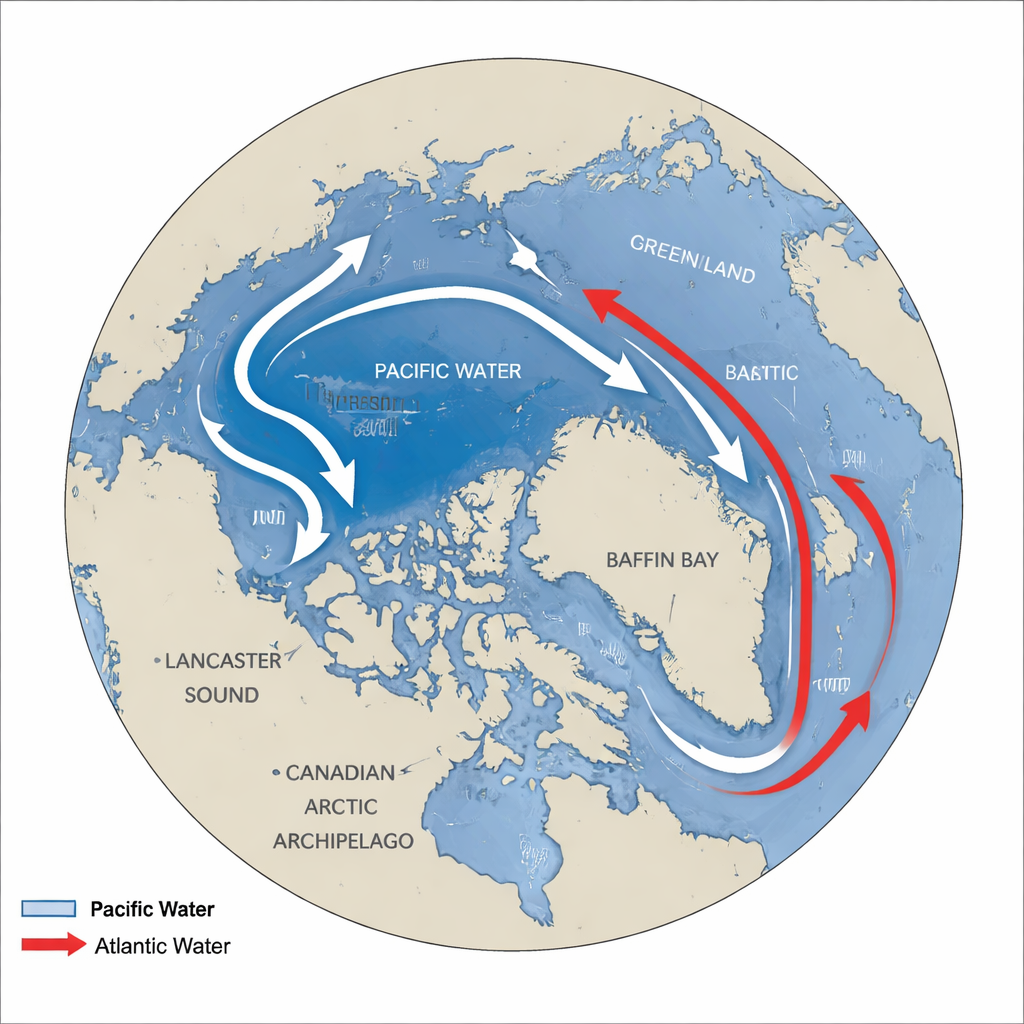
The Canada Basin, north of Alaska and Canada, holds a layered ocean: cold, fresh water at the surface, a mid-depth layer of Pacific-origin water, and deeper, saltier Atlantic water. Pacific water enters the Arctic through the narrow Bering Strait and then follows two main routes: a Transpolar branch that cuts across the central Arctic toward Fram Strait, and an Alaskan branch that hugs the Beaufort Sea slope. Part of this Pacific water turns toward the Canadian Arctic Archipelago and exits the Arctic through a maze of channels and straits, including Nansen and Eureka Sounds, Nares Strait, and Jones and Lancaster Sounds, before feeding into Baffin Bay. Along the way it mixes with river runoff, melting sea ice, and Atlantic-influenced waters carried by the West Greenland Current.
Using Natural Glow as a Tracer
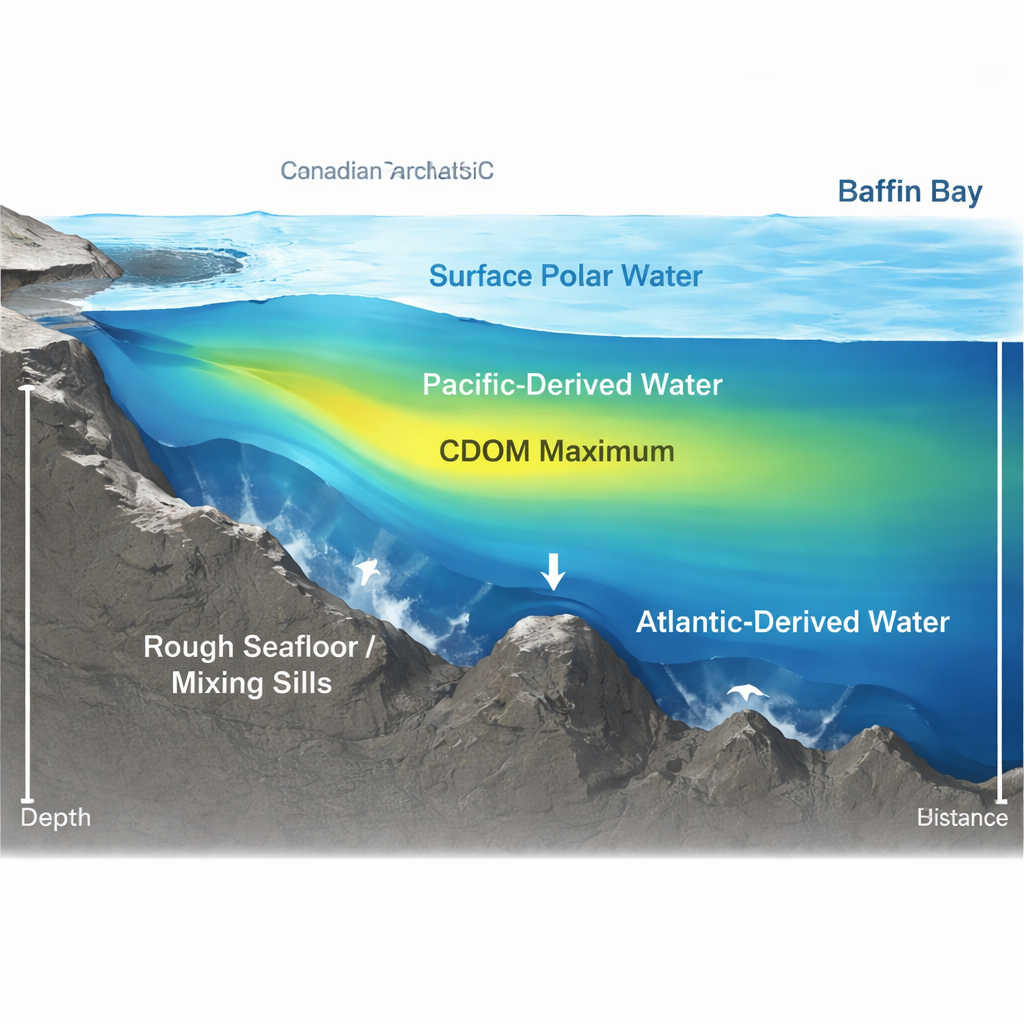
To track this moving freshwater, the researchers relied on a property called fluorescence of colored dissolved organic matter (FCDOM). This material, largely made of broken-down organic compounds from Arctic shelves and river inputs, absorbs light and re-emits a faint glow that can be measured with optical sensors. Pacific winter water in the Canada Basin is known to carry a clear subsurface FCDOM peak, formed when this water interacts with organic-rich sediments on the shallow Chukchi and northern Bering shelves. By combining measurements of temperature, salinity, and FCDOM taken from two Canadian research icebreakers in summer 2024, and comparing them with earlier data from a drifting ice-tethered profiler, the team used this FCDOM peak as a “fingerprint” to follow Pacific-derived water from the central Arctic into the Eastern Canadian Arctic.
What Happens Along the Northern Routes
The scientists examined two main Arctic gateways. Along the northwestern route, through Nansen and Eureka Sounds and onward to Jones Sound, the Pacific fingerprint is initially strong: a cool, relatively fresh layer at about 50–180 meters depth with a clear FCDOM maximum. However, as the flow crosses shallow sills and rough seabed, powerful tidal mixing stirs the water column. This vertical mixing weakens and spreads the FCDOM peak, especially downstream of narrow passages such as Cardigan Strait and Fram Sound. In Jones Sound and nearby northern Baffin Bay, swirling eddies and the arrival of water influenced by the West Greenland Current further blur the original Pacific signal, making it difficult to identify Pacific water using temperature and salinity alone.
The Eastern Route and Mixing in Baffin Bay
Along the northeastern route, through Nares Strait—from Robeson Channel past Kane Basin and Smith Sound—the Pacific signal remains clearer for longer. Here, the subsurface FCDOM maximum is preserved as the water flows south, even while gradual freshening and added FCDOM reveal increasing contact with water transported by the West Greenland Current. By the time the water reaches northern Baffin Bay, the upper layer still carries elevated FCDOM values that can be linked to Pacific outflow, but the deeper layers show a gradual FCDOM increase with depth typical of water that has circulated for a long time in Baffin Bay and mixed with Atlantic-derived inflows. Measurements across Lancaster Sound then show how these mixed waters partially recirculate, carrying both Pacific and Atlantic influences back toward Baffin Bay.
What This Means for the Future
Overall, the study demonstrates that the natural fluorescence of dissolved organic matter is a powerful tool for tracing how Pacific water moves through the Arctic’s complex channels and where it mixes with Atlantic and Greenland-influenced waters. Even when traditional markers such as temperature and salinity become muddled, the FCDOM fingerprint often remains visible until strong mixing over rough seafloor or interaction with the West Greenland Current erodes it. As optical sensors become more common on moorings, floats, and ships, this approach will allow scientists to monitor changing freshwater pathways in a warming Arctic and better understand their impacts on sea ice, marine life, and the larger ocean circulation that helps regulate Earth’s climate.
Citation: Dmitrenko, I.A., Stedmon, C.A., Babb, D.G. et al. Using colored dissolved organic matter fluorescence to trace Pacific-derived water in the Eastern Canadian Arctic. Sci Rep 16, 7757 (2026). https://doi.org/10.1038/s41598-026-38848-2
Keywords: Arctic Ocean circulation, Pacific freshwater, dissolved organic matter, Baffin Bay, Canadian Arctic Archipelago