Clear Sky Science · en
Emotion-specific vocabulary is associated with preschoolers’ emotion knowledge and behavioral emotion regulation
Why children’s feeling words matter
Young children often say they feel just “good” or “bad,” even when their emotions are more complicated. This study asks whether having a richer set of feeling words – and really understanding them – helps preschoolers better recognize emotions in others and manage their own emotional reactions. The findings matter for parents, educators, and anyone interested in how early language can support children’s social and school success.
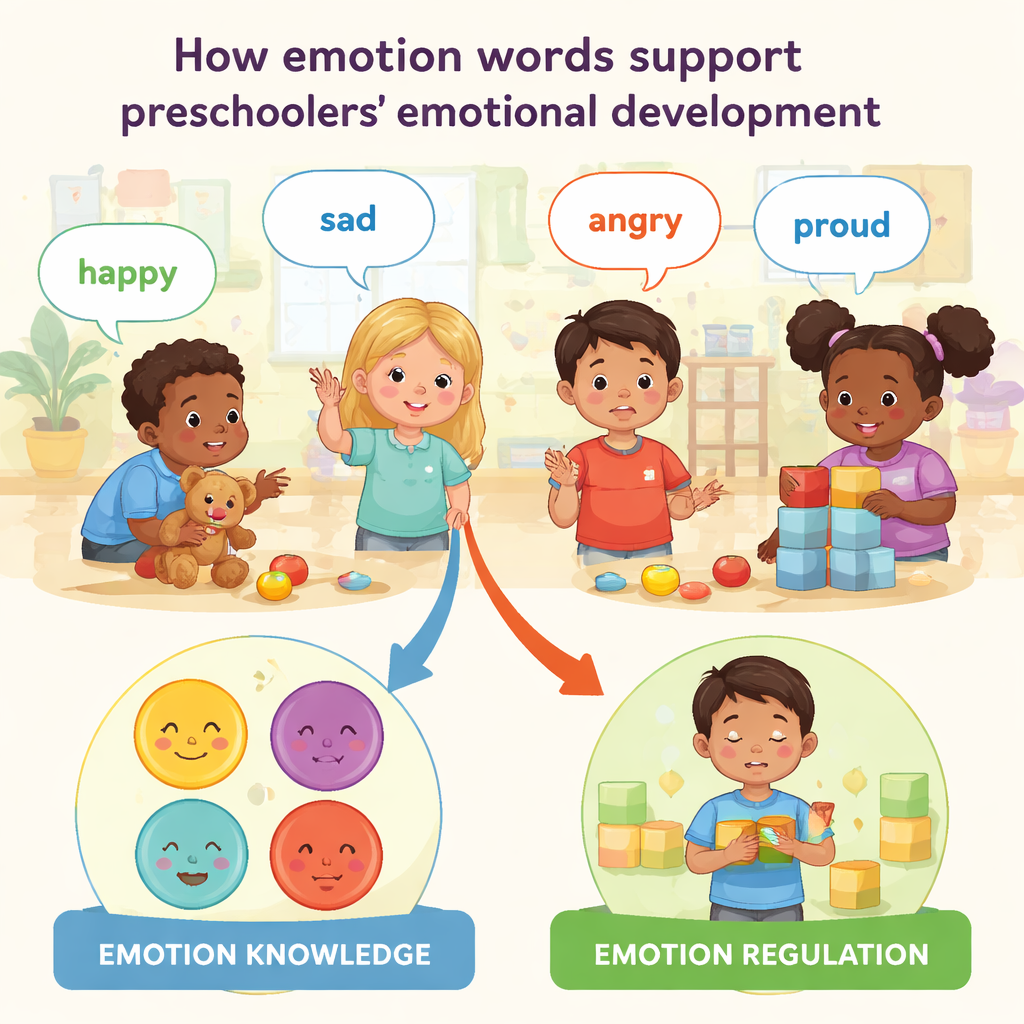
Two kinds of emotional word power
The researchers focused on two aspects of children’s emotion vocabulary. First was size: how many different emotion words a child could use, such as “happy,” “sad,” “angry,” but also more nuanced ones like “proud,” “jealous,” or “lonely.” Second was depth: how accurately and precisely children used these words in context, in a way that resembled how adults talk about feelings. A child with high depth, for example, might distinguish between “proud” and “happy,” or “frustrated” and “angry,” instead of using one broad term for many situations.
Testing feelings with stories and games
The study involved 197 typically developing German preschoolers aged 4 to 6. In one session, children completed a standard picture-naming test to measure general vocabulary and a special task that told short stories about children in emotional situations. After each story, the child was asked to name how the character felt, which revealed how many and what kind of emotion words they used. The researchers also measured emotion knowledge in two ways: how well children could label facial expressions like joy, anger, fear, sadness, and surprise, and how many helpful strategies they could suggest for dealing with negative feelings such as anger, fear, or sadness.
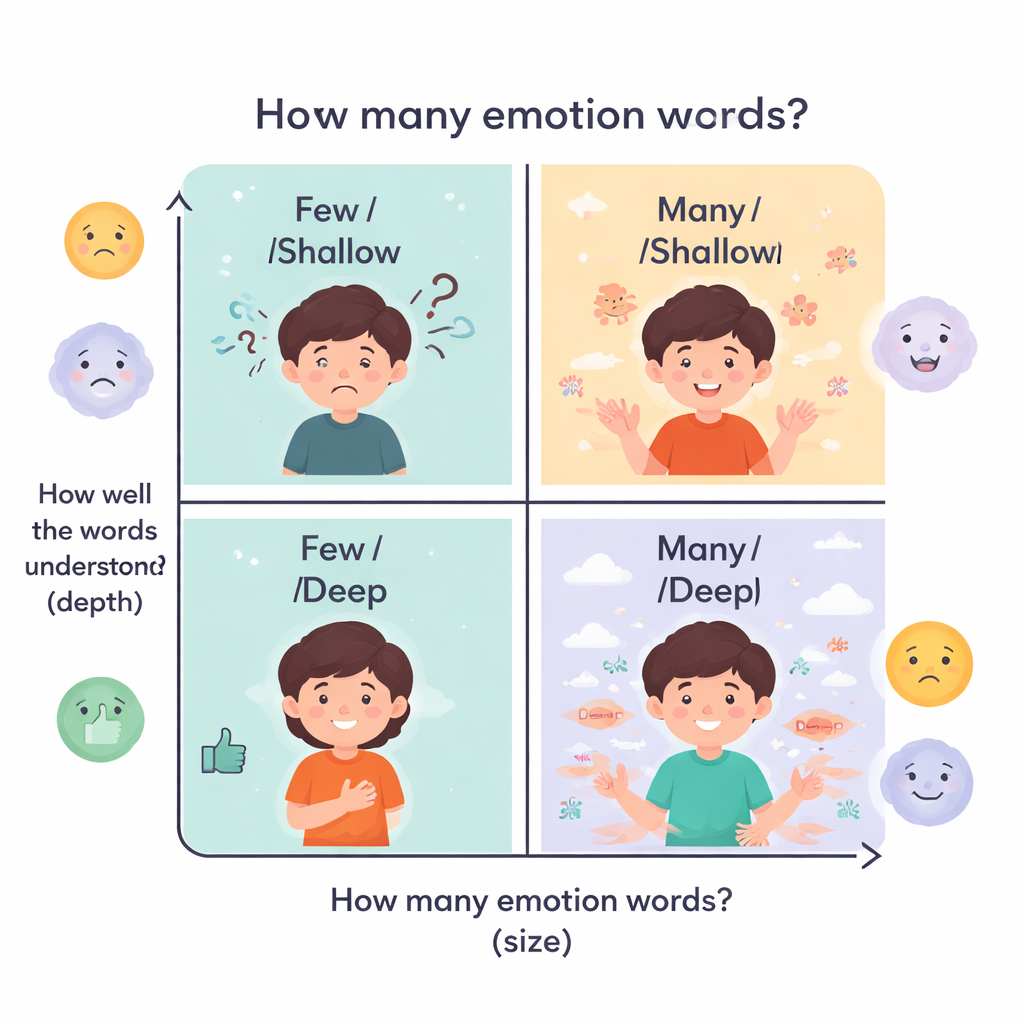
Watching real-time emotional reactions
To capture emotion regulation in action, the children played a computerized “balloon game.” Sometimes everything worked smoothly and winning was easy, which usually brought out positive emotions. Other times the mouse stopped working and the child lost, which tended to trigger frustration or disappointment. In one round the children were simply told to play. In another, they were asked to hide from an observer whether they were winning or losing. Video recordings were analyzed with specialized software that tracked small changes in facial expressions. This allowed the researchers to see how much each child dialed up or down visible signs of positive and negative emotion when asked to regulate.
Many words help, but real understanding counts more
Children with larger and deeper emotion vocabularies generally showed better emotion knowledge: they were more accurate at recognizing facial expressions and more able to name useful ways to handle negative feelings. Crucially, size and depth worked together in complex ways. A deep understanding of a smaller set of feeling words could compensate for knowing fewer total words – these children performed as well as peers with larger vocabularies. By contrast, simply knowing many labels without a clear grasp of what they meant was not enough and could even be confusing. For controlling outward emotional displays, especially positive ones, having many emotion words appeared helpful only when children also showed strong depth. A large but shallow vocabulary was linked to slightly poorer control of exuberant positive expressions, whereas deeper understanding seemed to protect against this downside.
What this means for helping children grow
Overall, the study suggests that knowing feeling words is not just about counting terms; it is about building clear, precise concepts of different emotions. Such depth supports children in reading others’ faces and thinking of better ways to cope with strong feelings. For positive emotions, it may also help them adjust how much they show on the outside when the situation calls for it. For families and educators, this points to the value of talking about emotions in nuanced ways – not only teaching new labels like “proud” or “disappointed,” but also helping children use them accurately in everyday situations.
Citation: Streubel, B., Khammous, N., Saalbach, H. et al. Emotion-specific vocabulary is associated with preschoolers’ emotion knowledge and behavioral emotion regulation. Sci Rep 16, 5414 (2026). https://doi.org/10.1038/s41598-026-38847-3
Keywords: emotion vocabulary, preschool development, emotion regulation, emotion knowledge, social-emotional learning