Clear Sky Science · en
Synergistic effects of compost amendment and foliar nano-micronutrients on yield and quality of sugar beet grown in calcareous soil
Turning Tough Soils into Sweet Harvests
In many dry regions, farmers struggle to grow crops in pale, chalky soils that lock away key nutrients. This study asks a practical question with global importance: can we coax more sugar and better yields from sugar beet—one of the world’s main sugar sources—by pairing ordinary compost with cutting-edge nano-sized nutrients sprayed on leaves? The answer matters not just for beet growers, but for anyone interested in how smarter soil care and tiny technologies can help feed a warming, drying world.
Why Chalky Soils Hold Plants Back
Calcareous soils, rich in lime and high in pH, are common in arid and semi-arid areas. They look bright and powdery, but for plants they are like a locked pantry: nitrogen and potassium are scarce, and vital trace elements such as iron, manganese, and boron become hard to absorb. Sugar beet, which supplies about 40% of the world’s sugar, can grow in these soils but often falls short of its potential. The researchers set out to test whether two tools—compost added to the soil and nano-sized droplets of micronutrients sprayed on leaves—could work together to unlock this pantry and push both yield and sugar content upward.
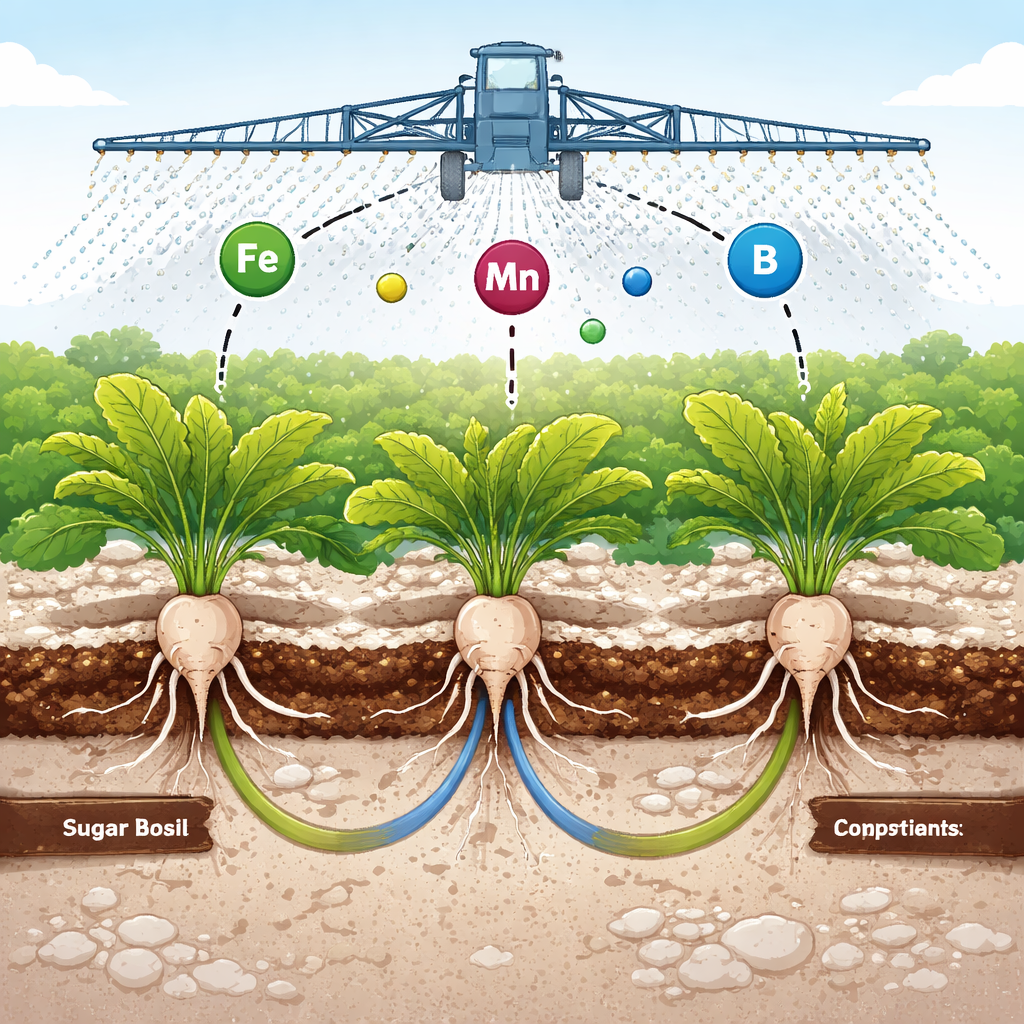
Testing Compost and Tiny Nutrients in the Field
Over two growing seasons in Egypt, the team planted a commercial sugar beet variety in drip-irrigated calcareous soil. They compared three compost levels mixed into the soil (none, a moderate dose, and a high dose of 6 tons per acre) and five spray treatments on the leaves: no spray, two-element mixes, or a three-way mix of nano-iron, nano-manganese, and nano-boron. These nanoparticles, only a few dozen billionths of a meter across, were applied in low concentrations several times during growth. The scientists then measured how green and leafy the plants became, how strongly they defended themselves against stress, and how much sugar they ultimately packed into their roots.
Greener Leaves, Stronger Roots, and Stress Protection
The most striking result was how strongly compost and nano nutrients reinforced each other. The best combination—6 tons of compost per acre plus the three-way nano spray—gave plants noticeably greener leaves, with chlorophyll levels rising by about a quarter compared with compost alone. Leaf area expanded by more than half, meaning the plants captured more sunlight. Inside the leaves, key protective enzymes that break down harmful by-products of stress, such as catalase and peroxidase, jumped by around one-third to nearly one-half. The plants also built up more natural protective compounds called phenolics. Together, these changes indicate that the beets were not only better fed but also better shielded against the harsh conditions of high-pH, nutrient-poor soil.
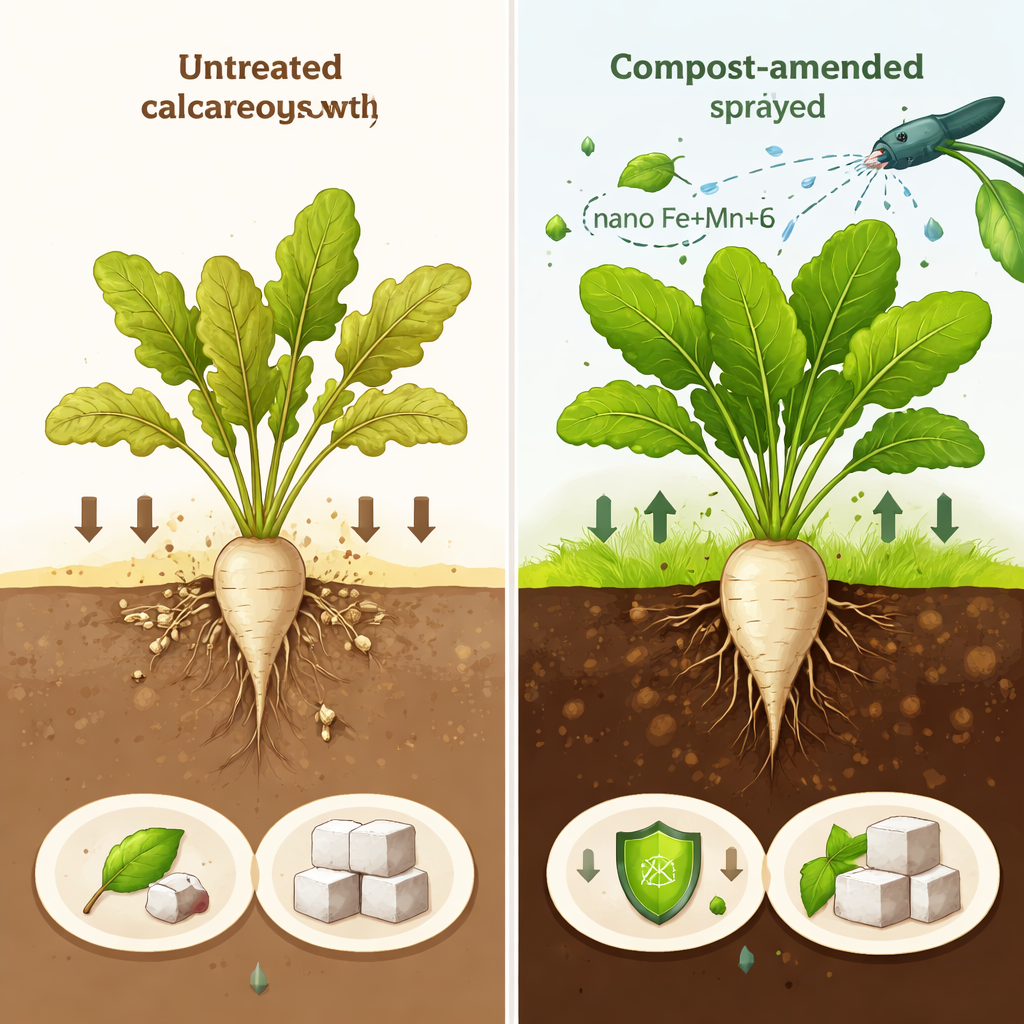
From Healthier Plants to More Sugar
These internal improvements translated directly into heavier and sweeter roots. With compost alone, yields improved, but adding the nano iron–manganese–boron spray unlocked far greater gains. Root size and fresh weight increased, and the concentration of sucrose in the roots climbed to nearly 20%. The portion of sugar that factories can actually extract also rose. When all the numbers were added up, fields receiving both high compost and the full nano spray mix produced roughly one-third more root mass and about two-thirds more sugar per acre than fields given compost without the nano nutrients. Although some impurities in the juice also rose, the overall quality index of the sugar remained high, meaning the extra sugar still translated into better processing value.
A Simple Recipe for Better Beets in Hard Soils
For farmers facing stubborn, chalky soils, this study offers a clear takeaway in simple terms: building the soil with a solid dose of compost lays the foundation, and a light mist of nano iron, manganese, and boron on the leaves acts like a turbocharger. Together they help sugar beet plants grow bigger, stay healthier under stress, and store more sugar in their roots. The work suggests that pairing traditional organic amendments with carefully targeted nano nutrients can turn difficult land into more productive fields, boosting both farm income and the efficient use of limited water and fertilizer resources.
Citation: El-Gamal, I.S.H., Salem, EA.S.R., El-Sharnoby, H.M. et al. Synergistic effects of compost amendment and foliar nano-micronutrients on yield and quality of sugar beet grown in calcareous soil. Sci Rep 16, 7731 (2026). https://doi.org/10.1038/s41598-026-38845-5
Keywords: sugar beet, calcareous soil, compost, nano-fertilizer, crop yield