Clear Sky Science · en
Passive surgical correction of rigid adult spine deformities to normative alignment and balance
Why Back Shape Matters as We Age
Many older adults develop a stooped posture that makes standing and walking painful and exhausting. This forward-bent stance is more than a cosmetic issue: it can rob people of independence and quality of life. The study described here explores a simpler way to straighten severely bent, stiff spines in older patients using existing surgical tools and careful body positioning, with the goal of restoring a more natural, energy‑saving posture.
A Growing Problem of Bent Backs
Adult spine deformity becomes more common with age and can lead to chronic back pain, difficulty walking, and a heavy social and economic burden. When pain and disability no longer respond to exercise, medication, or braces, surgeons may straighten and fuse parts of the spine. The challenge is not just to make the spine straight, but to restore a posture that lets the body balance its weight with minimal muscle effort. If this balance is not achieved, metal implants can fail and new bends can appear just above the fused area, a complication known as junctional breakdown.
A Simple Target: Keeping the Head Over the Pelvis
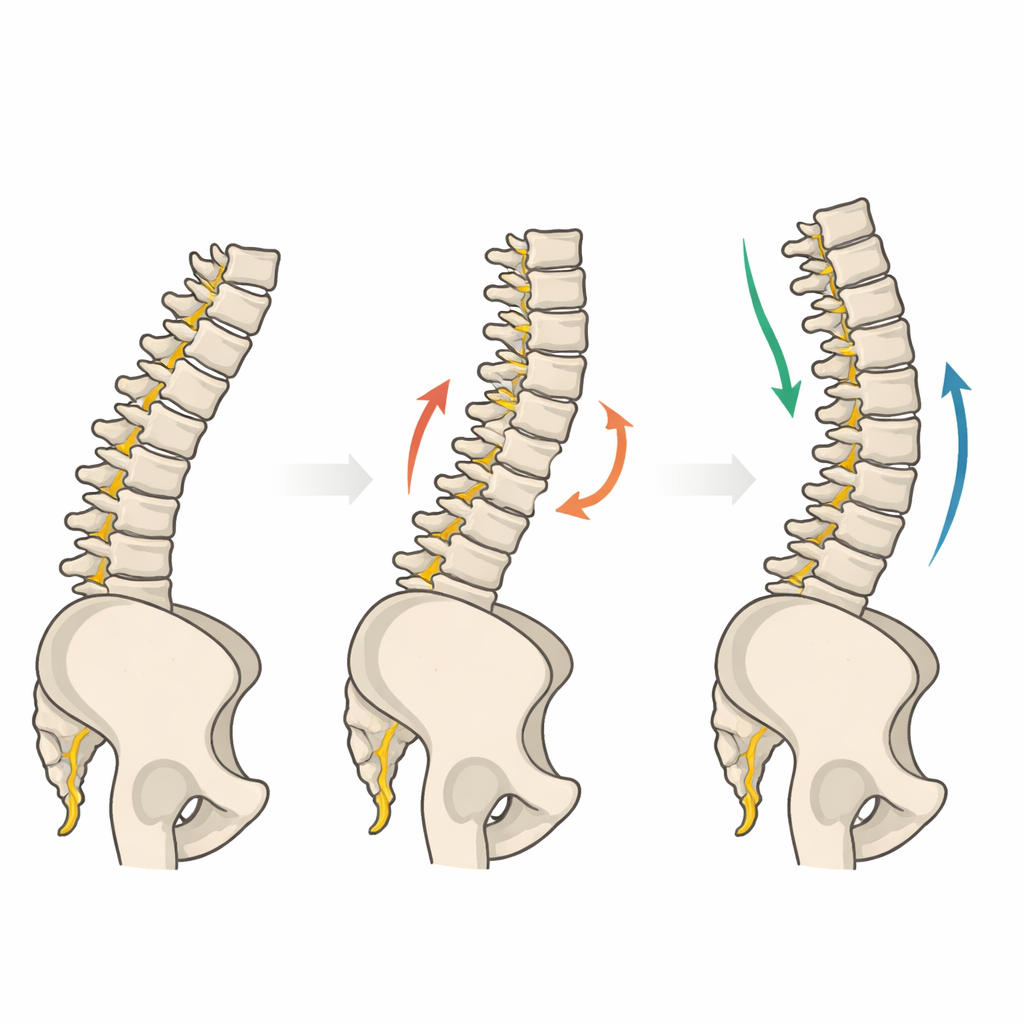
Existing planning methods for complex spine surgery often rely on multiple angles and formulas that can be difficult to use in everyday practice. The authors propose a more intuitive measure: the horizontal distance between the center of a neck vertebra (C7) and the ideal, age‑adjusted line of balance running through the pelvis. They call this distance the C7‑SA norm. In plain terms, it captures how far forward the upper body has drifted. By virtually “bending” the lower spine on digital X‑rays until this distance shrinks toward zero, surgeons can see how much inward curve (lordosis) must be restored in the lower back to bring the trunk back over the hips.
Letting Gravity Help in the Operating Room
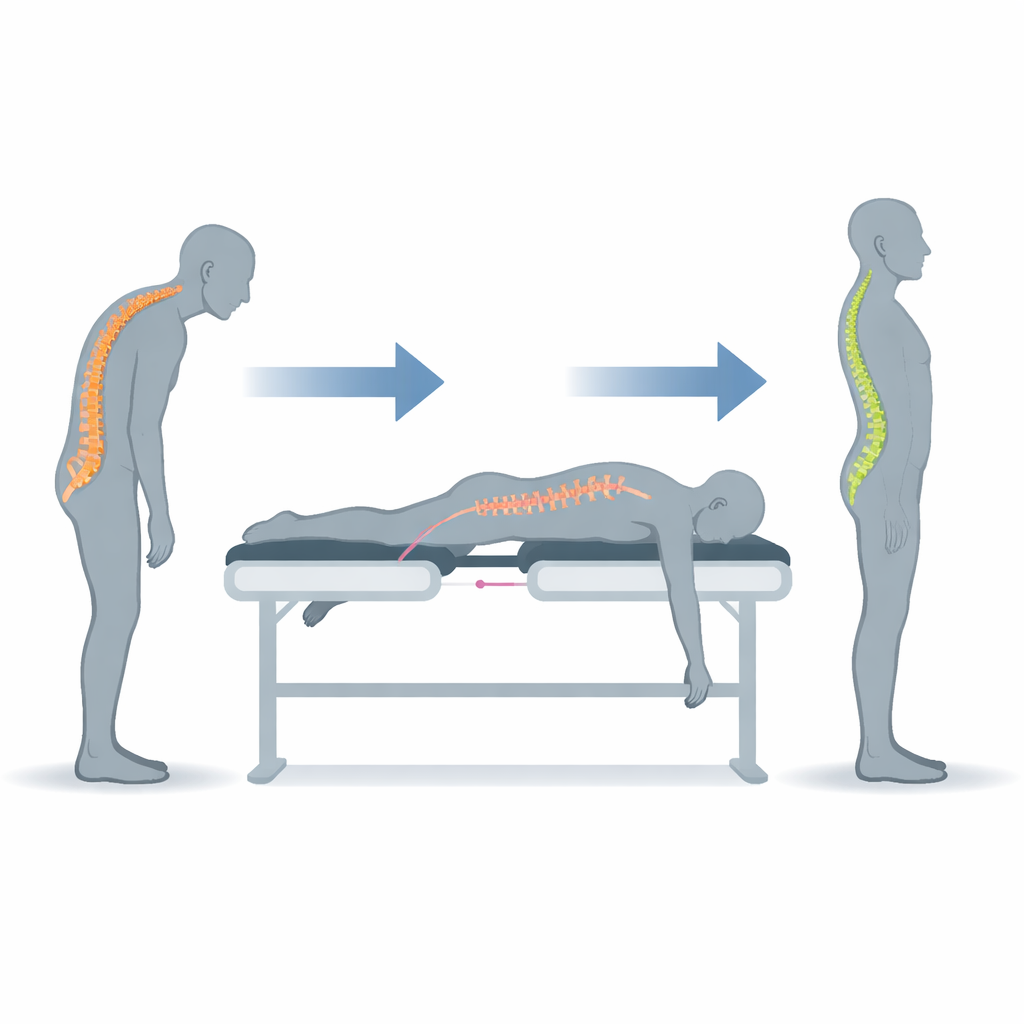
The team reviewed 26 older patients with very stiff, often previously fused spines who needed a powerful type of bone cut called a three‑column osteotomy in the lower back. All patients were placed face‑down on a special operating table that keeps shoulders, hips, and ankles in a straight line while the abdomen hangs freely, mimicking an upright stance. After carefully cutting through a chosen vertebra in the lower spine, surgeons used clamps and the patient’s own body weight to gently close the wedge‑shaped gap. This maneuver restored the inward curve of the lower back without repeatedly bending the table or relying on complex intraoperative measurements.
What Changed for Patients
Before surgery, patients’ upper bodies leaned forward by more than 11 centimeters on average, and their overall spinal shape was far from normal. After surgery, the forward shift was reduced to about 3.5 centimeters, values considered close to healthy alignment for their age. The new C7‑SA norm also shrank markedly, and the lower back regained around 27 degrees of inward curve. Pain scores for back and leg pain were roughly cut in half at follow‑up. Complication and revision rates were comparable to those reported in other large studies of such demanding procedures, suggesting that the simplified method did not increase risk despite the severity of the deformities.
What This Approach Could Mean
The study suggests that surgeons can plan and perform major spine straightening in older adults using a single, easy‑to‑grasp landmark—how far the neck sits in front of the ideal balance line—and by allowing gravity to assist correction on a properly adjusted table. A C7‑SA norm above about 6–7 centimeters in a rigid spine signaled the need for a strong corrective cut in the lower back. While this is an early, single‑center experience and not yet a universal rule, it points toward a more accessible way to achieve age‑appropriate posture, potentially lowering the chance of future mechanical problems while helping patients stand more upright with less effort.
Citation: Capone, C., Pötzel, T., Bratelj, D. et al. Passive surgical correction of rigid adult spine deformities to normative alignment and balance. Sci Rep 16, 7868 (2026). https://doi.org/10.1038/s41598-026-38840-w
Keywords: adult spinal deformity, spine surgery, posture balance, lumbar lordosis, osteotomy