Clear Sky Science · en
An emission-capacitated vehicle routing model for sustainable urban waste collection using hybrid guided local search
Why Smarter Trash Routes Matter
Garbage trucks are a familiar sight in every city, but few people realize how much fuel they burn and how much carbon they emit as they weave through crowded streets. This paper shows that by planning waste collection routes more intelligently—taking into account not just distance and time, but also how heavy the trucks are and how much carbon they produce—cities can cut fuel use, reduce greenhouse gas emissions, and save money, all without buying new vehicles or changing how often trash is picked up.
Garbage Trucks and Climate Change
Transportation is a major source of global warming pollution, and urban services like waste collection contribute more than their share because they involve heavy vehicles making frequent stops on busy streets. Traditional route planning tries to keep travel distance or cost low, assuming that shorter routes naturally mean less fuel and fewer emissions. In reality, that is only part of the story. A fully loaded garbage truck burns more fuel than an empty one, and city governments are starting to set explicit carbon targets and budgets. The authors argue that cities need routing systems that directly “see” fuel and carbon, not just kilometers or labor hours.
A New Way to Plan City Routes
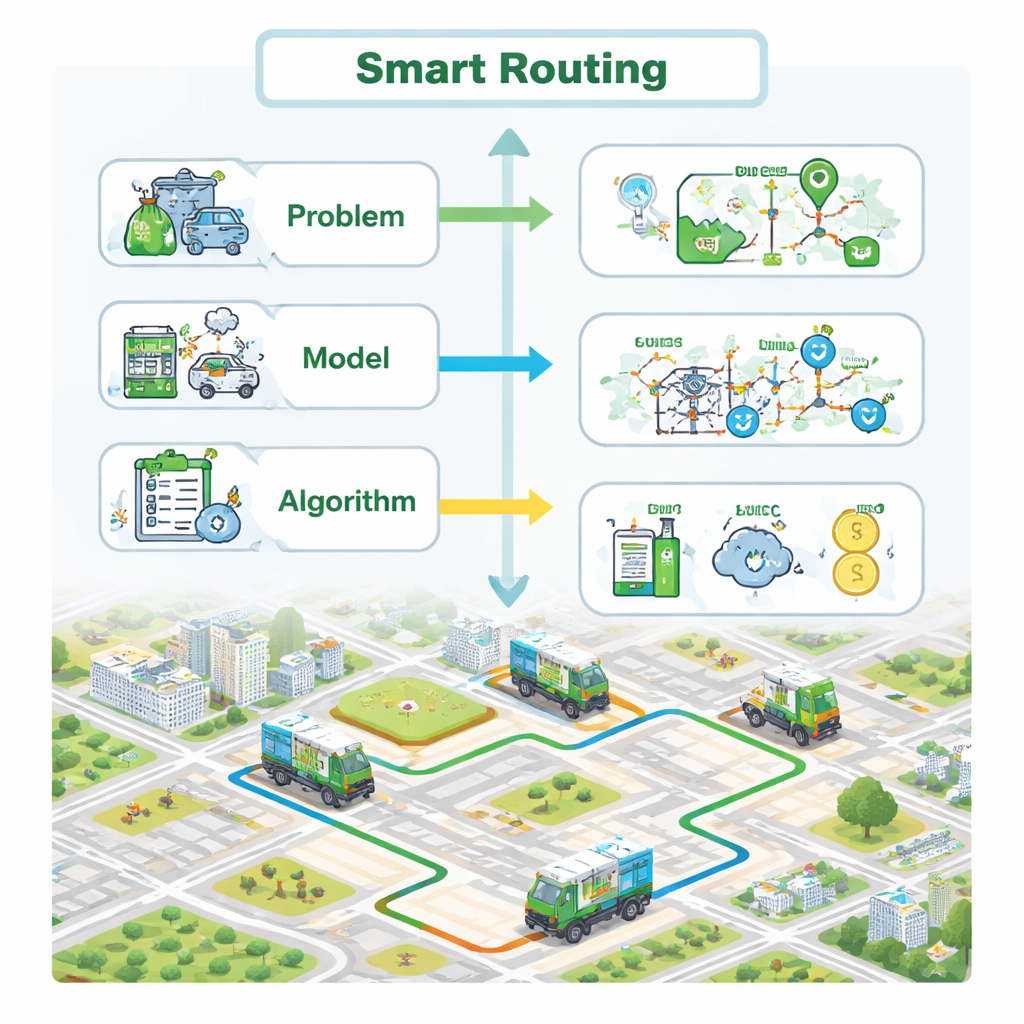
To tackle this, the study introduces an enhanced planning model called the Emission-Capacitated Vehicle Routing Problem with Time Windows. In simple terms, it is a mathematical blueprint that decides which truck serves which containers, in what order, and at what time, while respecting limits on truck capacity, working hours, and customer time windows. What makes it new is that it builds fuel and emissions into the heart of the calculation. Fuel use is linked to both distance and load: a truck that is heavier burns more fuel per kilometer. On top of that, the model lets a city impose policy-style rules, such as a maximum total amount of carbon allowed per day and an upper limit on average emissions per kilometer for the entire fleet.
Smart Search for Better Routes
Because the number of possible routes explodes as a city grows, no computer can simply check them all. The authors therefore develop a tailored search procedure called Hybrid Guided Local Search. It starts with a fast, “cheapest feasible insertion” method that stitches together an initial set of workable routes by always adding the next stop in the least costly way that still obeys all constraints. Then it repeatedly tweaks these routes—swapping stops, reversing segments, or moving customers between trucks—while keeping an eye on both logistics rules and emission limits. A guiding penalty mechanism steers the search away from patterns that repeatedly cause high costs or high emissions, helping the algorithm escape local dead ends and continue improving the solution.
Putting the Model to the Test
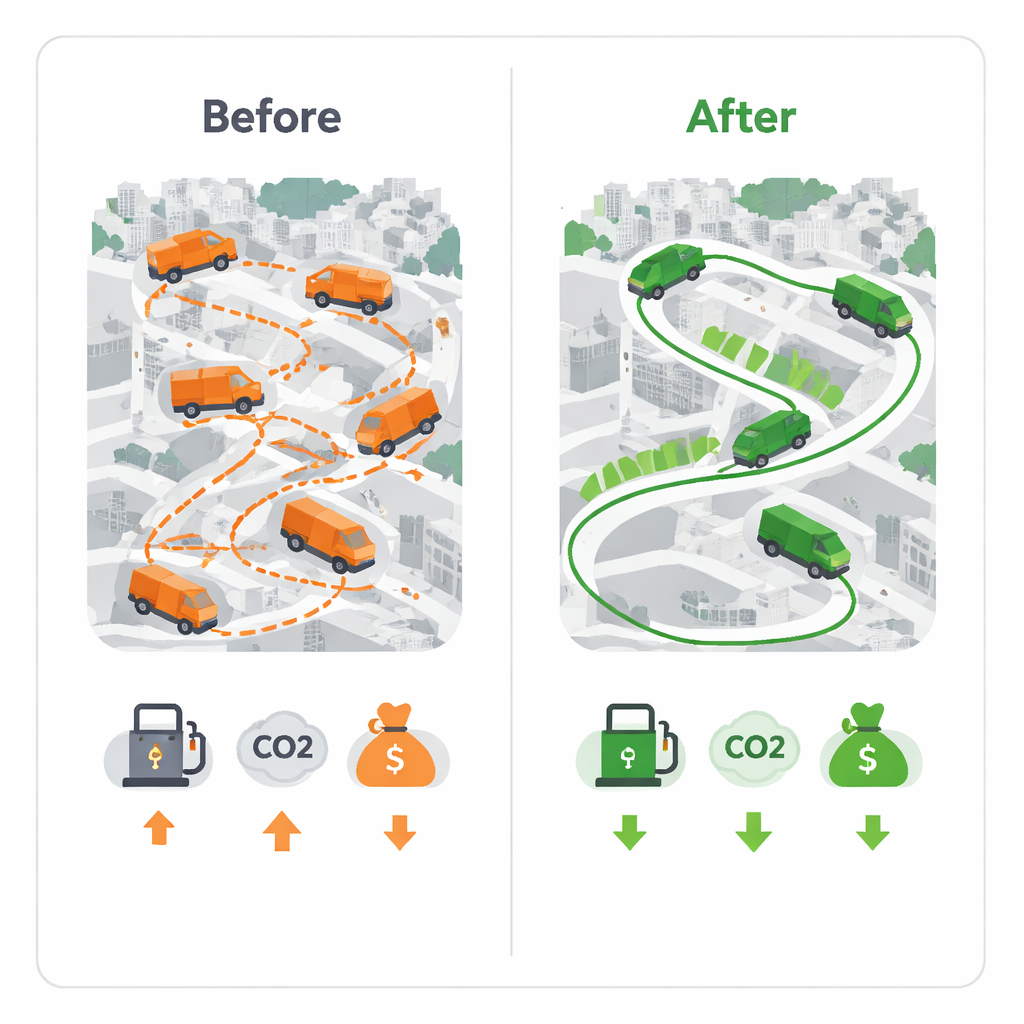
The approach is first tested on standard academic benchmark problems to make sure it is competitive with well-known methods. Across dozens of test cases, the hybrid search often matches or beats the best-known solutions in terms of vehicles used and distance traveled, and it consistently outperforms common alternatives such as genetic algorithms and simulated annealing. More importantly for real life, the authors apply their model to an actual waste collection zone in Peshawar, Pakistan, covering 109 container sites and a complex street network with one-way streets, narrow alleys, and school-related restrictions. Compared with the city’s ad hoc routing, the optimized plans cut fuel consumption and CO₂ emissions by about 9–11 percent and reduce total operating cost by roughly 8–9 percent, all while meeting strict carbon budgets and emission-intensity caps.
What This Means for Cities
For non-specialists, the bottom line is straightforward: without buying new trucks or changing collection frequency, better planning alone can noticeably shrink a city’s carbon footprint and fuel bill. By treating emissions and policy limits as first-class inputs—rather than after-the-fact reports—the proposed method lets city managers explore different scenarios: prioritizing cost savings, tightening carbon budgets, or insisting that every kilometer driven stays below a chosen emission threshold. The study’s case results show that such smart routing can make municipal waste collection cleaner, cheaper, and more resilient, providing a practical tool for cities seeking to meet climate targets while keeping essential services running smoothly.
Citation: Khalid, Q.S., Maqsood, S., Mumtaz, J. et al. An emission-capacitated vehicle routing model for sustainable urban waste collection using hybrid guided local search. Sci Rep 16, 7691 (2026). https://doi.org/10.1038/s41598-026-38829-5
Keywords: urban waste collection, vehicle routing, carbon emissions, sustainable logistics, optimization algorithms