Clear Sky Science · en
LINC01857 promotes clear cell renal cell carcinoma progression by scaffolding DNMT1 to suppress WIF1 expression
Why this kidney cancer story matters
Clear cell kidney cancer is the most common and deadliest form of kidney cancer in adults. Many patients are diagnosed only after the disease has already spread, and current drugs do not work for everyone. This study uncovers a hidden molecular "switch"—a long strand of non‑coding RNA called LINC01857—that helps kidney tumors grow and spread. Understanding this switch could open new paths for earlier diagnosis and more precise treatments.
A growing cancer problem in the kidney
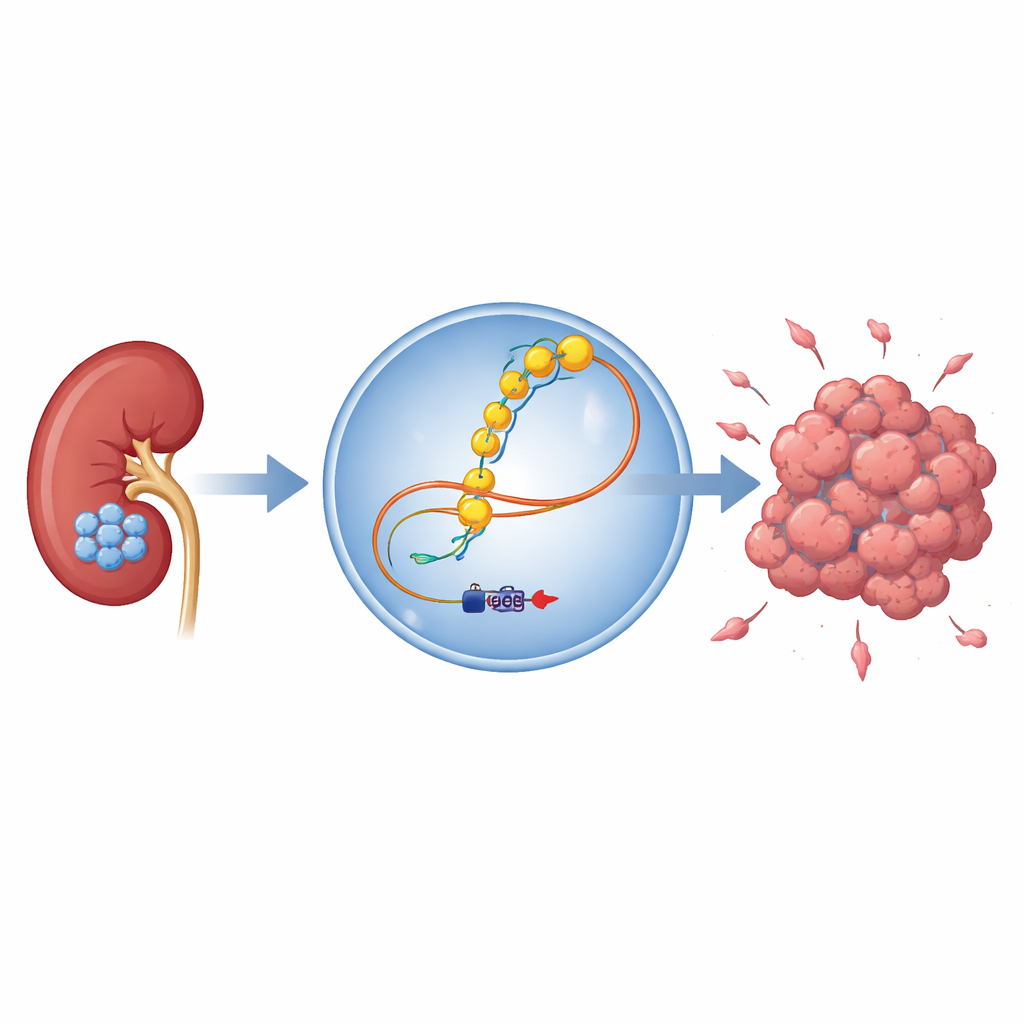
Clear cell renal cell carcinoma begins in the tiny filtering units of the kidney and is responsible for most kidney cancer deaths. Although imaging has improved detection, up to a third of patients experience a return of the disease after surgery, often because microscopic tumor deposits have already escaped. Researchers know that cancer cells rewire their internal control systems by turning certain genes on or off, but the full list of players and how they interact in kidney cancer remains incomplete. The authors set out to investigate whether an overlooked class of genetic material—long non‑coding RNAs—might be driving this process.
The rise of a silent troublemaker
Unlike typical genes that carry blueprints for proteins, long non‑coding RNAs act more like control cables, shaping which genes are used and when. The team focused on one such RNA, LINC01857, previously linked to several other cancers. By analyzing large public cancer datasets and samples from 26 patients, they found that LINC01857 levels were much higher in clear cell kidney tumors than in nearby normal kidney tissue. In kidney cancer cell lines grown in the lab, LINC01857 was also strongly increased and concentrated mainly inside the cell nucleus—the command center where gene activity is managed—hinting that it might be directly influencing which genes are silenced or activated.
How LINC01857 helps tumors grow and spread
To see what LINC01857 actually does, the researchers dialed its levels up and down in kidney cancer cells. When they reduced LINC01857, the cells divided more slowly and were less able to move through and invade artificial barriers—behaviors associated with weaker tumors. Boosting LINC01857 had the opposite effect, speeding growth and invasion. In mice, cancer cells engineered to produce less LINC01857 formed smaller tumors and produced fewer lung metastases after being injected into the bloodstream. Together, these experiments show that LINC01857 is not just a bystander: it actively fuels tumor growth and spread.
A molecular clamp on a protective brake
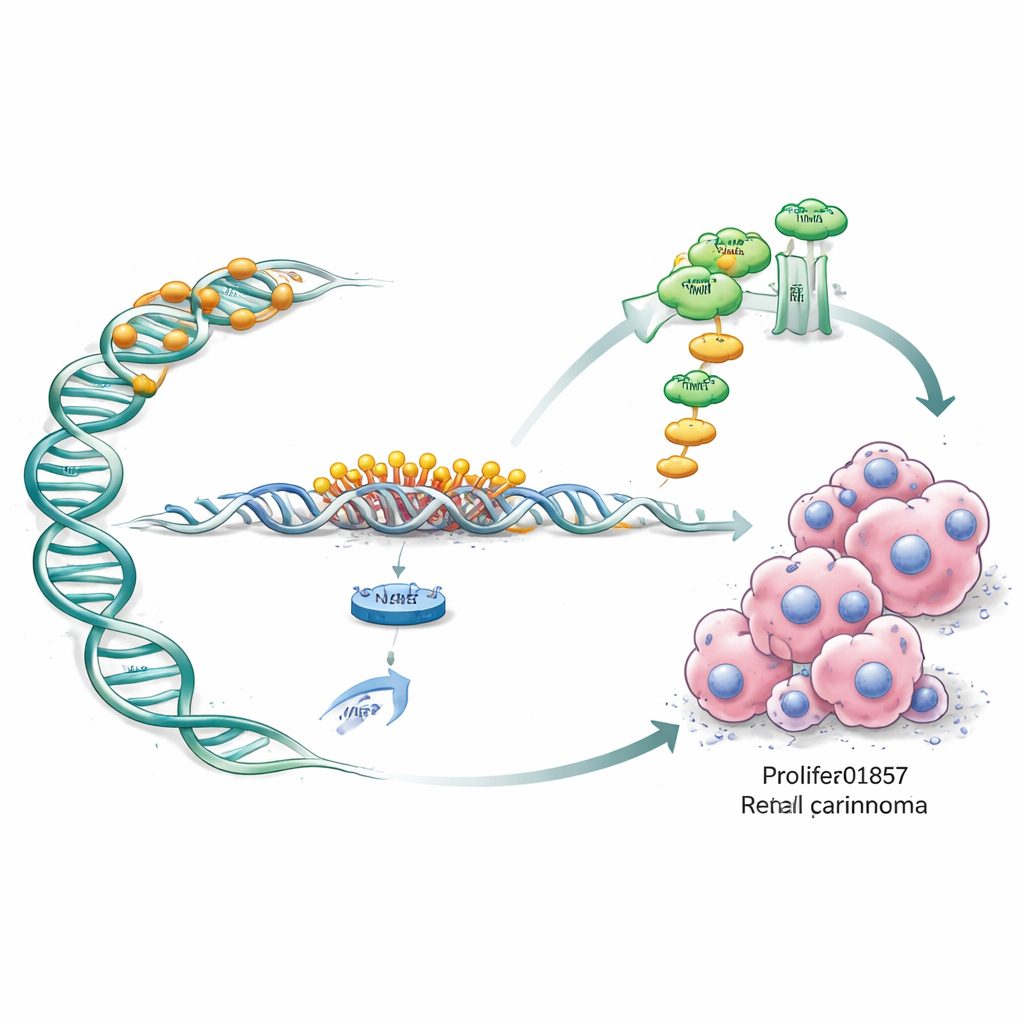
Digging deeper, the scientists discovered how LINC01857 exerts its influence. Inside the nucleus, LINC01857 binds to DNMT1, an enzyme that adds chemical tags to DNA and can shut down genes. Acting like a scaffold, LINC01857 guides DNMT1 to the on‑off switch of a protective gene called WIF1, which normally helps keep a powerful growth pathway, known as Wnt/β‑catenin, in check. Once DNMT1 is in place, it heavily “decorates” the WIF1 control region with methyl groups, effectively muffling WIF1. The team confirmed that in kidney cancer cells this control region is more heavily tagged when LINC01857 is high, and that blocking DNMT1 or lowering LINC01857 restores WIF1 activity. When WIF1 is silenced, the Wnt/β‑catenin pathway runs more freely, raising levels of proteins that drive cell division and movement, and making tumors more aggressive.
Turning a discovery into potential treatment
By mapping this chain—from LINC01857 to DNMT1 to WIF1 to Wnt/β‑catenin—the study reveals a clear route by which a non‑coding RNA can tip kidney cells toward cancer. Targeting LINC01857, disrupting its partnership with DNMT1, or reawakening WIF1 could all be explored as new strategies to slow or halt clear cell kidney cancer. Although more work is needed, including finer measurements of DNA tagging and studies in patients, this research identifies LINC01857 as both a possible marker of disease severity and a promising handle for future therapies aimed at stopping kidney tumors before they spread.
Citation: Xiang, W., Lyu, L., Zheng, F. et al. LINC01857 promotes clear cell renal cell carcinoma progression by scaffolding DNMT1 to suppress WIF1 expression. Sci Rep 16, 8069 (2026). https://doi.org/10.1038/s41598-026-38828-6
Keywords: clear cell renal cell carcinoma, LINC01857, DNA methylation, WIF1, Wnt beta-catenin signaling