Clear Sky Science · en
The effects of mixed-mode ventilation on energy saving and employee job satisfaction, work engagement, and job performance
Why Cooler Offices Matter for Everyone
As heat waves and steamy nights become more common, keeping offices comfortable without overheating the planet is a growing challenge. This study looks at a new way to cool office buildings in the tropics that promises big energy savings without making workers less happy, less engaged, or less productive. Instead of relying only on energy-hungry air conditioners, the researchers test a "mixed" system that uses outside breezes whenever possible and switches to traditional cooling only when truly needed.
A New Kind of Office Breeze
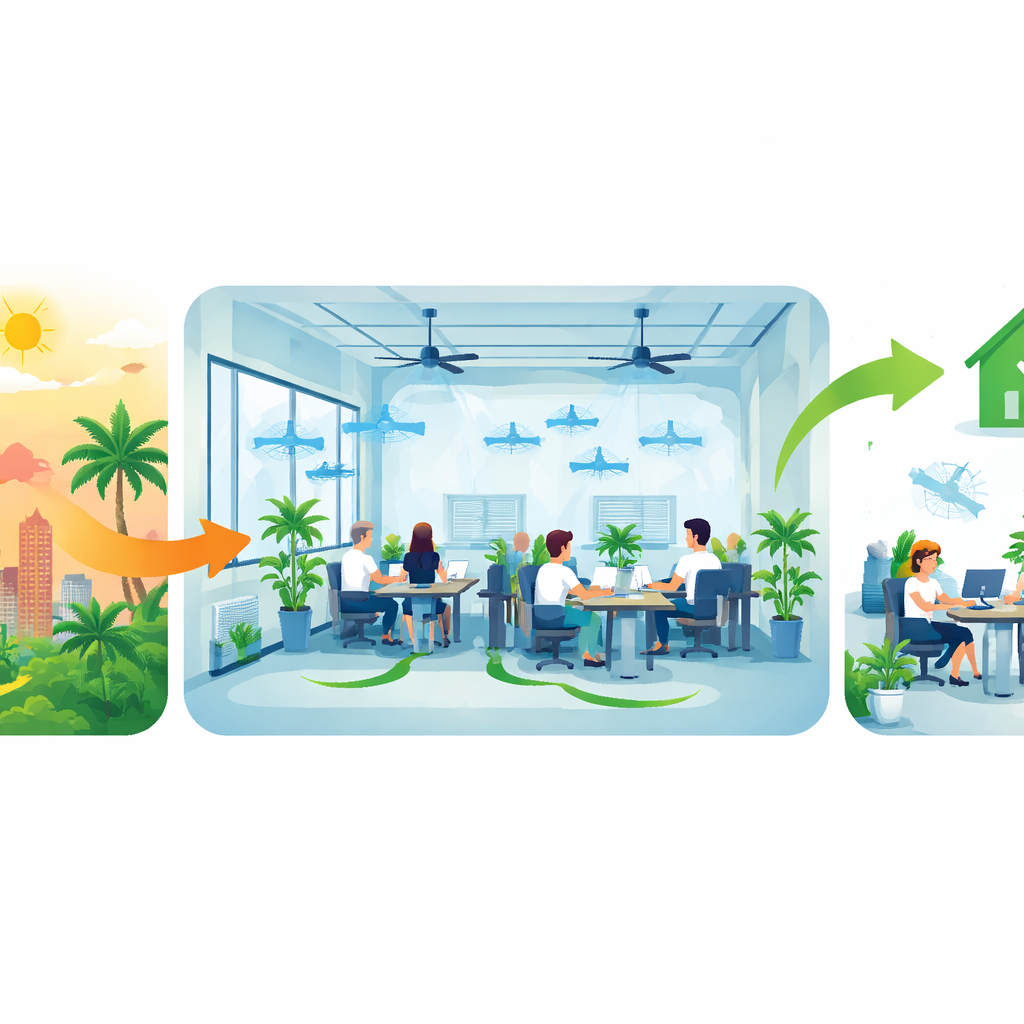
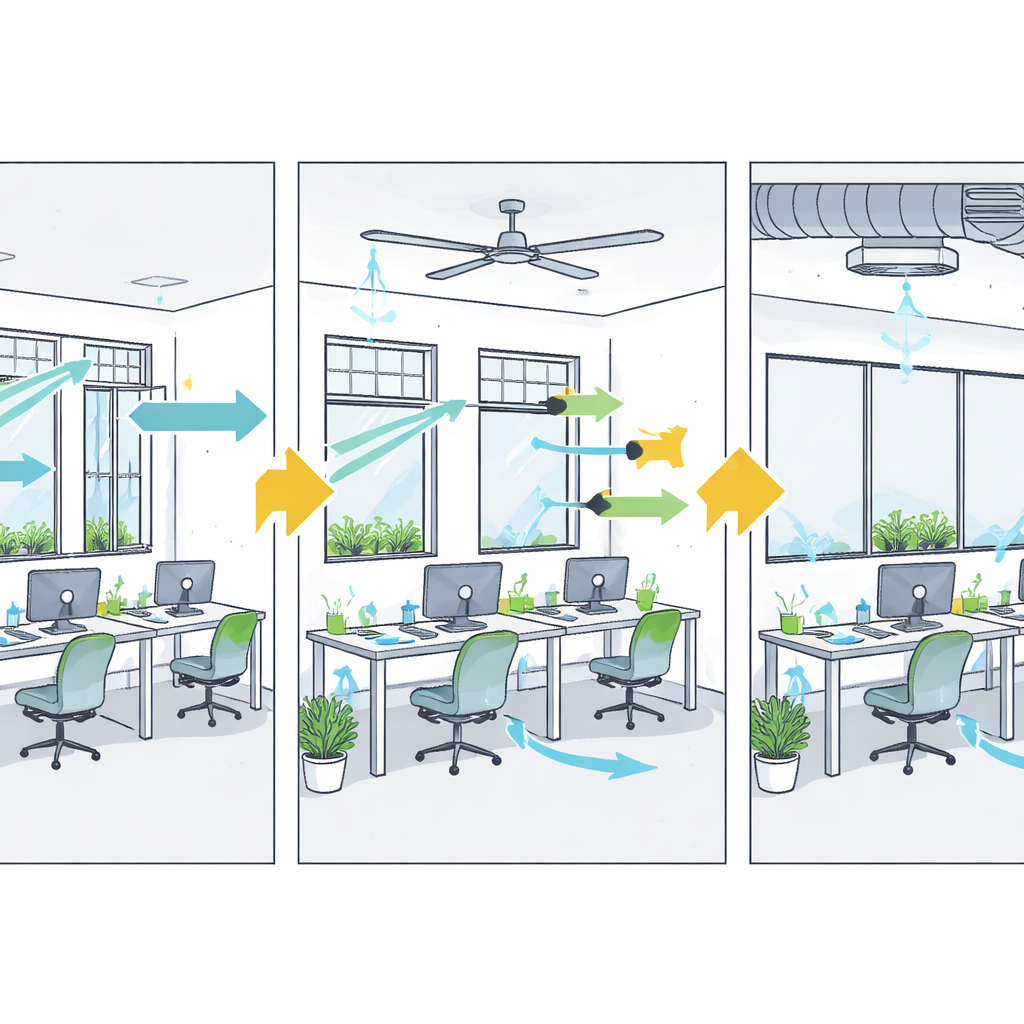
Most modern offices in hot countries are sealed boxes chilled by powerful air conditioners. These systems keep people cool but burn a lot of electricity and pump heat and greenhouse gases into the air outside. The team studied an alternative called mixed-mode ventilation. In this setup, windows can open automatically to bring in fresh air when the weather cooperates. Ceiling fans and small vents at each desk provide a gentle stream of cooler air close to where people sit. When outdoor conditions become too hot, humid, or rainy, the system gradually shifts toward more mechanical cooling rather than snapping straight to maximum air conditioning.
Testing the System in a Real Office
To see how well this approach works in the real world, the researchers ran two complementary studies in the same open-plan office in tropical Singapore. In the first, they followed 19 employees over 19 weeks as their workplace alternated between normal air conditioning and the mixed system. Every couple of weeks, workers reported how satisfied they felt with their jobs, how engaged they felt in their work, and how often they helped colleagues; their supervisor rated their job performance. At the same time, power meters recorded how much energy was used to cool the space under each setup.
A Controlled Trial of Comfort and Performance
In the second study, more than 300 student and staff volunteers spent two hours working in the office under one of three conditions: traditional air conditioning, the mixed system, or a control setup with only open windows and no mechanical cooling. Participants completed typing, math, memory, word puzzle, and creativity tasks designed to mimic mental work, then rated their job satisfaction, work engagement, and how comfortable they felt with the temperature. This allowed the researchers to compare not just feelings, but actual performance, across different cooling strategies while also accounting for outdoor temperature.
Energy Savings Without Hurting Workers
Across both studies, the mixed system consistently used substantially less cooling power than traditional air conditioning at almost every outdoor temperature range. In many cases, it cut cooling-related energy use by more than a third, and sometimes by over two thirds, even though it was tested during slightly warmer periods. Despite operating at higher indoor temperatures than a standard air-conditioned office, participants reported similar levels of thermal comfort under the mixed system as under traditional cooling, and much better comfort than in the no-intervention control. Crucially, there were no meaningful differences in job satisfaction, work engagement, or job performance between people in the mixed-mode and fully air-conditioned conditions.
What This Means for Hotter Cities
For readers wondering whether greener offices must come with sweaty shirts and slower work, this research offers reassuring news. In a hot, humid city, a well-designed mixed-mode system can keep people feeling just as satisfied and productive as in a fully air-conditioned office while dramatically cutting energy use. The authors note that more work is needed in other buildings and over longer periods, but their findings suggest a practical path for organizations to shrink their carbon footprint and power bills without sacrificing employee comfort or output. In a warming world where billions of air conditioners are already in use or on the way, this kind of smarter cooling could become an important part of how we adapt.
Citation: Min Ye, Y., Liang, W., Xu, F. et al. The effects of mixed-mode ventilation on energy saving and employee job satisfaction, work engagement, and job performance. Sci Rep 16, 8463 (2026). https://doi.org/10.1038/s41598-026-38812-0
Keywords: office cooling, energy-efficient buildings, thermal comfort, employee productivity, mixed-mode ventilation