Clear Sky Science · en
Dynamic adaptation of non standard service tasks through reinforcement learning driven task technology fit and service interaction
Why small service businesses need smarter digital tools
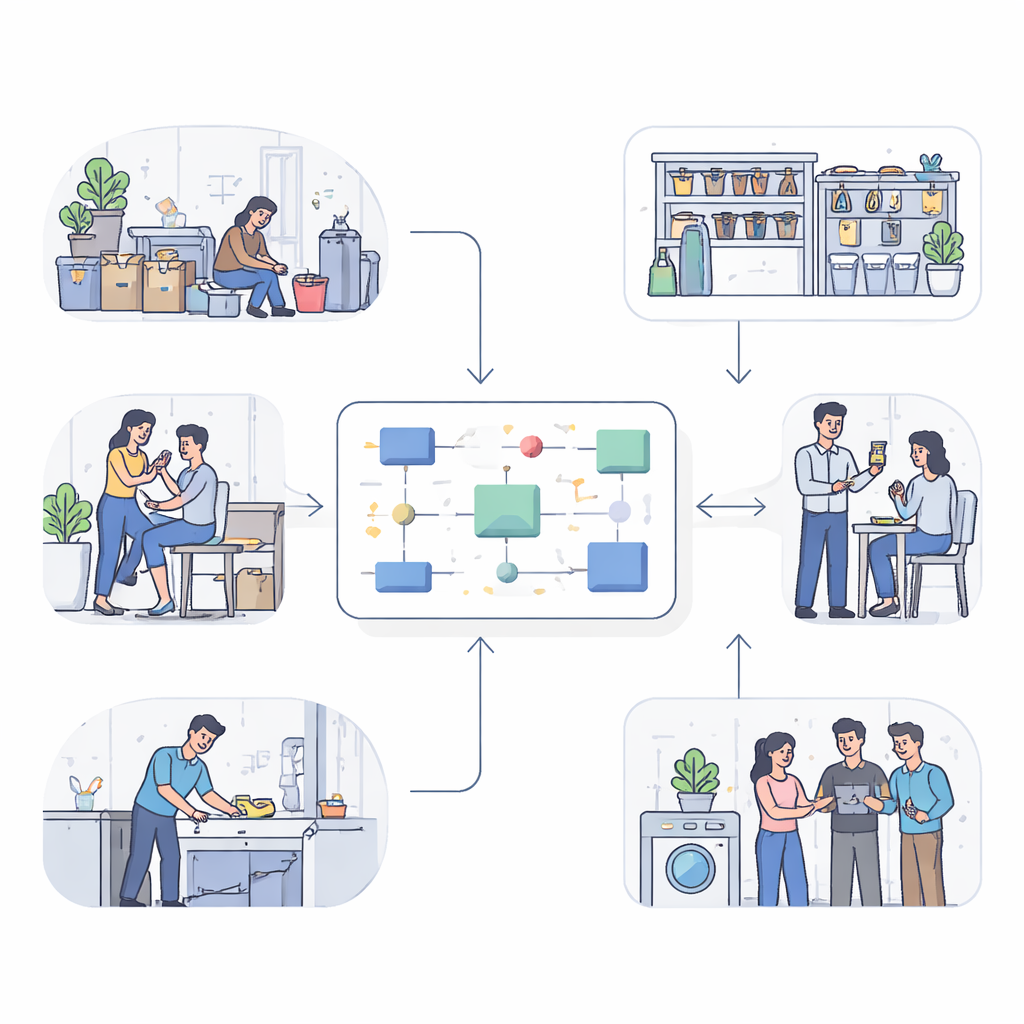
From professional home organizers to mobile beauty salons and on-site repair services, many tiny businesses run on improvisation: every job is different, every client is unique, and plans change on the spot. Yet most digital tools they can afford are built around rigid templates and fixed steps. This paper introduces a new kind of lightweight, intelligent platform that learns how these non-standard services actually work, then helps small businesses turn messy, one-off jobs into clearer, repeatable digital workflows without hiring programmers.
How today’s systems fall short in real life
Most software for small enterprises assumes that work can be neatly broken into standard forms, menus, and checklists. That may suit online stores or simple booking systems, but it fails when tasks are fluid and depend on judgment and conversation—such as deciding how to reorganize a family’s chaotic wardrobe. Traditional machine learning can classify tasks or predict next steps, but it typically works in a “static” way: models are trained once on labeled data and then remain fixed. When users improvise, add new rules, or face unusual situations, these systems cannot reorganize the underlying process on the fly, leaving workers to bend their practice to fit the software rather than the other way around.
A loop that listens, configures, and learns
The authors propose a Task–Service–HCI (TSH) method that flips this logic. Instead of starting from predefined templates, the platform starts from what users are trying to do. First, it recognizes the task by observing how people describe it and what steps they take. Then it helps configure a service pathway—essentially a digital flow of steps, rules, and options—using visual tools rather than code. Finally, it provides interactive feedback during execution, showing status and results and letting people adjust the flow in real time. This three-part loop—recognition, configuration, feedback—means the system continually realigns itself with how work actually unfolds, and users stay in control rather than being locked into a designer’s assumptions.
How the learning engine works under the hood
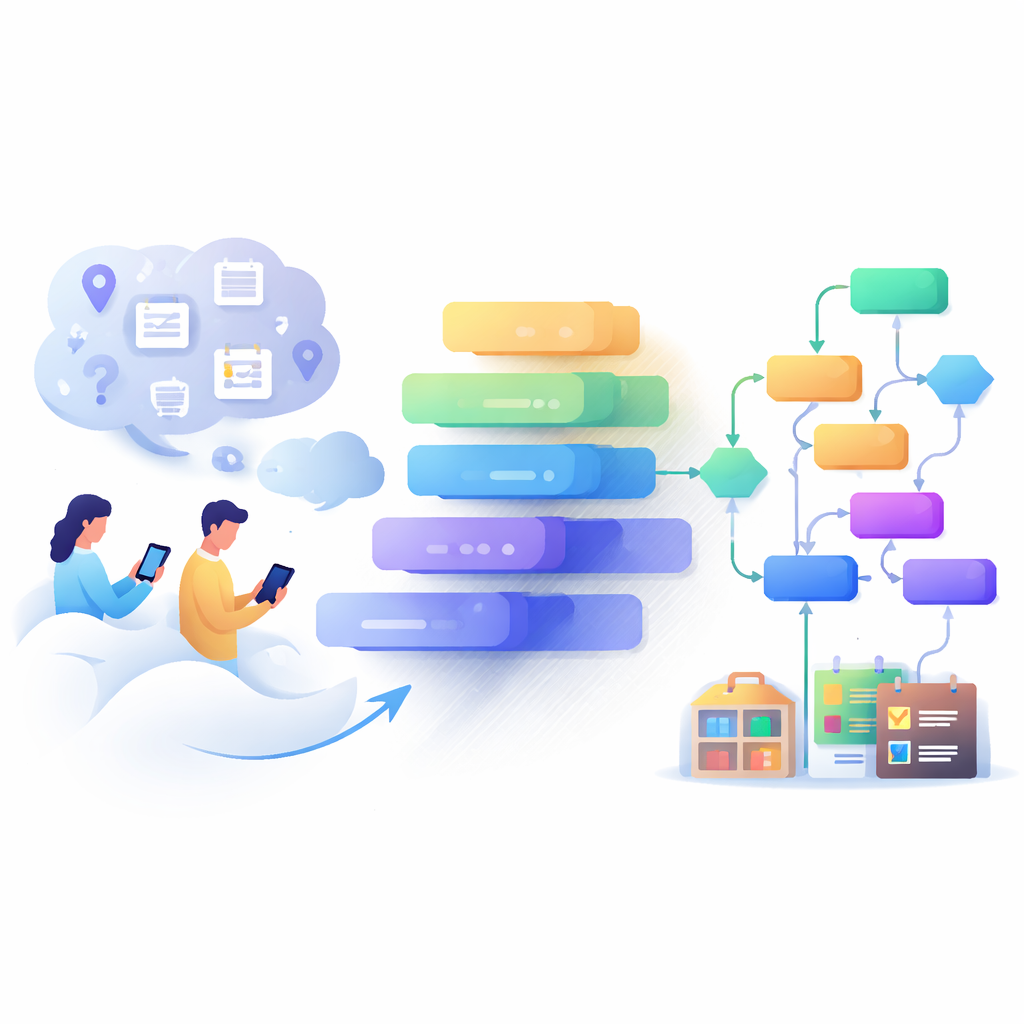
To make this loop intelligent, the platform uses a reinforcement learning mechanism called RL‑TTFO. In simple terms, the system treats each possible combination of software modules (like scanning, 3D visualization, or rule engines) as a strategy for handling a task. It reads natural-language descriptions with a language model and tracks the order of user actions to build a compact picture of the task. A learning agent then experiments with different module combinations and gets “rewards” based on how well they fit the task, how efficiently they run, and how actively users engage. Over time, this trial‑and‑error process discovers workflows that better match what people need. To keep costs low for microenterprises, a small version of the model runs on users’ phones or mini‑apps, while heavier training happens in the cloud and periodically updates the edge models.
Testing in the world of professional organizing
To see whether this approach works outside the lab, the team deployed a prototype in the fast‑growing professional organizing industry. Organizers used a mini‑app to define how they classify items, set goals for each project, and configure steps like labeling, scanning, and locating stored goods. The system supported modules such as a virtual wardrobe that shows where each item lives, and quick QR scanning to jump from a box or closet to its contents. In a month‑long study with 300 participants, the reinforcement learning version of the platform adapted successfully to non‑standard tasks nearly 90% of the time—almost four times better than a version based on static templates. Average task time was cut by about half, and people configured their workflows more than three times as often, reporting higher satisfaction and a stronger sense of control.
What this means for everyday work
At a high level, the study shows that it is possible to give very small, resource‑strained service businesses a kind of “living” digital assistant that grows with them. Instead of forcing them into one‑size‑fits‑all software, the proposed platform listens to how they actually work, lets them shape their own processes, and then quietly optimizes those processes in the background. For organizers—and, by extension, beauty technicians, cleaners, and repair workers—this can mean fewer manual adjustments, faster jobs, and tools that feel intelligent without being complex. The authors argue that such human‑centered, adaptable systems offer a realistic path for microenterprises to join the digital transformation wave without heavy investments or technical expertise.
Citation: Sun, Y., Gao, J., Han, K. et al. Dynamic adaptation of non standard service tasks through reinforcement learning driven task technology fit and service interaction. Sci Rep 16, 8768 (2026). https://doi.org/10.1038/s41598-026-38808-w
Keywords: digital transformation, reinforcement learning, small service businesses, workflow automation, human–computer interaction