Clear Sky Science · en
Unravelling the activity rhythms of urban vector mosquitoes with smart-trap technology
Why City Mosquito Routines Matter
For many city dwellers, mosquitoes are more than a summer annoyance: they can carry viruses like dengue and West Nile. Yet we still know surprisingly little about exactly when, in a bustling urban day, these insects are most active and most likely to bite. This study turns Barcelona into an open-air laboratory, using smart traps and artificial intelligence to watch two key mosquito species around the clock. The results offer a kind of city “mosquito timetable” that could help time control measures more precisely and better protect public health.

A New Way to Watch Invisible Wings
Instead of relying only on technicians checking traps by hand, Barcelona’s public health agency installed four smart mosquito traps in public spaces. Each trap uses an optical sensor to detect insects flying through and automatically classify them by genus and sex in real time. Over four years, from 2021 to 2024, these devices logged the comings and goings of two widespread urban mosquitoes: the Asian tiger mosquito (Aedes albopictus), known for daytime biting and invasive spread, and the Northern house mosquito (Culex pipiens), a common carrier of West Nile virus. Every detection was time-stamped and linked to temperature, humidity and rainfall, providing an unusually detailed record of mosquito life in the city.
Daily Routines Around Sunrise and Sunset
When researchers looked at how mosquito activity changed over a typical day, a clear pattern emerged for both species: two main bursts of movement, one around sunrise and another around sunset. These twilight “rush hours” were remarkably consistent, but the details differed. The Asian tiger mosquito behaved as a day lover, with broader, more extended activity that stretched through the afternoon and peaked before dusk. The Northern house mosquito showed a more strictly twilight and early-night pattern, concentrating its efforts closer to dusk and into the dark. Males in both species tended to get going slightly earlier than females in the evening, a hint of mating strategies that position them at the right place before females arrive.
Seasons, Weather, and the Inner Clock
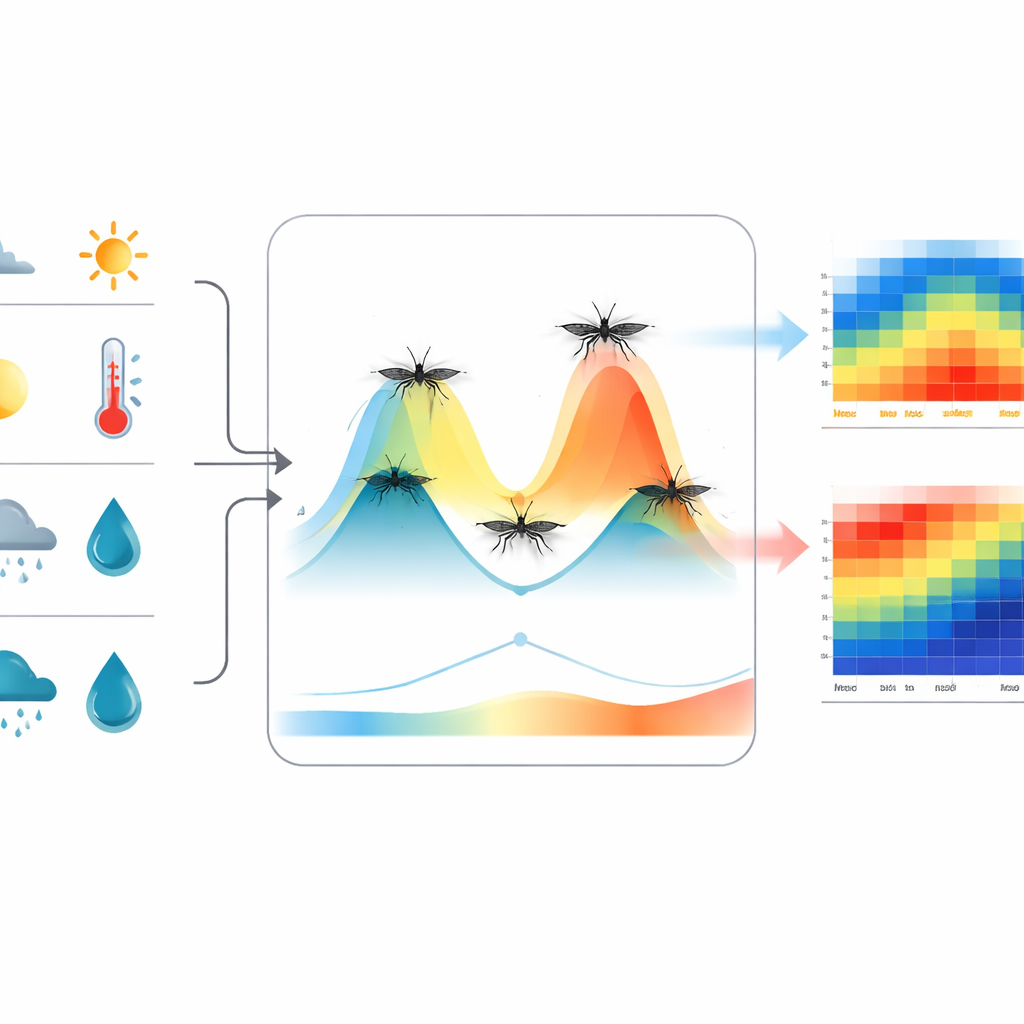
The team then asked what drives these daily rhythms. Using a machine-learning method known as random forests, they explored how light, temperature, humidity and recent rain shape female mosquito activity—crucial because females are the ones that bite. They found that cues linked to daylight—how far a given hour is from sunrise or sunset—play the role of a main switch, turning activity on and off. Temperature and rainfall then act more like volume knobs, increasing or damping the intensity of movement within those windows. For the Asian tiger mosquito, changes in light were the strongest influence on both timing and intensity of activity. For the Northern house mosquito, temperature was the key fine-tuner, especially at night, while light still helped set the basic schedule.
Looking Back Two Decades in Time
Armed with this understanding, the researchers used past weather records going back to 2004 to estimate how mosquito activity in Barcelona has likely changed over 20 years. Their models suggest that the Asian tiger mosquito has steadily expanded and intensified its activity in the city, especially on warm summer afternoons and increasingly into autumn and even mild winter periods. The Northern house mosquito shows a more mixed picture: in many months, predicted activity has risen, but in the hottest times of year—particularly August—it appears to dip, likely because extreme heat pushes mosquitoes to seek shelter rather than hosts. These reconstructed histories are not perfect, but they reveal how background climate trends may already be reshaping when mosquitoes are around and ready to bite.
What This Means for City Health
To a non-specialist, the key message is that mosquitoes in cities do not buzz at random: they follow repeatable daily and seasonal routines that are tightly tuned to light and weather. By watching these routines in real time with smart traps, public health agencies can move from fixed, calendar-based spraying to more precise, “just-in-time” interventions when risk is highest. As climate change and artificial light at night continue to alter mosquito behavior, such smart, data-driven surveillance could become a cornerstone of urban health, helping cities respond faster and more effectively to outbreaks of mosquito-borne disease.
Citation: González-Pérez, M.I., Cerecedo-Iglesias, C., Richter-Boix, A. et al. Unravelling the activity rhythms of urban vector mosquitoes with smart-trap technology. Sci Rep 16, 9075 (2026). https://doi.org/10.1038/s41598-026-38795-y
Keywords: urban mosquitoes, smart traps, circadian rhythms, vector surveillance, climate change