Clear Sky Science · en
Numerical investigation on the torsional improvement of reinforced concrete beams strengthened with various techniques
Why twisted beams matter
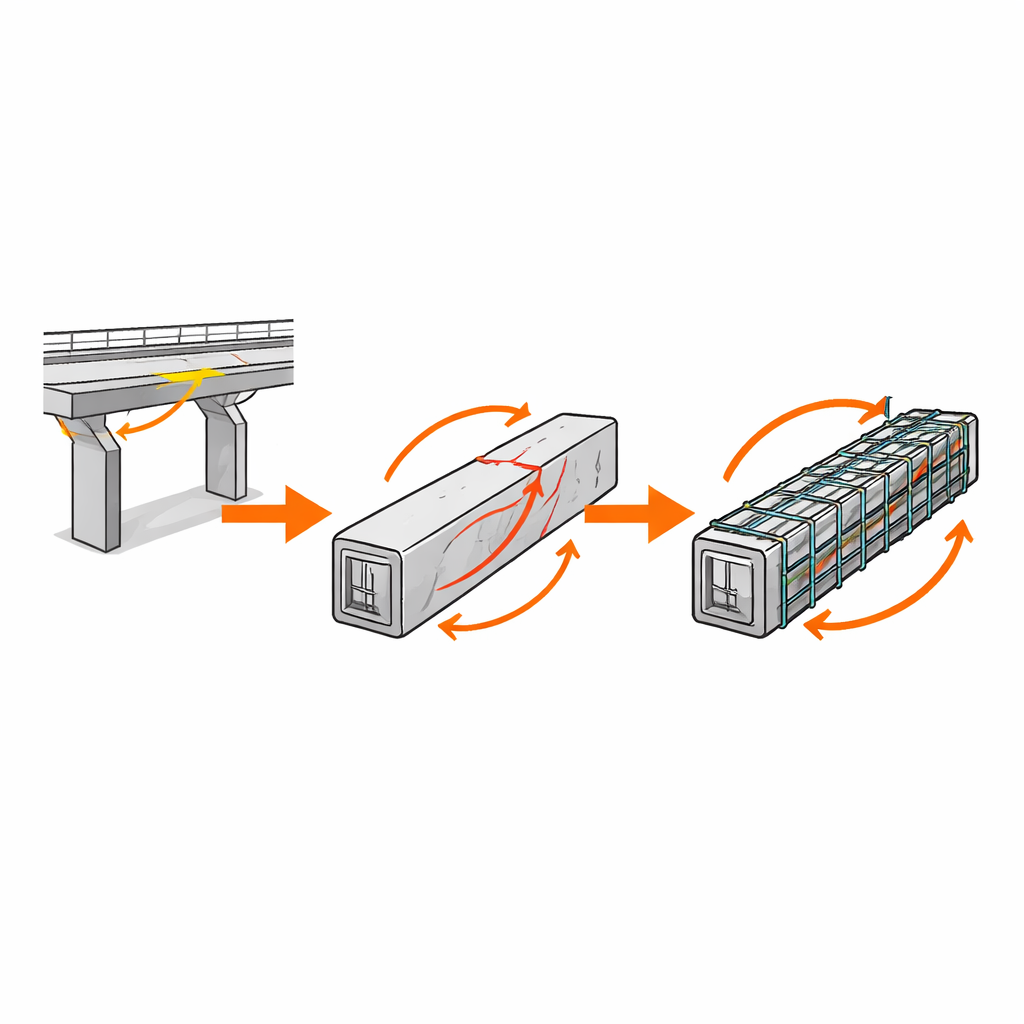
When we think of bridges or elevated highways, we usually picture them sagging under weight, not twisting like a wrung towel. Yet this twisting, known as torsion, can quietly weaken the concrete beams that hold up many structures. Over time, changes in use, heavier traffic, or aging materials can leave these beams short of the safety margin engineers intended. The study summarized here explores how to strengthen such beams efficiently using computer simulations, so that existing bridges and buildings can be upgraded without excessive cost or trial‑and‑error testing.
How beams are strengthened
The researchers focused on reinforced concrete beams—rectangular blocks of concrete containing steel bars—that are especially prone to twisting in elements such as bridge girders, ring beams, and end beams. Rather than rebuilding these members, engineers often add extra reinforcement to their outer surfaces. One method, called near-surface mounted bracing, cuts shallow grooves into the concrete and inserts steel bars that are bonded in place with epoxy. Another method adds thin steel or fiber meshes on the outside of the beam, working like a cage that helps hold the concrete together when it twists. The team combined and compared these methods to see which arrangements give the most extra strength and flexibility.
Using virtual beams instead of many tests
Physical experiments on full-size beams are expensive and slow, so the authors built a detailed three-dimensional computer model of the beams using the Abaqus/CAE simulation program. They based this model on an earlier laboratory study of five beams: one unstrengthened and four upgraded with different near-surface bracing layouts. The digital concrete could crack and soften, the steel bars could yield, and the glued interfaces could gradually separate, closely mimicking real materials. By fine‑tuning the model—choosing the right mesh size and a key parameter that controls how cracked concrete spreads—they achieved predictions of maximum twisting strength and twist angle that differed from the lab results by less than about 5 percent.
Finding the sweet spot for extra steel
Once they trusted the model, the researchers used it to run a broad parametric study, systematically changing strengthening details. First, they varied how far the external near-surface bars overlapped across the depth of the beam. Very short overlaps brought only modest strength gains and could even reduce ductility, meaning the beam failed more suddenly. As the overlap increased to between about 60 and 80 percent of the beam depth, both strength and twist capacity rose sharply: ultimate twisting moment roughly doubled or more, and the beams could twist noticeably further before failure. Beyond that range, additional overlap still helped but brought smaller returns relative to the added material and effort.
Layering meshes and changing the direction of bracing
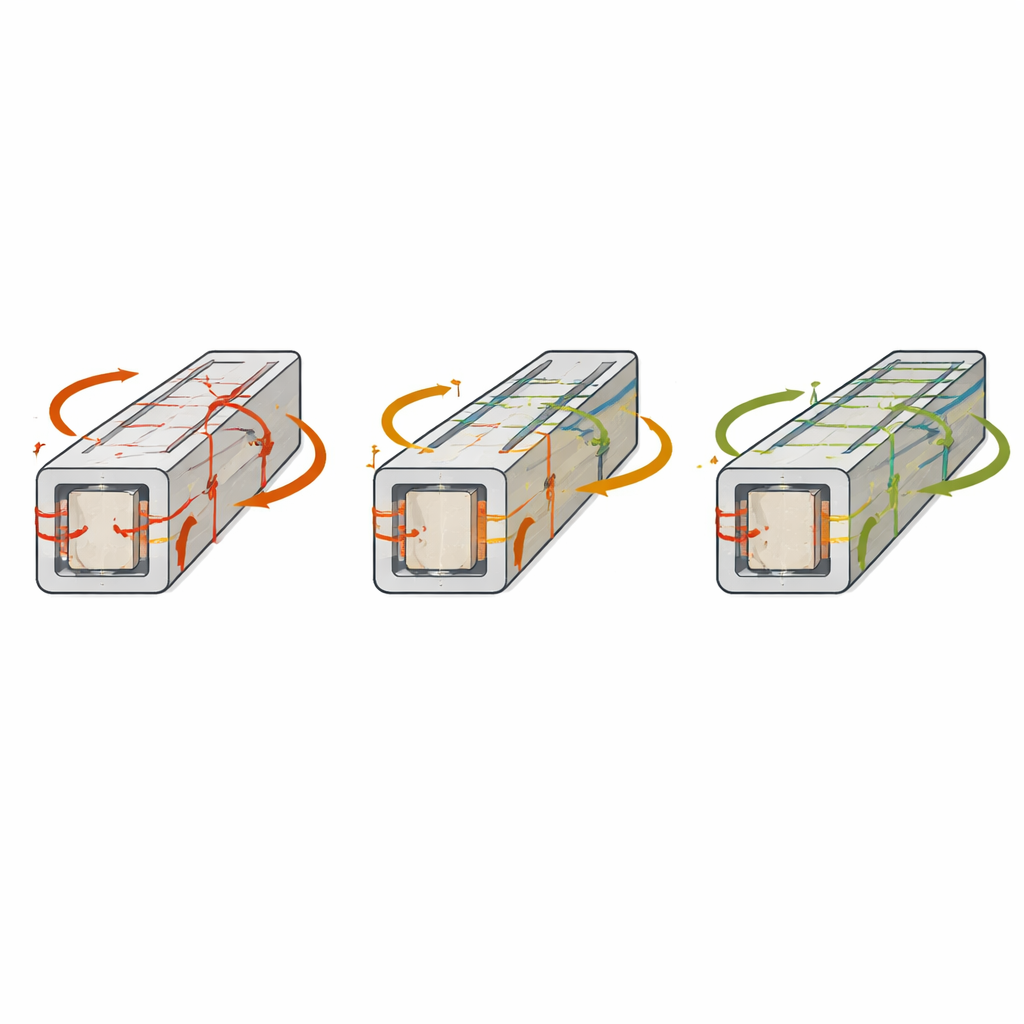
The team then examined what happens when near-surface bars are combined with outer steel mesh layers. Adding one, two, and then three mesh layers progressively boosted twisting strength, with increases up to several times the original capacity, while also allowing more twist before failure. However, adding a fourth or fifth layer stiffened the beams too much, encouraging brittle, sudden failures with little extra strength gained—an important warning against over‑reinforcing. Finally, the researchers turned the external stirrups from vertical to inclined layouts, aligning them more directly against the diagonal cracks that twisting tends to produce. These inclined systems, especially when fitted with hooks that anchor them inside the beam ends, delivered the largest improvements: twisting strength rose by more than threefold and the beams could twist nearly twice as much before failure, with cracks spreading more evenly instead of localizing.
What this means for real structures
For non-specialists, the main takeaway is that the way extra steel is arranged on a concrete beam matters as much as how much steel is used. Carefully designed near-surface bars and mesh layers can more than double or even triple a beam’s resistance to twisting while keeping its failure gradual rather than abrupt. There is a clear “enough but not too much” range for overlap length and number of mesh layers, and bracing that follows the natural crack directions works best. Because the computer model closely matches real tests, engineers can now use it as a practical tool to plan cost‑effective upgrades to aging bridges and buildings, improving safety without relying solely on expensive experimental campaigns.
Citation: Yusuf, M.A., Zahran, M.S., Osman, A. et al. Numerical investigation on the torsional improvement of reinforced concrete beams strengthened with various techniques. Sci Rep 16, 8618 (2026). https://doi.org/10.1038/s41598-026-38794-z
Keywords: torsion strengthening, reinforced concrete beams, near-surface mounted reinforcement, steel mesh retrofitting, finite element modeling