Clear Sky Science · en
Assessing the impact of infrastructure proliferation on shoreline dynamics around Mexico
Why this matters for people and beaches
Mexico’s coasts are home to millions of people, major ports, and world-famous tourist beaches. To protect these places from storms and erosion, governments and developers have built hundreds of walls, piers, and other hard structures along the shore. This study asks a simple but far-reaching question: when we keep adding more of this infrastructure, what does it actually do to the shape and health of our beaches over time?
Taking stock of a rapidly changing coastline
The researchers created the first detailed, countrywide inventory of coastal infrastructure along Mexico’s shores. Using aerial photos from 1995 and high-resolution satellite images from 2019, they painstakingly mapped six types of structures: groynes, jetties, ports, breakwaters, seawalls, and piers. Over just 24 years, the number of mapped structures nearly doubled, from 570 to 1,030. Growth was not even: Yucatán, for example, now has more than one structure per kilometre of shoreline, largely because of dense fields of small groynes built to trap sand and protect beachfront properties. Other states, especially along cliffed or sparsely populated coasts, saw much slower expansion. 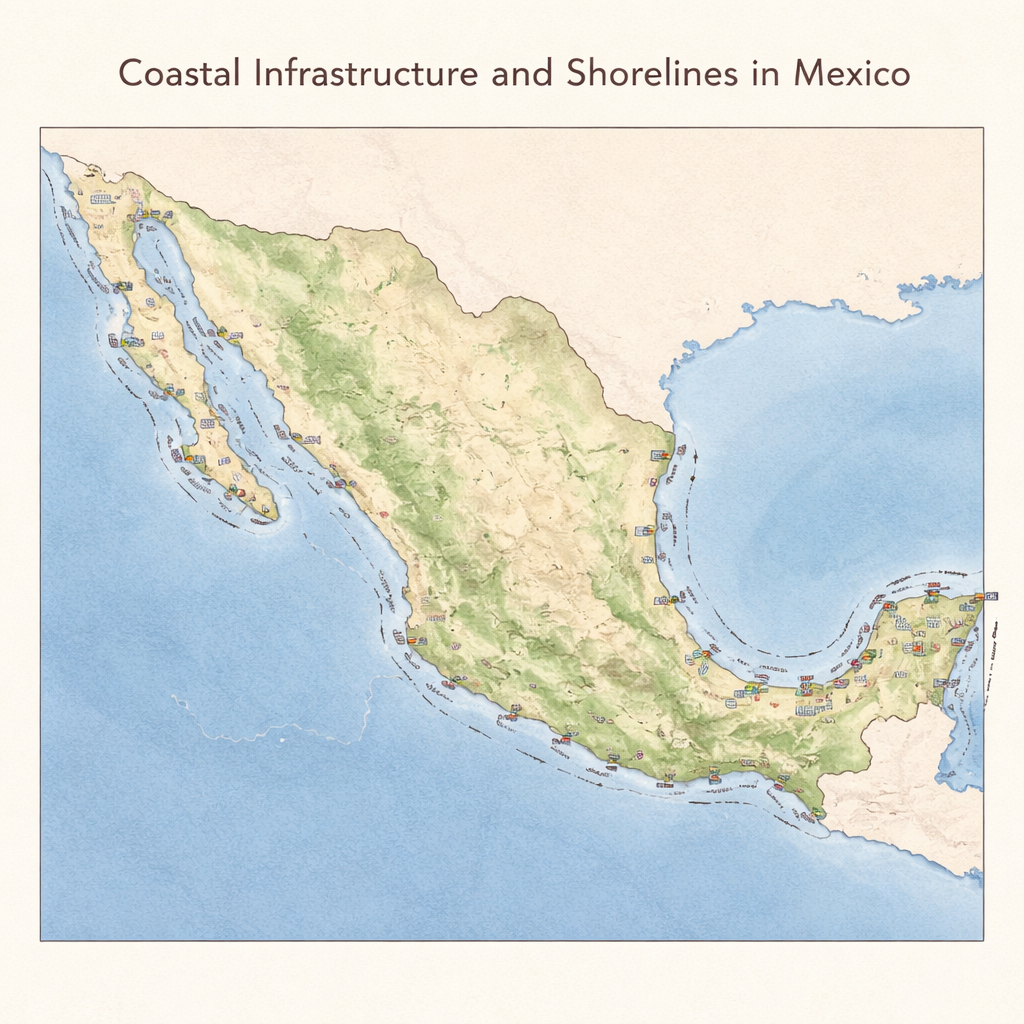
Linking structures to shifting shorelines
Counting structures is only half the story; the team also wanted to know how these constructions relate to actual shoreline change. They turned to a global dataset that tracks how sandy shores moved between 1984 and 2016 using decades of satellite imagery. For each mapped structure, they found nearby shoreline “transects” that record whether the beach was eroding, stable, or building outward. After careful filtering, they analysed 517 transects on open sandy coasts, both updrift and downdrift of structures. Overall, 45% of these sites were stable, 33% were gaining sand, and 22% were eroding—showing that hard infrastructure does not always spell disaster, but that trouble spots are common.
Winners, losers, and strong local contrasts
The results reveal that the same kind of structure can have very different effects depending on where and how it is built. At the national scale, jetties and ports often produced strong sand buildup on one side, sometimes several metres per year, while contributing to severe erosion on the other side. Breakwaters were the structure most frequently linked with erosion overall. Groynes, seawalls, and piers were more often found along stable coasts, but even there, many sites still showed clear signs of beach loss. In highly engineered tourist areas such as Yucatán and Quintana Roo, long lines of groynes and other defences created a patchwork of short, widened beach segments next to severely narrowed or retreating ones. This unevenness shows that hard protection can simply move the problem down the coast rather than solving it.
Two places that tell the story on the ground
To see how these patterns play out locally, the authors zoomed in on two sites: Puerto Chiapas on the Pacific and Antón Lizardo on the Gulf of Mexico. In Puerto Chiapas, twin port jetties and later structures altered sand transport, leading to steady erosion on one side and accretion on the other. Yet the shoreline changed gradually over three decades, with the coast constantly trying to re-establish a new balance while the port channel tended to silt up. Antón Lizardo told a sharper story: as a naval base and harbour were gradually expanded with a pier, groyne, land reclamation, and breakwaters, some sectors of coast grew rapidly while neighbouring stretches flipped from gaining sand to losing up to six metres per year. The net effect was a drastic reshaping of the shoreline, driven by a chain reaction of new works. 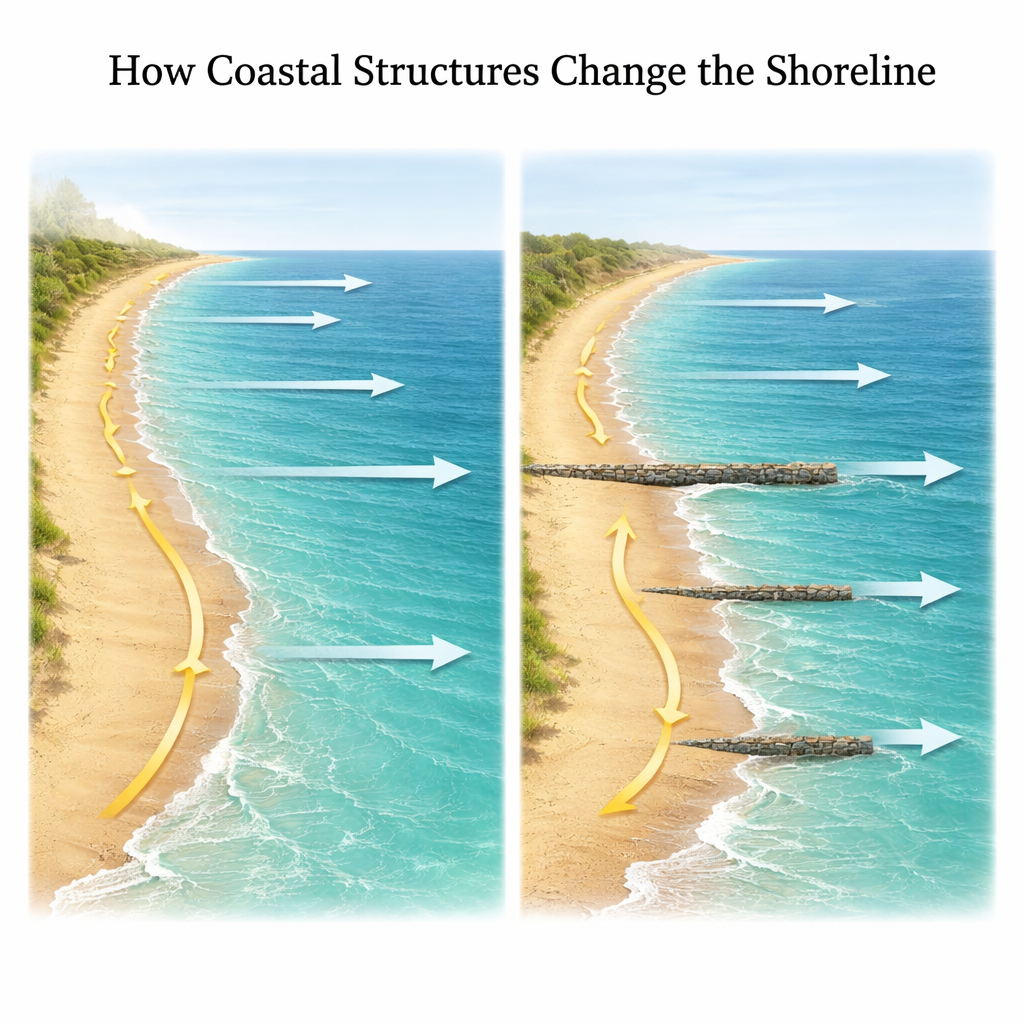
Rethinking how we protect the coast
For non-specialists, the main takeaway is that hard coastal structures are powerful tools that can protect specific sites but often do so by borrowing sand from somewhere else. Their impacts are not simple or uniform; they depend on local waves, currents, sand supply, and how many other structures already exist nearby. In Mexico, heavily built-up coasts show more erosion linked to infrastructure than relatively natural ones. The authors argue that future planning must treat sand as a connected system, looking beyond single projects to whole stretches of shoreline and their watersheds. They highlight “green” and nature-based options, such as restoring dunes, wetlands, and reefs, as ways to work with natural processes rather than constantly fighting them with concrete.
Citation: Marin-Coria, E., Martínez, M.L., Silva, R. et al. Assessing the impact of infrastructure proliferation on shoreline dynamics around Mexico. Sci Rep 16, 7447 (2026). https://doi.org/10.1038/s41598-026-38793-0
Keywords: coastal erosion, shoreline change, coastal infrastructure, nature-based solutions, Mexico coasts