Clear Sky Science · en
Polishing dental ceramics using shear-thickening slurry
Smoother, Safer Fake Teeth
Dental crowns and veneers made from ceramic help damaged teeth look and work like new, but getting those tiny pieces glass-smooth is surprisingly hard, expensive, and often done by hand. This study explores a new way to polish these ceramics using a clever kind of thickening liquid made from common starch and hard grit, aiming to give patients longer‑lasting, shinier restorations while reducing the workload and health risks for dental technicians and dentists.
Why Polishing Matters for Your Smile
Ceramic teeth are prized because they look natural, are kind to the body, and can last for years. Yet their surfaces gradually lose shine and can become rough from friction, chewing, and chemical attack in the mouth. A rough surface does more than dull a smile: it traps plaque, can wear down opposing teeth, and may shorten the lifespan of the restoration. Today, most polishing is done manually with small rotary tools. That process is slow, depends heavily on the operator’s skill, and releases clouds of fine particles that can be inhaled. Automated methods exist but tend to be costly or complex, relying on lasers, magnetic fields, or specialized machines that are not practical for routine crown production.
A Liquid That Turns Thick on Demand
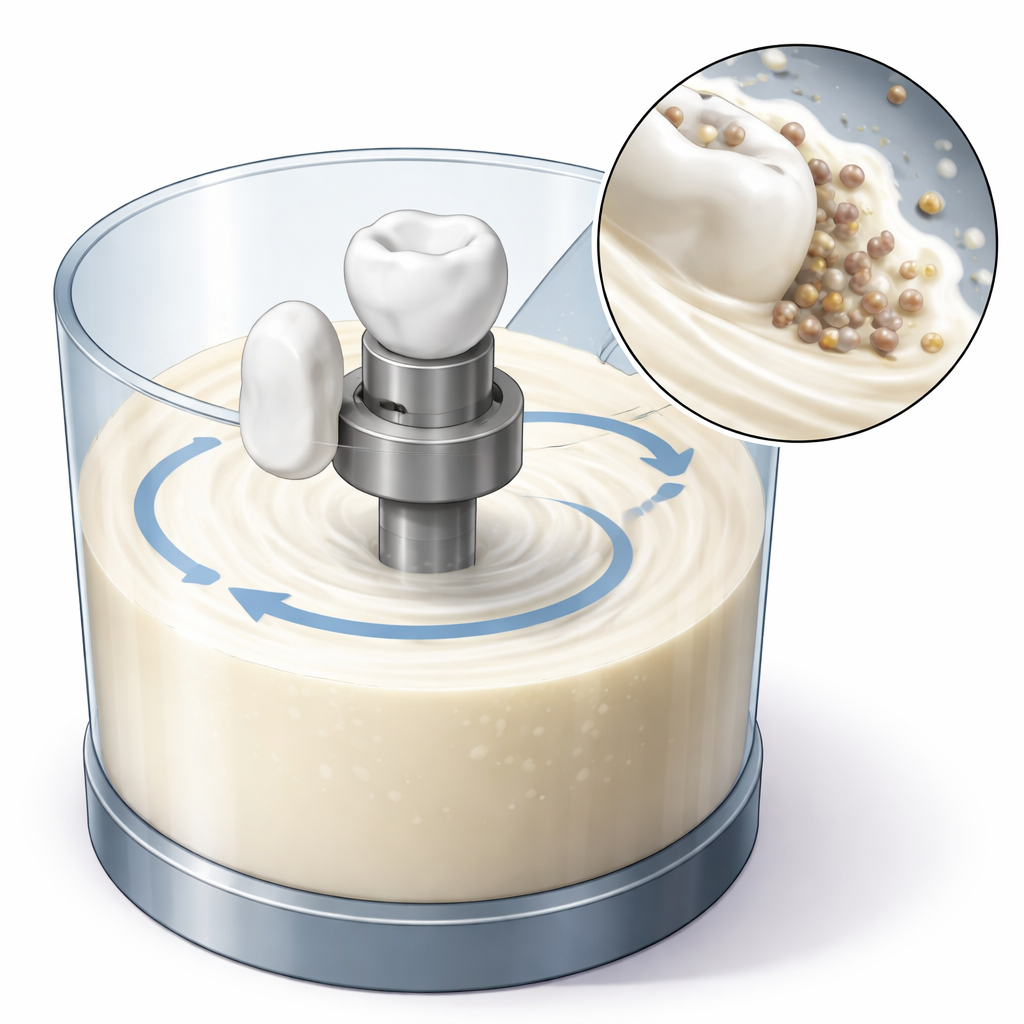
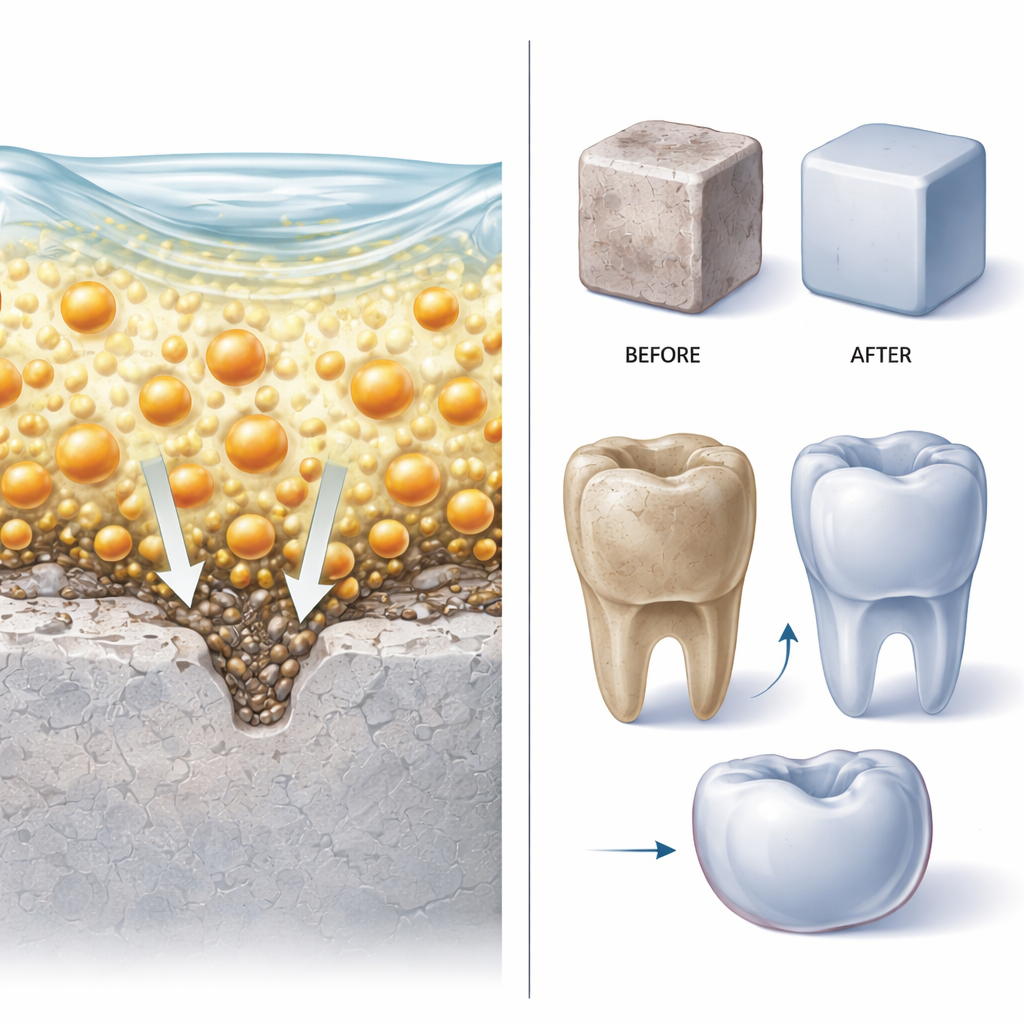
The researchers turned to a class of materials known as shear‑thickening fluids—liquids that suddenly become thicker when hit or rapidly stirred, much like the famous mixture of cornstarch and water. In their system, the key ingredients are ordinary cassava starch, water, and sharp silicon carbide (SiC) particles that act as microscopic polishing stones. When the fluid is gently moved, it flows easily. When the ceramic surface and slurry move quickly against each other, the slurry stiffens, packing the abrasive grains tightly against the surface. The team built a polishing setup in which zirconia samples, veneers, and crowns are held at an angle inside a rotating cylinder filled with this slurry. As both the fixture and the tank spin, the thickened slurry hugs the curved surfaces, acting as a flexible yet firm polishing tool without the need for magnets, lasers, or chemical etchants.
From Rough Tiles to Mirror‑Like Teeth
To see how well the method works, the authors measured how the fluid’s thickness changed with different amounts and sizes of SiC particles, then tested polishing on flat zirconia blocks, tubes, veneers, and full crowns. Starting from surfaces with a typical roughness of about 200 nanometers—already quite smooth to the naked eye—they found that the starch‑based slurry could reduce roughness down to as low as 9.5 nanometers on veneers after about 30 to 40 minutes, essentially creating a mirror finish. Higher rotation speeds and larger abrasive grains removed material faster, while smaller grains were better for achieving the finest final surface. Because the slurry flows around the parts, it was also able to polish curved ceramic tubes and complex shapes, though deep grooves in crowns remained more challenging due to slurry build‑up that limited even contact.
Strength and Safety for Everyday Use
One concern with any polishing method is whether it weakens the ceramic. The team compared the bending strength of zirconia polished by their automatic slurry method with samples finished by skilled manual lapping. Both groups showed similar average strengths—about 800 megapascals—indicating that the new process does not introduce hidden cracks or chemical damage. Microscopy and chemical analysis confirmed that only the original elements of zirconia were present after polishing, supporting the idea that the method relies purely on mechanical rubbing with an essentially food‑grade fluid. This makes it attractive for medical applications, where toxic residues are unacceptable.
What This Could Mean at the Dentist
In plain terms, the study shows that a simple mixture of starch, water, and hard grit can automatically polish ceramic teeth to an extremely smooth, shiny finish without harming their strength or adding chemical risks. The approach is cheaper and less complex than many high‑tech methods and could eventually allow dental labs to batch‑polish many crowns and veneers at once with less manual effort and fewer airborne particles. While further work is needed to test how these ultra‑smooth surfaces behave in the mouth over time, this shear‑thickening slurry method points toward cleaner, more consistent, and more affordable production of the ceramic teeth that millions of patients rely on.
Citation: Zhou, Z., Zhu, L., Wang, J. et al. Polishing dental ceramics using shear-thickening slurry. Sci Rep 16, 7027 (2026). https://doi.org/10.1038/s41598-026-38788-x
Keywords: dental ceramics, zirconia crowns, polishing, shear-thickening fluid, starch-based slurry