Every time we snap a photo, scan a patient, or beam images from a satellite, we are juggling a trade-off between image quality, storage space, and time. This paper introduces a new way to clean up noisy images that were captured in a highly compressed form, helping produce clearer pictures from fewer measurements. That matters for everything from crisper phone photos in low light to safer medical scans that use less radiation.
Why Cutting Corners Can Still Look Good
Traditional cameras and scanners follow a simple rule: collect far more pieces of information than you might actually need so that nothing is missed. Only afterward is the image compressed to save space. Compressive sensing turns this logic on its head. Instead of recording every pixel first, it captures a carefully chosen, smaller set of combined measurements that still contain most of the important visual information. In theory, this lets us reconstruct a sharp image from surprisingly little data. In practice, however, noise during capture and poor choices in how those measurements are taken can lead to blurry details, blocky artifacts, and loss of fine structure, especially in demanding settings like medical imaging.
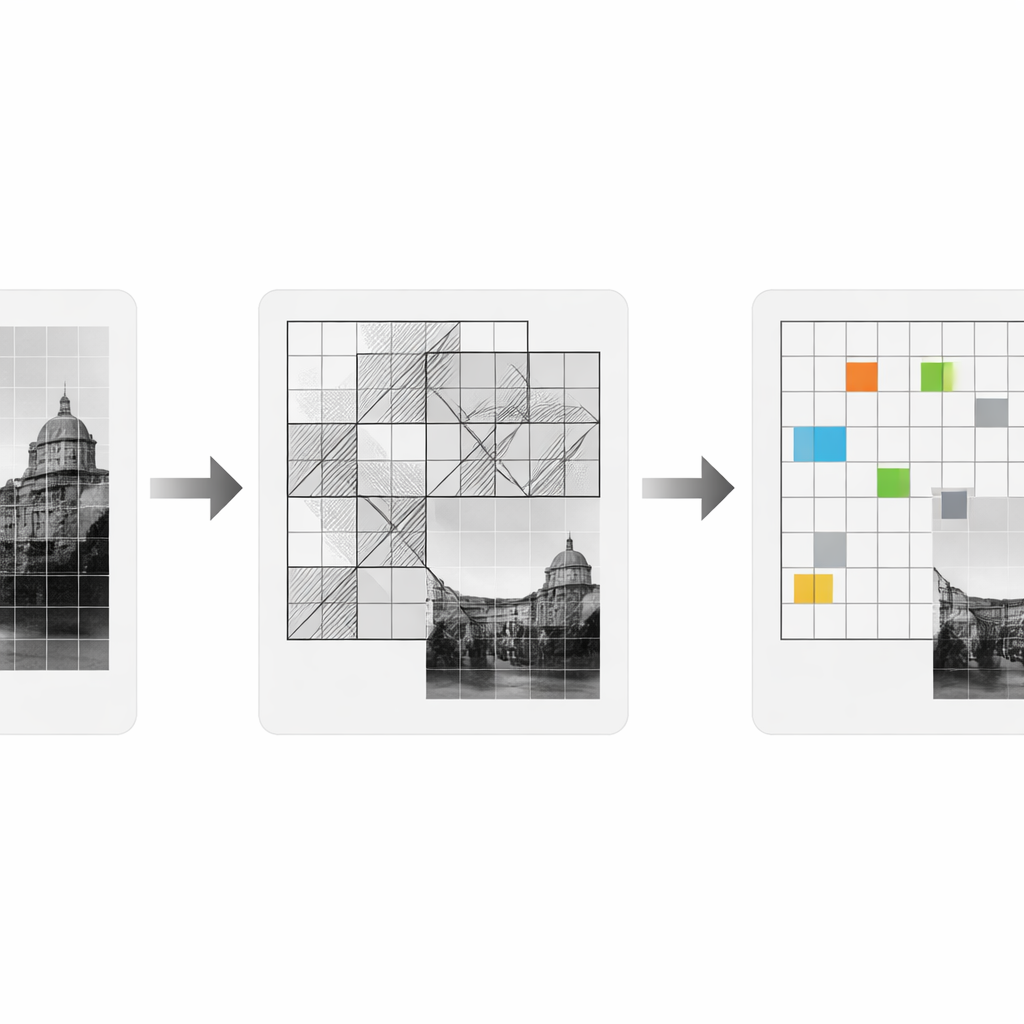
Breaking Images into Smart Little Pieces Figure 1.
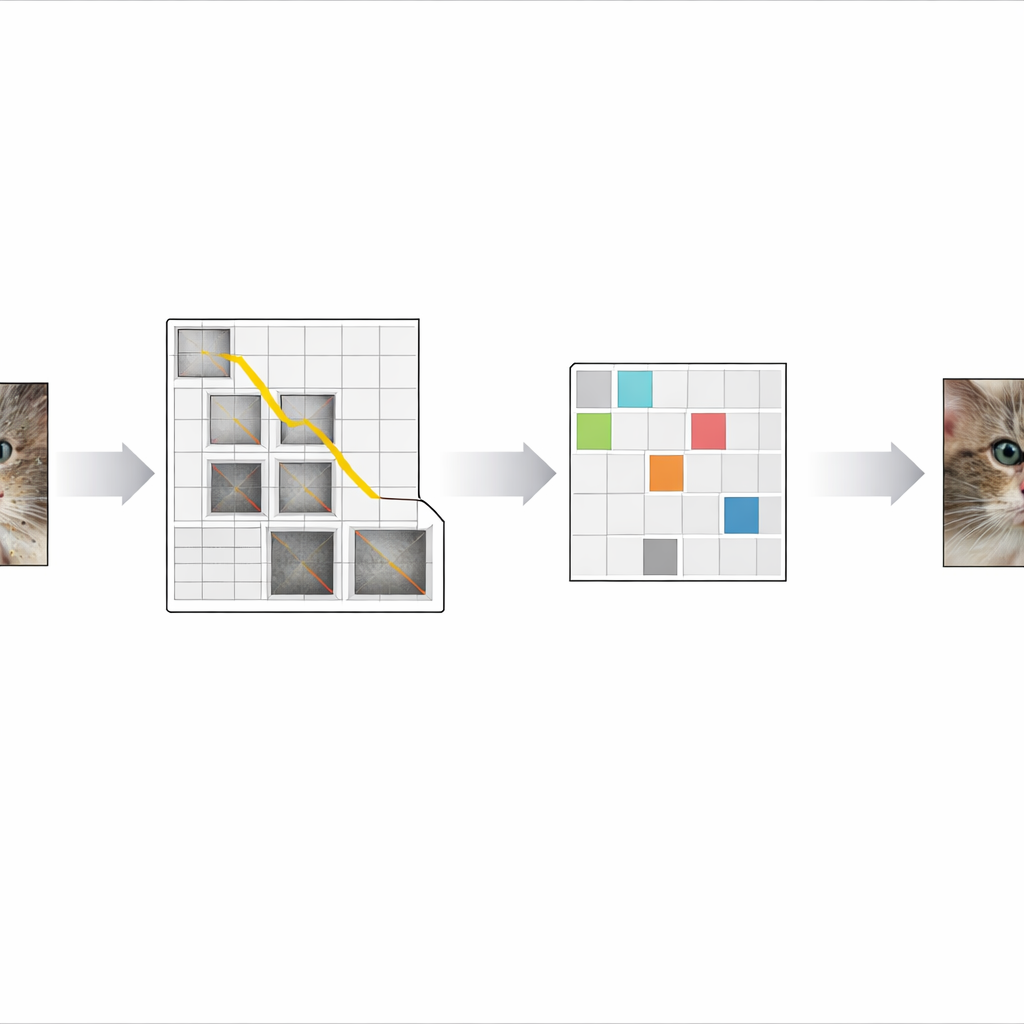
The authors propose a three-step framework that works on small square patches, or blocks, of an image rather than on the whole picture at once. Each block is first transformed into a form where most of the meaningful content is condensed into a compact set of values while fine details and textures are separated out. These values are then reordered in a zigzag path that naturally lines up the broad, smooth parts of the picture first and the tiny, sharp variations later. This ordering matters because it ensures that, when the image is compressed, the most visually important pieces are kept in front of the line, even if only a fraction of the data is stored.
Taking Better Shortcuts Through the Data
Once each block has been reordered, it is passed through a mathematical device called a sensing matrix, which determines exactly how the many original values are mixed down into a smaller set of measurements. Rather than relying on a generic, random choice, the researchers tune this matrix so that it is especially well suited to the kinds of images they want to reconstruct. They do this by solving an optimization problem that reshapes the matrix until its internal patterns make it easier to tell important structure from noise. A popular reconstruction procedure then uses these compressed measurements to approximate the original block, guided by the assumption that only a relatively small number of underlying features are truly needed to describe it.
Polishing Away the Remaining Noise Figure 2.
Even after careful compression and reconstruction, some noise and small artifacts remain. To address this, the final stage applies a modern denoising technique known as the Split Bregman method. This approach treats the image like a surface and gently smooths away minor fluctuations while keeping edges and anatomical boundaries sharp. By repeatedly splitting the problem into simpler sub-steps, it converges quickly and robustly. The result is a denoised image in which grainy speckles are reduced but key lines and textures—such as tissue boundaries in a scan or edges in a landscape—are preserved.
From Test Photos to Medical Scans
The team tested their framework on both everyday pictures and medical images like CT and X‑ray scans. They deliberately contaminated the originals with different amounts of artificial noise and simulated scenarios where only 20% to 50% of the usual data was collected. Across these settings, they compared their method to a similar system that skipped the zigzag step and used a standard sensing approach. Using standard quality scores that measure sharpness, similarity to the original, and overall error, their method consistently produced cleaner, more faithful images. This held true for familiar test photos as well as for clinically relevant scans of lungs, knees, hands, and the chest.
Clearer Images with Less Exposure
In essence, the study shows that we can intelligently design both how we gather image data and how we remove noise afterward to get more from less. By combining block-based processing, zigzag ordering, an optimized way of taking compressed measurements, and a powerful final clean-up step, the proposed framework improves image clarity under tight data and noise constraints. For patients, this could one day translate into high-quality scans from fewer X‑ray projections and thus lower radiation doses; for imaging systems in general, it points toward a future where sharp pictures no longer demand massive amounts of data.
Citation: Thomas, E.N., Theeda, P. & Praveen, T. Block compressive sensing-based image denoising framework using optimized sensing matrix and split Bregman algorithm.
Sci Rep16, 9485 (2026). https://doi.org/10.1038/s41598-026-38785-0
Keywords: compressive sensing, image denoising, medical imaging, image reconstruction, signal processing