Clear Sky Science · en
O-RAID: a satellite constellation architecture for ultra-resilient global data backup
Why Saving Our Data in Space Matters
Humanity is creating data at an astonishing pace—scientific results, medical records, cultural archives, legal documents and the digital traces of everyday life. At the same time, climate extremes, cyberattacks and geopolitical tensions are putting the data centers that store this information under growing stress. This paper explores a striking idea: moving our most precious, long‑term backups off the planet entirely, into a carefully designed swarm of satellites that work together like a single ultra‑reliable vault circling Earth.
A New Kind of Safety Net Above Earth
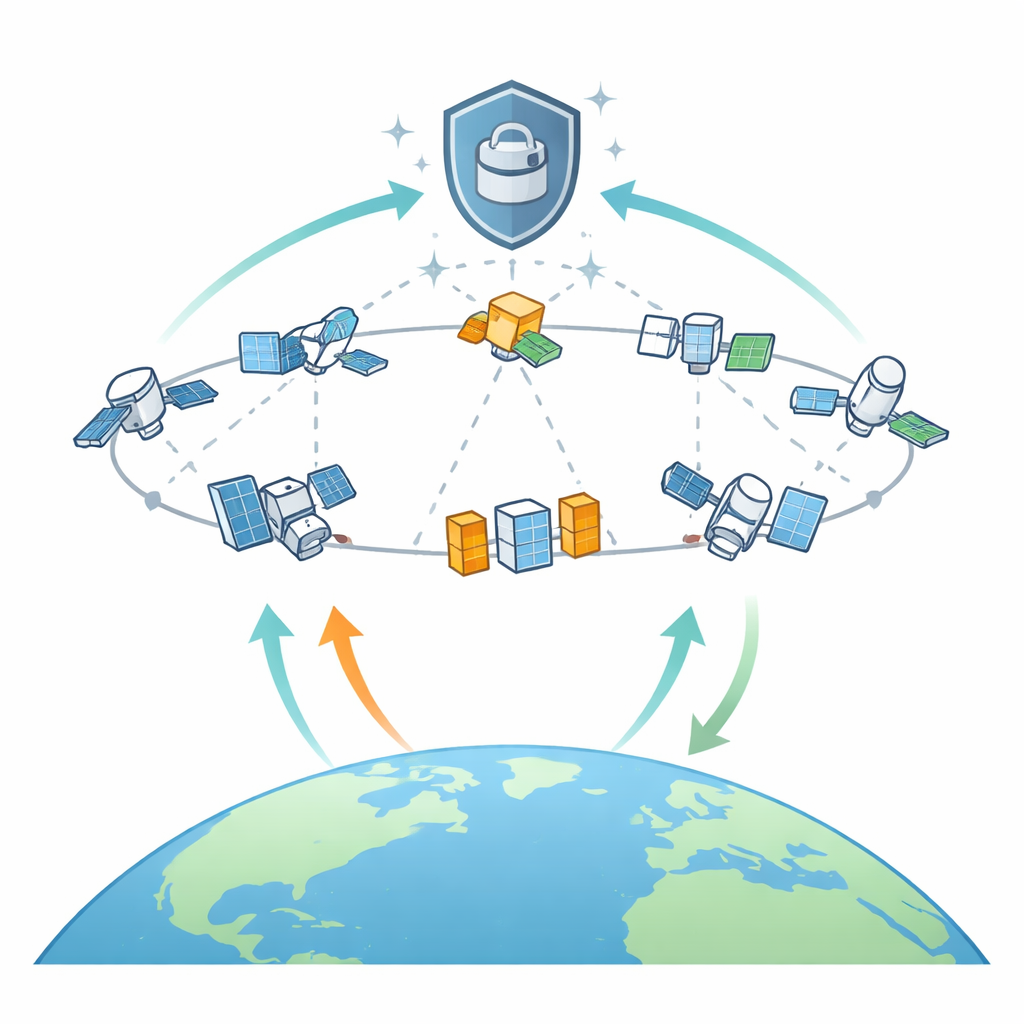
The proposed system, called O‑RAID, treats a constellation of satellites as if they were the individual drives in a familiar computer backup setup. Instead of one giant orbital warehouse, it uses many smaller spacecraft that share the job of storing and protecting data. This separation from Earth solves several problems at once. Space offers effectively unlimited room, no need for water‑hungry cooling systems, and natural immunity to floods, fires, heat waves and power‑grid failures. Because the satellites orbit high above any one country or region, they are also less exposed to local political conflict or physical attack.
Different Satellites with Different Jobs
Within O‑RAID, not every satellite is the same. Storage satellites act as the quiet workhorses, holding the raw data blocks on radiation‑hardened solid‑state drives designed to shrug off cosmic rays. Parity satellites handle the heavy math, constantly computing extra “check” information that allows lost data to be rebuilt if a satellite fails. A smaller set of coordinator satellites serve as the brains of the system. They know where every piece of information lives, direct how new data is written and recovered, and act as traffic controllers for communication between spacecraft and ground stations. Optical laser links knit all of these satellites into a fast‑moving mesh, while a separate solar‑power station in high orbit beams energy to them, reducing the need for large onboard batteries.
How the Space Backup Actually Protects Data
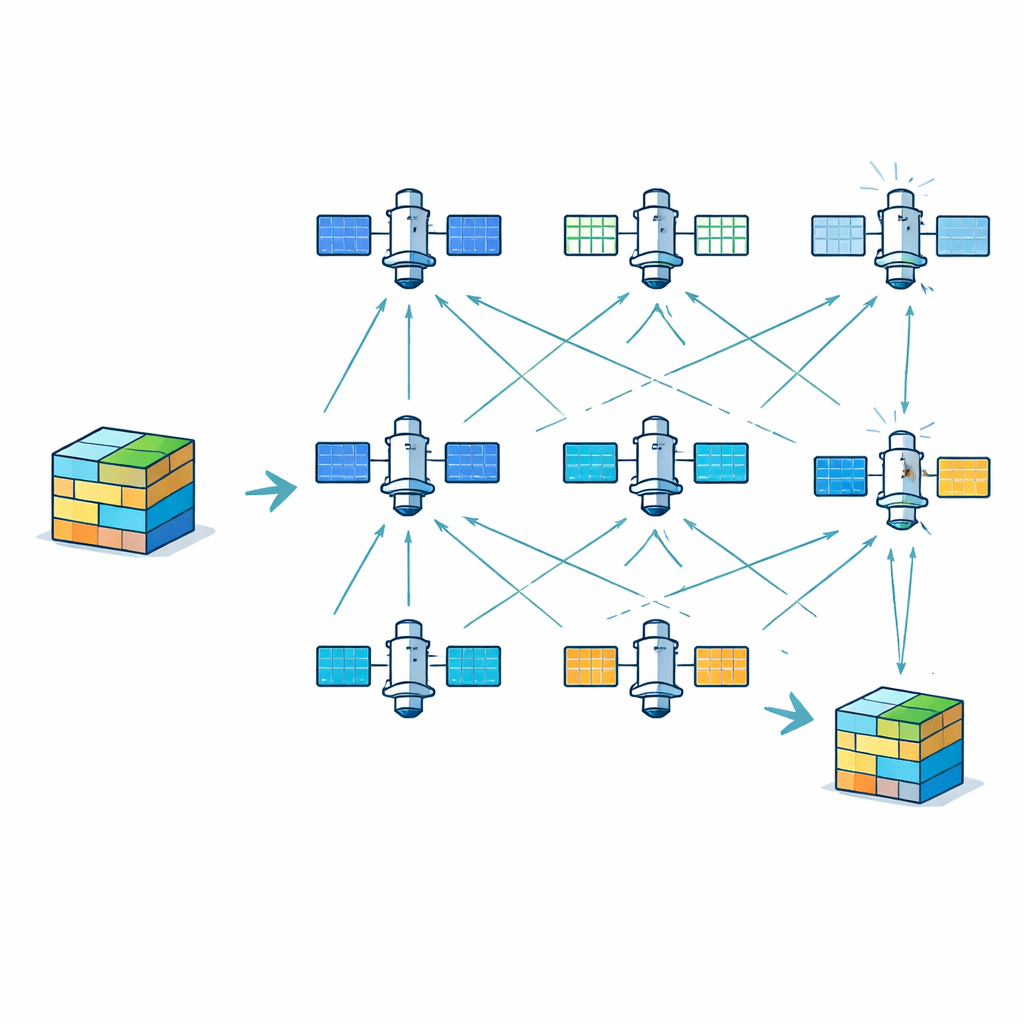
To keep information safe even if two satellites fail at once, O‑RAID slices each file into several pieces and creates extra parity pieces using advanced coding techniques. These chunks are spread across many satellites so that no single loss is critical. If a satellite does fail, the remaining nodes cooperate to rebuild the missing chunks on a spare unit, using the parity pieces like a puzzle guide. The authors build a detailed reliability model that tracks how often satellites might fail, how long it takes to launch and rebuild a replacement, and how communication slowdowns affect recovery. They then run large‑scale computer simulations that include realistic factors such as pointing jitter in laser links, changing bandwidth and orbital layouts.
What the Numbers Say About Longevity
The analysis paints a surprisingly optimistic picture. Even with conservative assumptions about failure rates and months‑long replacement times, constellations of a dozen to twenty satellites can reach mean times to catastrophic data loss measured in millions to hundreds of millions of years—far beyond what is achievable in modern ground‑based arrays using comparable backup schemes. Rebuild operations typically finish within hours, while the time between independent satellite failures is expected to be on the scale of years. This huge gap means that the system spends very little time in truly dangerous states where multiple failures might overlap. The work also compares O‑RAID with top‑tier terrestrial backup arrays and finds that orbital storage can be orders of magnitude more resilient, despite the harsher environment.
Promise, Trade‑Offs and the Road Ahead
O‑RAID is not a drop‑in replacement for everyday cloud storage. Uploads and downloads are tied to ground station passes, and the focus is on slow‑changing archives, not instant access. The paper also acknowledges daunting challenges: orbital debris and solar storms, the enormous up‑front cost of launching and maintaining satellites, and thorny legal questions about data sovereignty and space law. Still, if launch prices keep falling, optical links and space‑based solar power continue to mature, and effective debris management is enforced, the authors argue that by around 2035 an orbital backup layer could become a practical “last copy” for civilization‑scale records. In simple terms, the conclusion is that storing our most irreplaceable data in a carefully engineered ring of satellites is not just science fiction—it is a technically sound, if ambitious, way to ensure that key pieces of human knowledge can outlive disasters on Earth.
Citation: Meegama, R.G.N. O-RAID: a satellite constellation architecture for ultra-resilient global data backup. Sci Rep 16, 8062 (2026). https://doi.org/10.1038/s41598-026-38784-1
Keywords: orbital data storage, satellite constellations, disaster-resilient backups, space-based solar power, data center sustainability