Clear Sky Science · en
Assessment of cognitive load through photoplethysmography and bioimpedance responses during mental arithmetic tasks
Why your brain’s workload matters
Whether you are flying a plane, monitoring patients, or studying for an exam, there are moments when your brain quietly moves from focused to overloaded. Being able to measure that rising mental strain in real time could help prevent mistakes, burnout, and accidents. This study explores a new, noninvasive way to track “how hard your brain is working” using small sensors on the neck and forehead, avoiding bulky brain caps or complicated hospital gear.
Listening to the heartbeat of thought
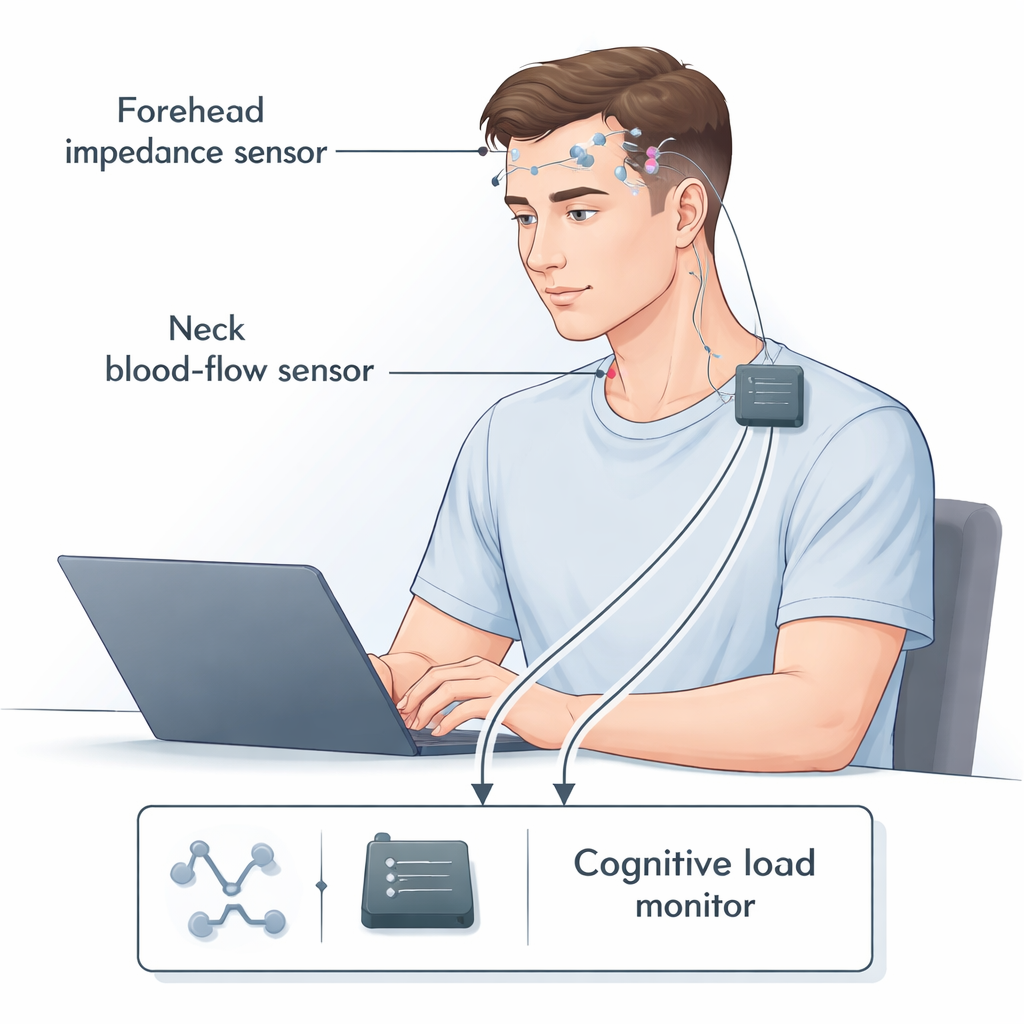
Instead of recording brain waves, the researchers tapped into the tight partnership between the brain and the heart. When we tackle a demanding task, the nervous system shifts gears: the heart beats differently, blood vessels tighten or relax, and blood flow to key brain regions changes. The team used two simple techniques to sense these changes. A light-based sensor on the neck (photoplethysmography, or PPG) tracked how much blood was pulsing through a major artery feeding the brain. At the same time, a set of tiny electrodes on the forehead (impedance plethysmography, or IPG) detected subtle shifts in local blood volume in the front of the brain, where we handle planning, numbers, and decisions. Together, these signals offered a window into both global and local blood supply during mental effort.
Putting pressure on the mind with numbers
To stress the brain in a controlled way, fifteen healthy volunteers, aged 20 to 35, solved series of mental arithmetic problems on a computer. The tasks were arranged in four stages: a relaxed baseline, followed by easy one-digit additions, then two-digit additions, and finally harder three-digit sums that required more memory and carrying. Each short trial began with on-screen instructions, continued with five problems, and ended with a brief rest while the screen showed a fixation cross. Throughout, the neck and forehead sensors streamed data, while the computer logged how quickly and how accurately each person answered. As expected, tougher problems led to slower responses and more mistakes, especially at the hardest level, confirming that the tasks were indeed ramping up mental load.
Decoding hidden patterns in blood signals
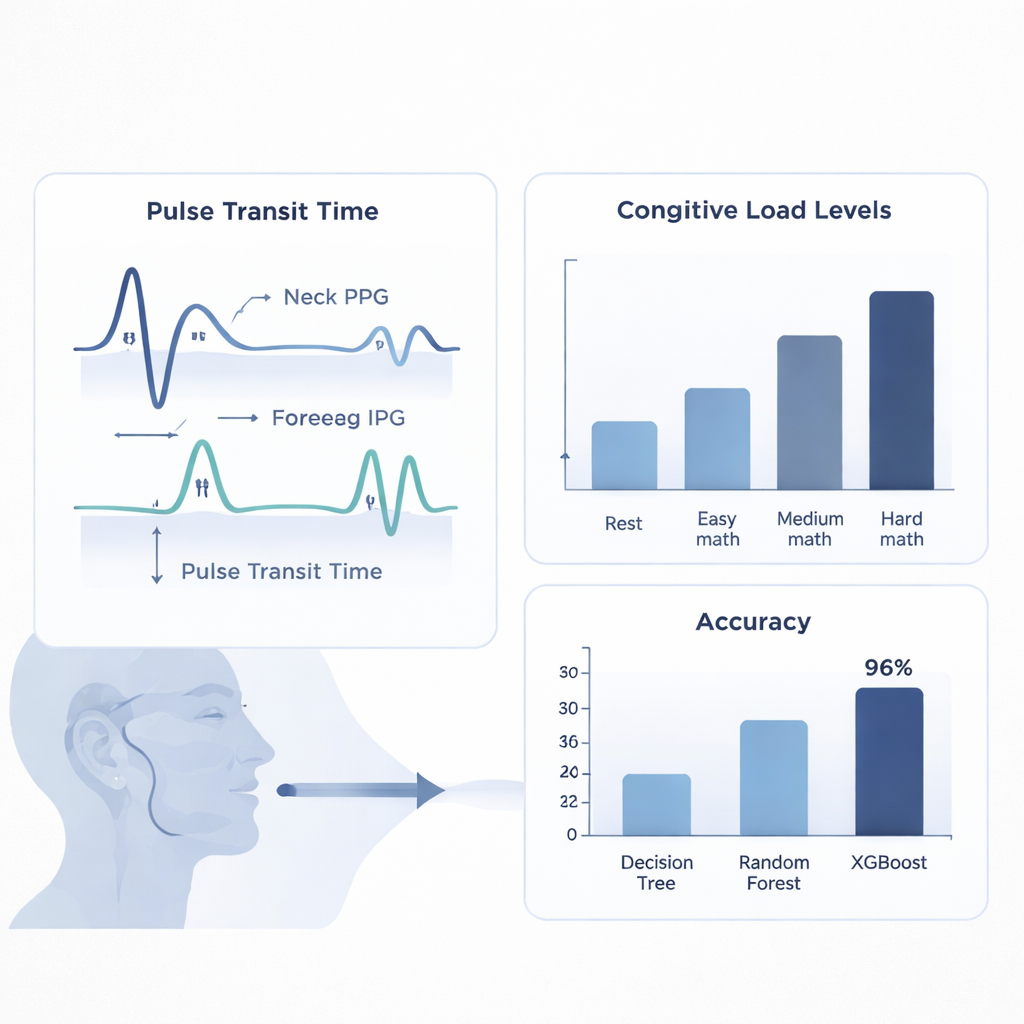
The raw waveforms from the two sensors were sliced into small time windows and cleaned with digital filters to remove slow drifts and high-frequency noise. From each window, the researchers extracted dozens of simple descriptors: maximum and minimum values, averages, how much the signal varied, and how its energy was spread across different frequencies. They also measured the timing between heartbeats and the delay between the neck pulse and the forehead pulse, a quantity known as pulse transit time. These numerical features were then fed into three off-the-shelf machine learning algorithms—Decision Trees, Random Forest, and XGBoost—to see whether a computer could learn to tell different mental-load levels apart just from the cardiovascular patterns.
How well can a computer read your mental strain?
When each person had their own personalized model, the system was remarkably accurate. For the simple task of telling “relaxing” from “doing math,” all three algorithms reached 100 percent accuracy. Even for the harder four-way problem—relax, easy, medium, and hard math—the best method, Random Forest, correctly identified the level 96 percent of the time. However, performance dropped when the system tried to generalize from one group of people to another, with accuracy falling to about two-thirds. This suggests that individuals differ strongly in their baseline heart and blood-flow responses, and that real-world devices may need a short personal calibration to work reliably for each user.
What the most revealing signals tell us
By examining which features the algorithms relied on most, the researchers found that forehead-based IPG measurements carried much of the useful information. In particular, the average and extreme values of the forehead signal consistently ranked highest in importance, ahead of neck-based PPG features and the combined timing measure. This fits with current understanding of blood–brain coupling: when we do hard mental work, the front of the brain calls for more fuel, and local blood volume changes accordingly. The neck sensor still added value by reflecting overall cardiovascular arousal, but the localized forehead readings provided the sharpest clues about moment-to-moment mental demand.
From lab sensors to smart, safer workplaces
To a lay reader, the key message is that mental effort leaves a distinct fingerprint in the way blood flows to and within the brain, and that this fingerprint can be captured with small, wearable sensors instead of complex brain-scanning equipment. The study shows that combining a light sensor on the neck with simple electrodes on the forehead allows algorithms to track multiple levels of cognitive load with an accuracy comparable to many EEG-based systems, at least when tuned to an individual. With refinement and better comfort, such technology could one day help aircraft cockpits, cars, classrooms, and control rooms adjust tasks and alerts automatically, easing pressure before the human operator becomes dangerously overloaded.
Citation: Huynh, D.N., Tran, T.N., Tran, K.T. et al. Assessment of cognitive load through photoplethysmography and bioimpedance responses during mental arithmetic tasks. Sci Rep 16, 7367 (2026). https://doi.org/10.1038/s41598-026-38782-3
Keywords: cognitive load, mental arithmetic, wearable sensors, brain–heart interaction, machine learning