Clear Sky Science · en
Targeted metagenomics reveals hidden chickenpox epidemic amid Mpox surveillance in Uganda
Why a chickenpox mystery matters
When a serious viral outbreak strikes, doctors and health officials race to identify who is infected and how the disease is spreading. But what happens when people have all the right symptoms, yet their tests keep coming back negative? This study from Uganda explores that puzzle during a recent Mpox outbreak and reveals a surprising culprit behind many of the cases: a hidden wave of chickenpox infections that standard testing nearly missed.
A confusing rash during an Mpox scare
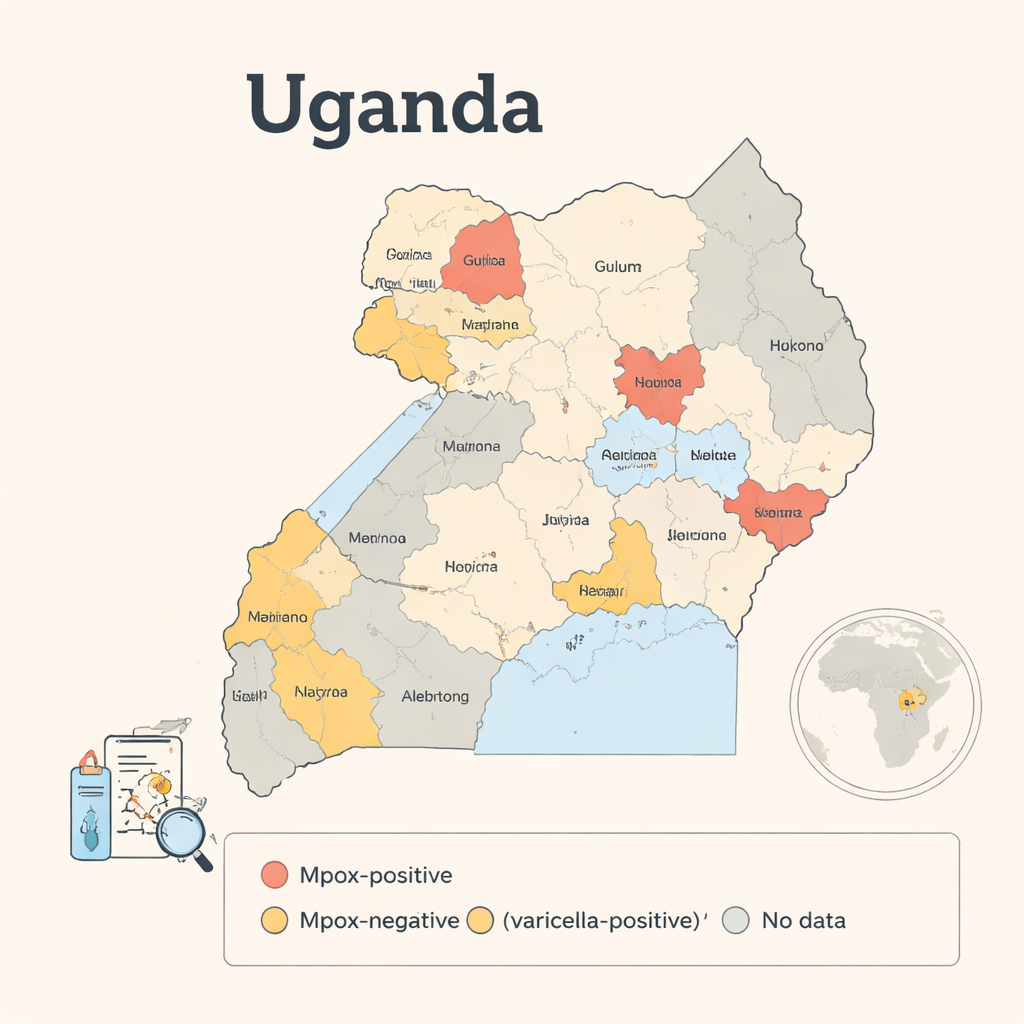
In mid-2024, Uganda faced an Mpox outbreak. People arrived at clinics with fever, swollen lymph nodes, and blister-like rashes that strongly resembled Mpox. Yet for almost half of these suspected patients, laboratory tests for Mpox were negative. Because Mpox and chickenpox can look very similar on the skin, doctors could not rely on appearance alone. The authors set out to discover what was truly making these patients sick, and whether another virus was quietly spreading while attention was focused on Mpox.
Looking beyond the usual test
Most outbreak testing relies on PCR, a method that searches for a specific virus that doctors already suspect. PCR is fast and precise, but it can miss other infections when patients are tested only for one threat. To cast a wider net, the researchers used a method called targeted metagenomic sequencing on 284 people whose Mpox tests were negative. Instead of asking “Is this Mpox?”, this approach scans bits of genetic material in the sample to see what viruses are actually present. The team used a specialized viral panel and a new software pipeline they built, called VaricellaGen, to analyze genetic fingerprints from varicella zoster virus—the virus that causes chickenpox.
Uncovering a hidden chickenpox surge
The results were striking. In 86 percent of the Mpox-negative samples, the scientists detected chickenpox virus, showing that many people thought to have Mpox most likely had chickenpox instead. For almost half of these chickenpox-positive cases, enough viral genetic material was present to reconstruct most of the virus’s genome. VaricellaGen then grouped all of these viruses into a known family called clade 5, which has been seen before in African countries. When the researchers compared the Ugandan viruses to global reference samples, they found two related clusters. One cluster grouped Uganda with India, the United States, and Kenya, hinting at travel or shared routes of spread; the other cluster mostly contained Ugandan viruses with a single Indian relative, suggesting local transmission with multiple introductions over time.

What this means for outbreak response
The study highlights how easy it is to misjudge an outbreak when only one pathogen is being tracked. During the Mpox emergency, health systems naturally focused on Mpox testing, but this narrow lens allowed a major chickenpox surge to go largely unnoticed. Because chickenpox can be severe in adults and people with weak immune systems, missing such an epidemic has real consequences. The work also shows the power of genomic tools like VaricellaGen, which can quickly sort viruses into families and lineages, helping officials trace how infections move within and between countries. At the same time, the authors note limits: they focused only on DNA viruses, so some other rash-causing viruses, especially RNA viruses, would not show up.
Take-home message for the public
For non-specialists, the key lesson is that one outbreak can hide another. Many Ugandans with Mpox-like rashes during the 2024 crisis were actually part of a large chickenpox wave. By using broad genetic testing instead of a single-target approach, scientists were able to uncover this hidden epidemic and show that a particular family of chickenpox virus, clade 5, is circulating in the country. The study argues that health systems need wider testing panels and genomic surveillance, so that when the next outbreak comes, we can see the full picture of which viruses are spreading—and respond in time to protect communities.
Citation: Kanyerezi, S., Ayitewala, A., Kabahita, J.M. et al. Targeted metagenomics reveals hidden chickenpox epidemic amid Mpox surveillance in Uganda. Sci Rep 16, 7591 (2026). https://doi.org/10.1038/s41598-026-38778-z
Keywords: mpox, chickenpox, genomic surveillance, Uganda outbreak, metagenomic sequencing