Clear Sky Science · en
CFD-based optimization and experimental validation of supersonic separator design with angular injection swirler for efficient gas dehydration
Why drying gas at high speed matters
Natural gas and even ordinary air usually contain tiny droplets of water. In pipelines and processing plants, that moisture can freeze into ice-like plugs, corrode metal, and waste energy. Today’s drying systems are bulky, expensive, and often need chemicals. This paper explores a much more compact approach: a "supersonic separator" that blasts gas through a shaped nozzle at faster-than-sound speeds, chilling it in a split second so water condenses and can be flung out by centrifugal force. The authors combine advanced computer simulations and lab experiments to show how to design this device so it actually works in practice.
A tiny tornado inside a tube
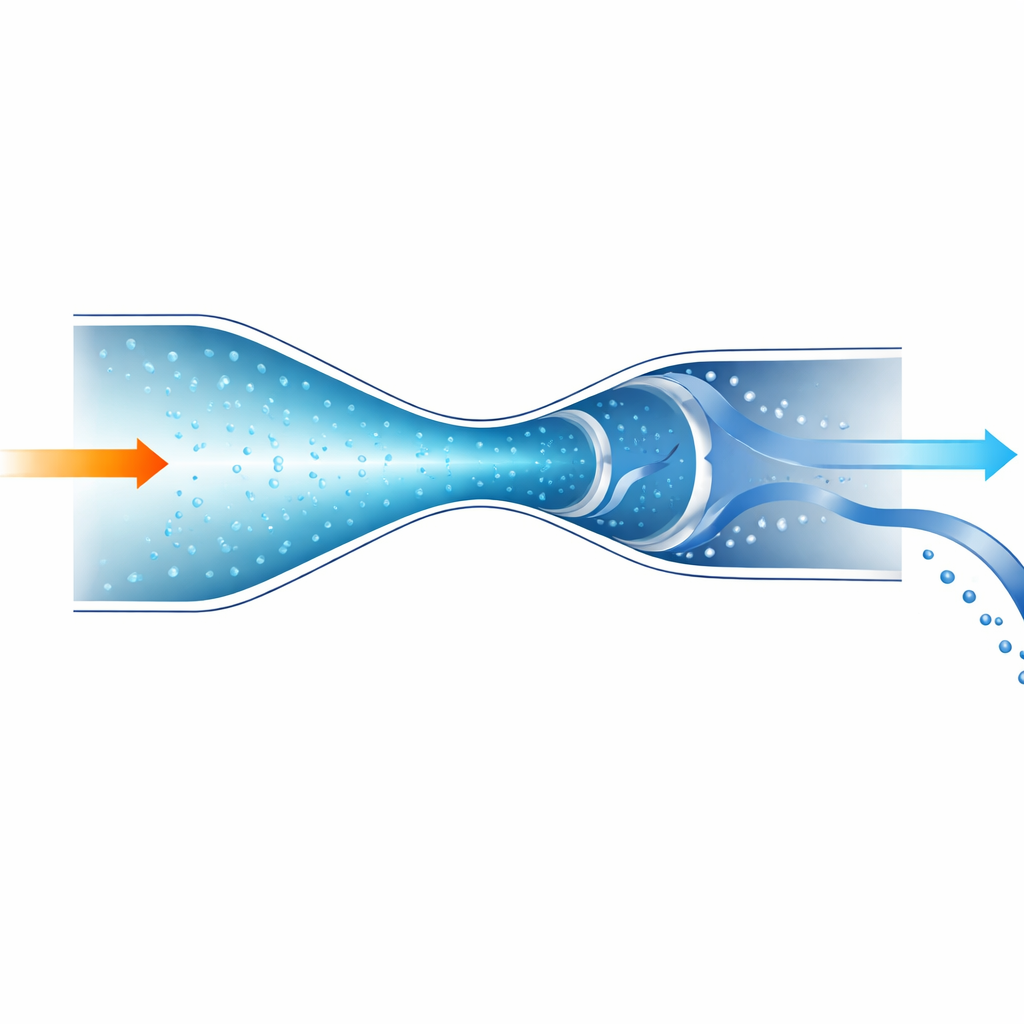
The basic separator looks like a smooth metal tube that narrows sharply and then widens again, a shape known as a Laval nozzle. When high-pressure, humid gas is forced through this nozzle, it accelerates to supersonic speeds and cools dramatically in a few centimeters, causing water vapor to turn into microscopic droplets. To remove those droplets, the gas must also spin like a miniature tornado, so that centrifugal force throws the denser liquid outward to the wall, where it can be collected. Earlier versions of this technology either did not cool the gas enough, or they created swirl with internal vanes that caused large energy losses and did not fully separate the droplets.
Designing the cold core
The team first used computational fluid dynamics, a numerical method for simulating fluid flow, to refine the shape of the nozzle itself. They compared several smooth wall profiles and lengths for the converging and diverging sections, as well as different shapes for the downstream diffuser that helps recover pressure. A particular contour known as the Witoszynski profile in the converging part, combined with a gentle linear expansion and a simple linear diffuser, produced the deepest and most uniform cooling. Gas temperatures dropped well below minus 50 degrees Celsius, long enough for water droplets to form and grow, all while keeping the device relatively compact and limiting friction losses.
Making swirl without moving parts
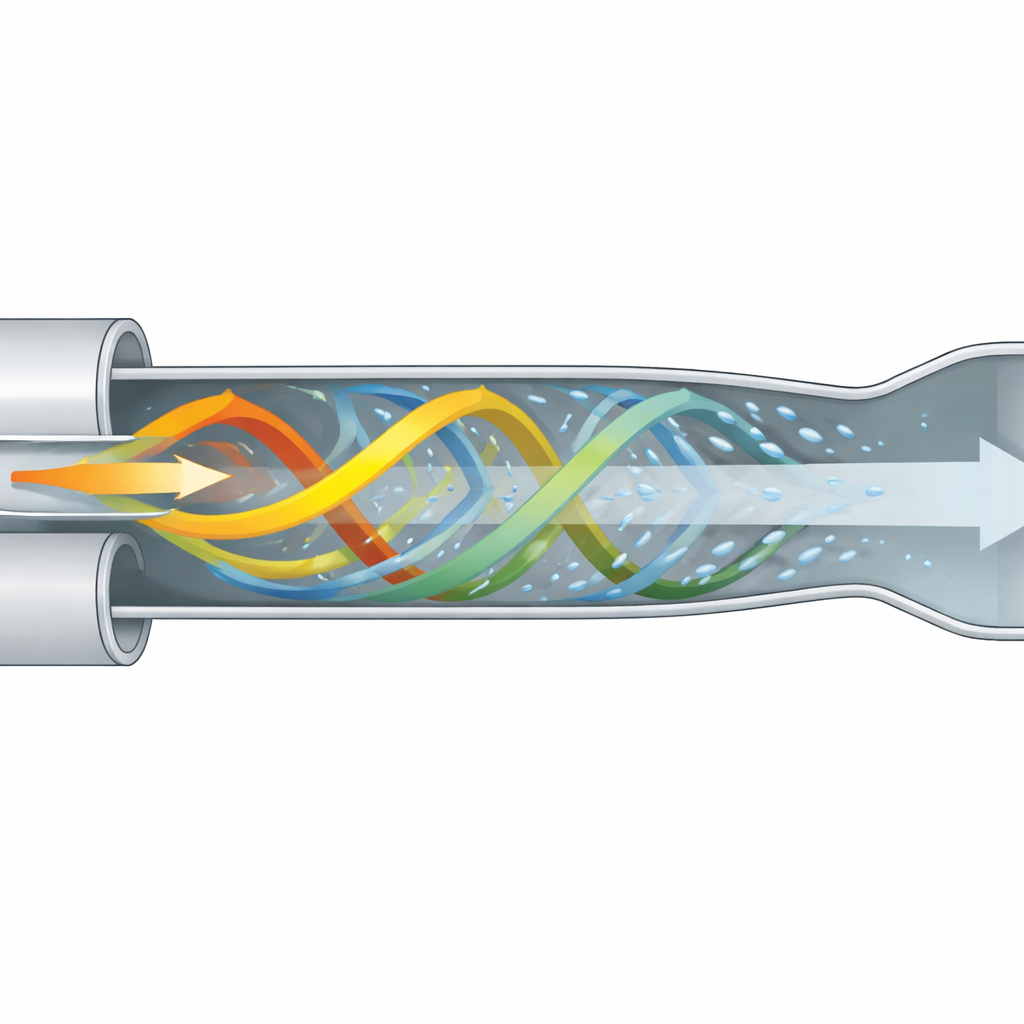
Cooling alone is not enough; without swirl, most droplets simply race out with the gas. The researchers tested two ways of adding spin. In the "active" approach, a set of thin vanes sits in the flow and forces it to rotate, much like stationary blades in a turbine. In the "passive" approach, a side tube injects gas into the main line at a shallow angle, creating rotation without any solid obstacles. Using simulations, the authors systematically varied vane angle, vane count, thickness, length, and, for the injection concept, the injection angle itself. They evaluated not just how many droplets were captured, but also how much cooling was preserved and how much gas could pass through. The best vane design reached a high overall separation performance but still disturbed the flow and robbed some cooling power.
A simple angled inlet proves best
The standout solution was the passive "angular injection swirler." Here, a single side port feeds gas into the main pipe at about 15 degrees. This side jet wraps around the main stream, setting up a strong swirling motion before the flow reaches the narrow throat. In simulations, this design combined deep cooling with strong centrifugal forces, achieving an overall droplet separation efficiency of about 83 percent for typical droplet sizes, and even higher values for larger droplets. Crucially, it did this while keeping the device free of fragile internal hardware, improving mechanical robustness and simplifying fabrication.
Putting the design to the test
To confirm that the device works outside the computer, the team built a laboratory-scale prototype using air made humid in a dedicated tank. High-speed video showed that, with the angled injection swirler installed, droplets in a two-phase inlet flow were rapidly driven to the wall, forming a liquid film that drained through the liquid outlet, while the gas outlet carried visibly drier air. Separate tests with saturated (single-phase) moist air showed that the nozzle’s rapid cooling could actually create droplets from vapor and then remove them, demonstrating both strong cooling performance and high collection efficiency. Non-contact laser temperature measurements along the outer wall closely matched simulated temperature fields, supporting the accuracy of the model and confirming that the gas inside reached very low temperatures.
What this means for future gas treatment
For a non-specialist, the key message is that it is possible to dry gas streams very quickly using only changes in pressure and clever pipe shaping, without moving parts or chemical additives. By tuning the nozzle shape and adding a simple angled side inlet to generate swirl, the authors show that water droplets can be condensed and spun out of the flow in milliseconds at practical scales. While the current experiments used air instead of natural gas and covered a limited pressure range, the results point toward compact, energy-efficient dryers that could one day replace or complement bulky conventional units in gas processing plants, air pre-treatment systems, and other industrial settings.
Citation: Shoghl, S.N., Pazuki, G., Farhadi, F. et al. CFD-based optimization and experimental validation of supersonic separator design with angular injection swirler for efficient gas dehydration. Sci Rep 16, 7984 (2026). https://doi.org/10.1038/s41598-026-38777-0
Keywords: supersonic separator, gas dehydration, droplet separation, swirling flow, computational fluid dynamics