Clear Sky Science · en
Uncovering the acoustic ecology of sympatric coral-dwelling fish with portable audio-video arrays
Listening to Life on a Coral Reef
Coral reefs are famous for their colors, but they also host a hidden world of sound. Many reef fish "talk" using pops, clicks, and grunts that carry through cloudy water and at night when vision fails. This study shows how scientists can eavesdrop on the love lives of two tiny coral-dwelling fish to learn how their calls change from place to place and how rising ocean temperatures might be reshaping underwater courtship.
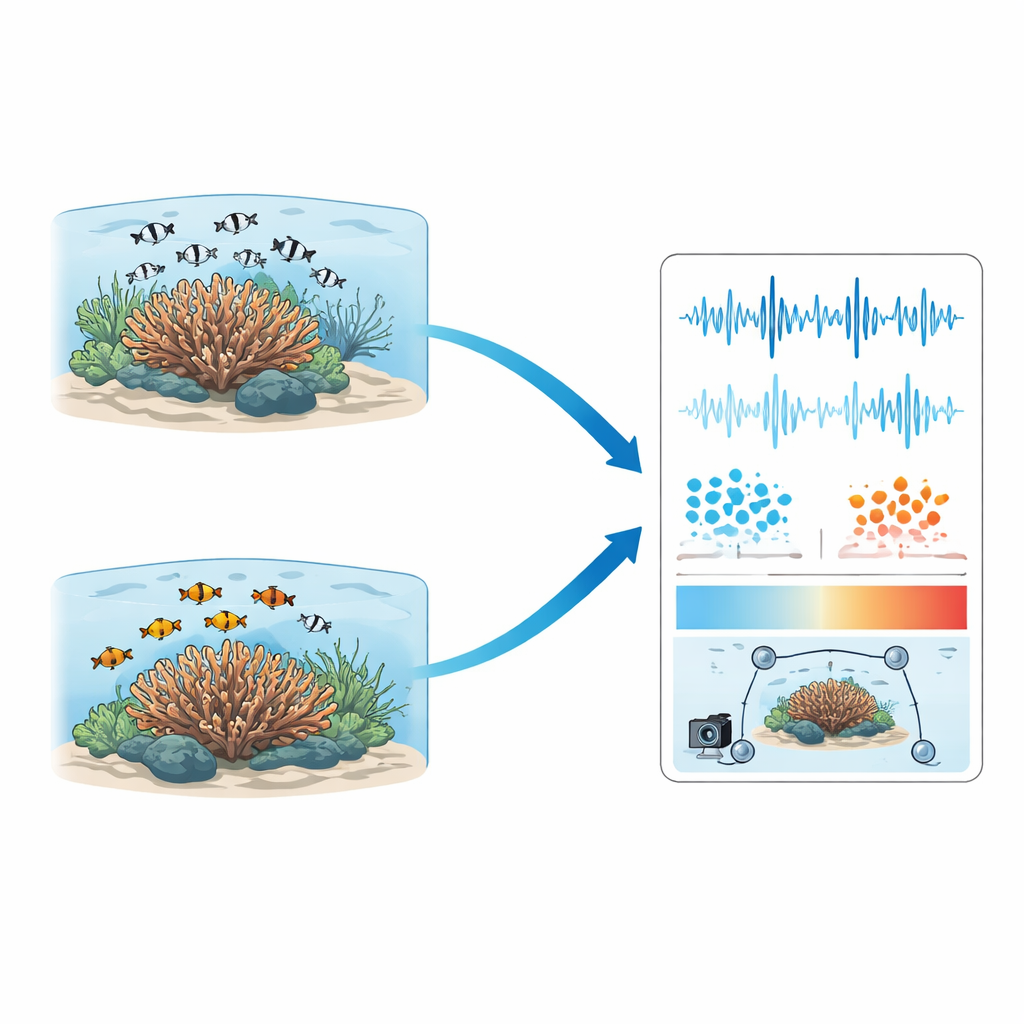
How Reef Fish Use Sound
Over a thousand fish species are known to make sounds, using them to attract mates, defend territories, stay together in groups, or warn of danger. Yet for most of these noises, we still do not know which species made them or what they mean. That gap is especially large on busy coral reefs, where many animals call at once and water can be murky. For two small damselfish that live among branching corals, males perform energetic "signal jumps": they dart up above their coral home, plunge back down, and at the same time produce a rapid burst of sound pulses. These brief trains of pulses carry information about species identity and the state of the caller, and they may help females choose partners and keep closely related species from interbreeding.
A Portable Underwater Listening Station
To untangle who is saying what, the researchers used a compact, low-cost listening station that combines four underwater microphones with a video camera. The frame sits in the sand around a single coral colony, with the camera looking in from a short distance away. This setup lets the team automatically detect sound pulses, pinpoint where each one comes from in three dimensions, and match movements on video to the sounds. By focusing on pulse trains that matched the top-to-bottom motion of a male’s signal jump, they could confidently link each call type to one of the two damselfish species and to its courtship behavior in the wild, rather than in an artificial tank.
Comparing Two Reefs and Two Species
The team deployed these arrays at two Australian reef systems: Coral Bay on the Nyinggulu (Ningaloo) Coast in the west, and Lizard Island on the Great Barrier Reef in the east. At each site they recorded multiple coral colonies occupied by just one of the two damselfish species. From more than 12,000 minutes of recordings they extracted hundreds of courtship pulse trains and measured simple features such as how many pulses each train contained, how long trains and individual pulses lasted, how quickly pulses followed one another, and what frequencies dominated each sound. They then compared these traits between species and between the two reef sites using both single-variable and multi-variable statistics to see where the biggest differences lay.
Local Conditions Leave an Acoustic Fingerprint
The calls of the two species were indeed different, as expected for closely related animals that rely on sound during courtship. But an even stronger pattern emerged: calls from the same species differed more between Coral Bay and Lizard Island than they did between species at the same site. At Coral Bay, where corals were experiencing sustained heat stress and warmer waters, males produced longer pulse trains with fewer pulses and slower rhythms. At Lizard Island, during cooler recovery conditions, pulse trains tended to be shorter, with more closely spaced pulses and higher dominant frequencies. These patterns match what is known about how muscle performance and energy use change with temperature, suggesting that chronic heat and recent heatwaves may be altering how fish produce sound, not just how often they call.
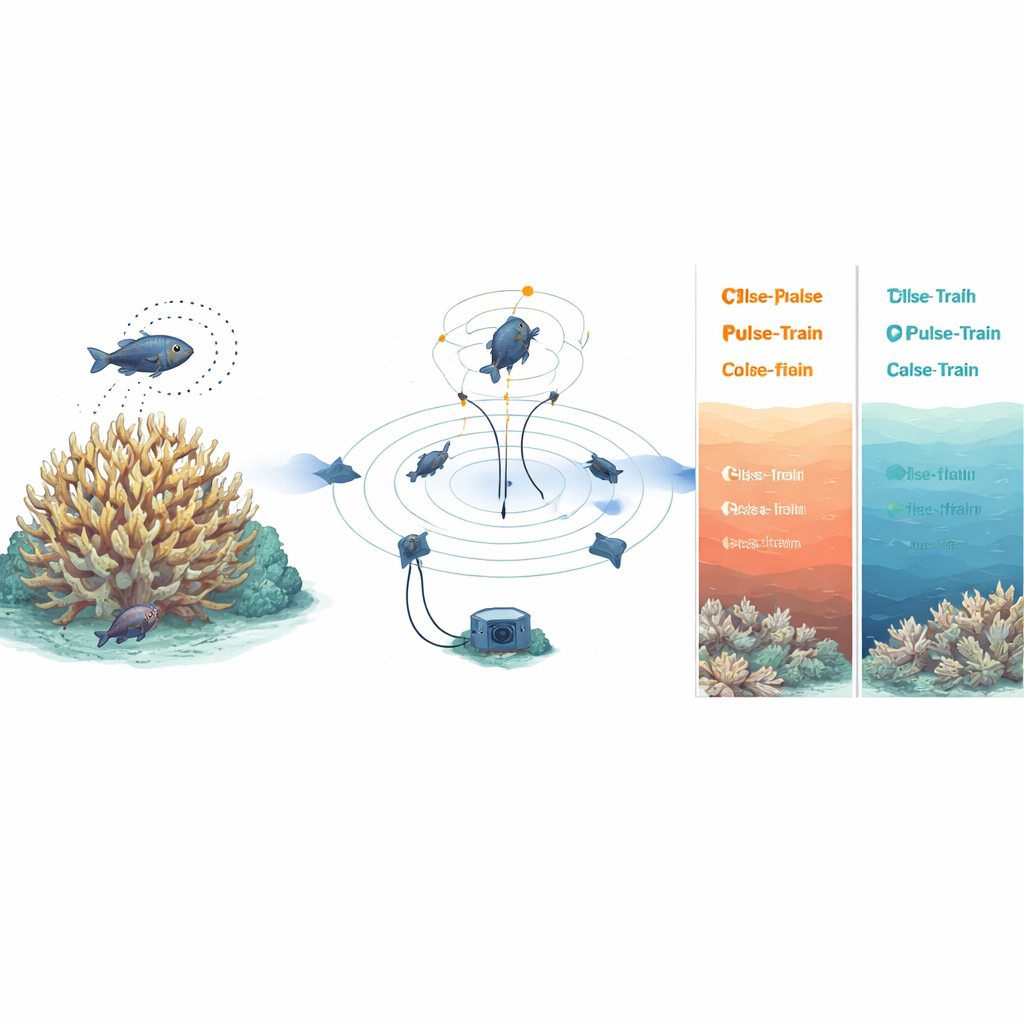
What This Means for Coral Reefs
By tying specific sounds to specific fish and behaviors, this work turns underwater noise into a powerful ecological signal. The study shows that portable audio-video arrays can reveal how social signals vary among populations and respond to local environments, offering a promising tool for long-term, non-invasive monitoring of reef health. For a lay reader, the key takeaway is that as oceans warm and reefs face repeated bleaching events, even the love songs of small reef fish are changing. Tracking these subtle shifts in underwater communication could help scientists understand which populations are coping, which are struggling, and how best to protect the rich but fragile acoustic communities of coral reefs.
Citation: Azofeifa-Solano, J.C., Mouy, X., Erbe, C. et al. Uncovering the acoustic ecology of sympatric coral-dwelling fish with portable audio-video arrays. Sci Rep 16, 8235 (2026). https://doi.org/10.1038/s41598-026-38774-3
Keywords: fish acoustic communication, coral reef ecology, damselfish courtship, marine heatwaves, passive acoustic monitoring