Clear Sky Science · en
Conditional survival after radiofrequency ablation for early-stage hepatocellular carcinoma
Why future survival chances matter
When someone is treated for early-stage liver cancer, one of the first questions is, “How long am I likely to live?” Most survival numbers, however, are calculated from the day of diagnosis and do not change, even as patients successfully live through years of follow-up. This study asks a more hopeful, practical question: if a person has already survived for some time after a targeted heat treatment called radiofrequency ablation, what are their chances of living several more years from that point onward?
A focused look at early liver cancer treatment
The researchers examined 791 people in Taiwan with early-stage hepatocellular carcinoma, the most common form of primary liver cancer. All were considered good candidates for treatment: their tumors were small or few in number, and their underlying liver function was still relatively well preserved (Child–Pugh class A). Each patient received radiofrequency ablation (RFA), in which a needle-like probe uses heat to destroy cancerous tissue inside the liver without major surgery. The team then followed these patients for up to five years to see who survived and how risk changed over time.
From fixed survival rates to “if you’ve made it this far”
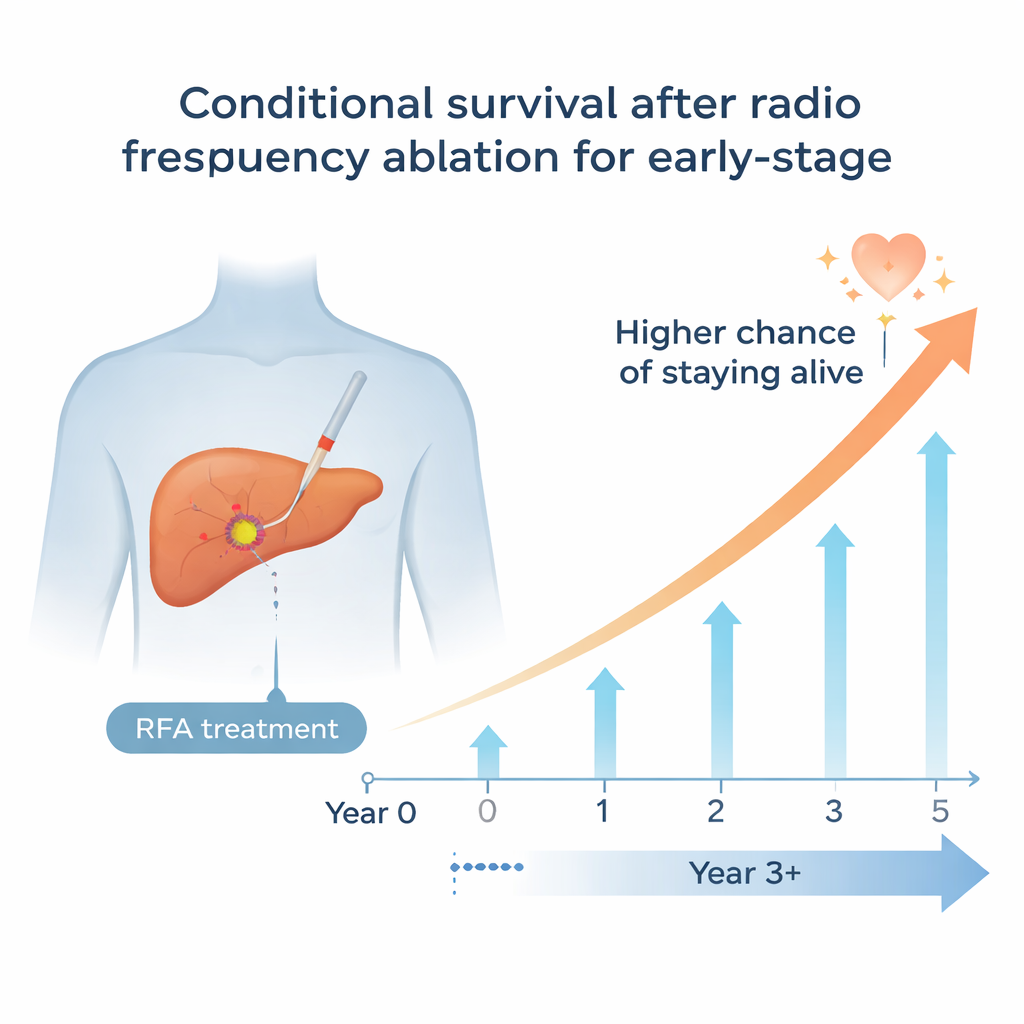
Traditional statistics showed that about 96% of patients were alive one year after RFA, 72% at three years, and nearly 60% at five years. At first glance, those numbers can seem discouraging. But they do not reflect the reality for someone who has already made it through the risky early period. To capture this, the authors used “conditional survival,” which asks: if a patient is alive now, what is the chance they will live another three years? For example, although the overall five-year survival was about 60%, patients who had already lived two years after RFA had an 88% chance of surviving three more years. In other words, their outlook actually improved with time.
Tumor traits matter early; liver health matters always
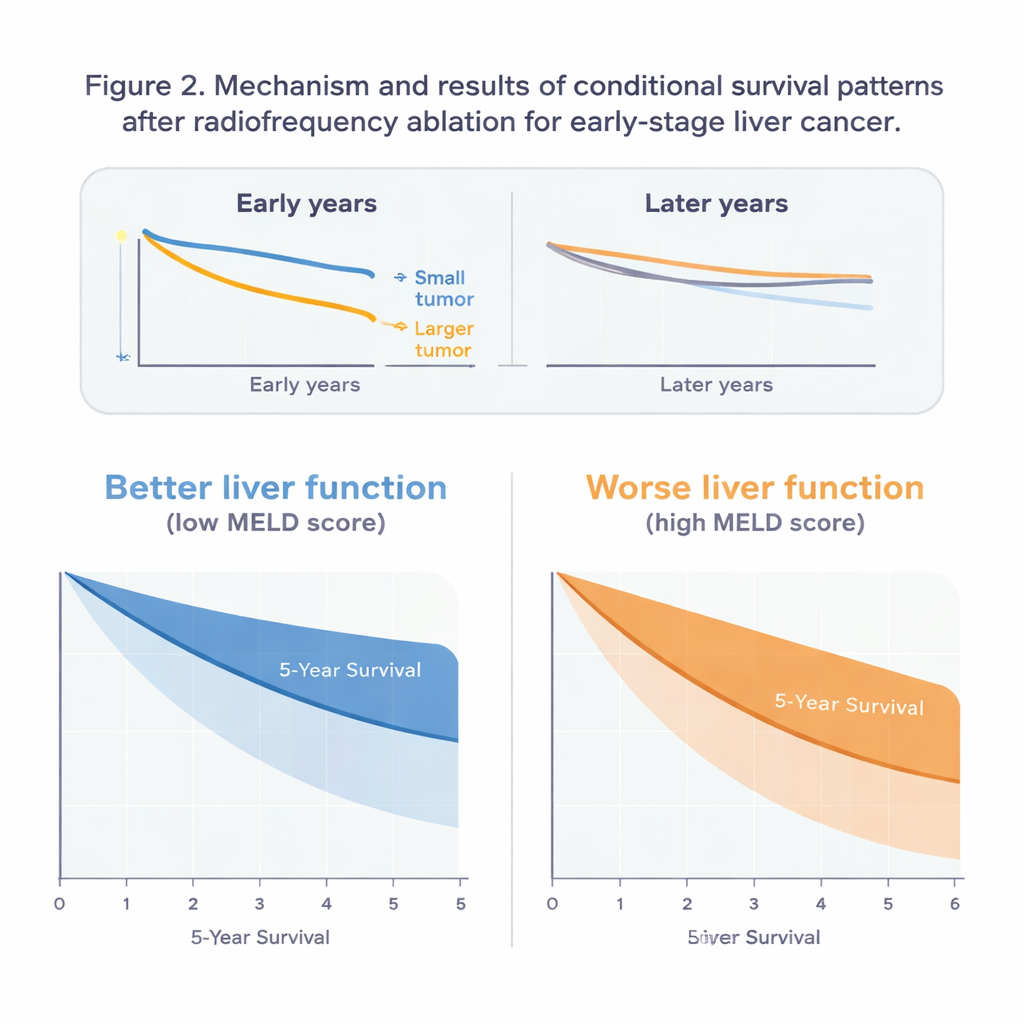
At the time of treatment, certain features predicted worse survival: more advanced but still early-stage tumors (called BCLC stage A), higher levels of the blood marker AFP, and poorer liver function measured by a score known as MELD. Early on, patients with bigger or more aggressive tumors or high AFP were more likely to die than those with smaller, less aggressive tumors. However, when the researchers re-calculated survival “on the fly” using conditional survival, they found that these tumor-related disadvantages faded after about three years. From that point onward, people who had started with more worrisome tumor features had nearly the same future survival chances as those who began with very favorable tumors.
Why liver function keeps shaping the road ahead
Liver reserve told a different story. Patients with better liver function (a MELD score of 9 or less) consistently had higher conditional survival than those with poorer liver function (MELD above 9), at every time point in follow-up. Even after several years, their likelihood of living another three years stayed clearly higher. This suggests that, once patients have passed the early high-risk window for tumor recurrence, the overall health of the liver—rather than the original tumor stage—becomes the main driver of their long-term outlook. Protecting liver function and managing chronic liver disease remain crucial long after the cancer has been treated.
What this means for patients and clinicians
For patients with early-stage liver cancer treated by radiofrequency ablation, survival prospects are not fixed at diagnosis. If they live through the first few years, their chances of remaining alive for several more years improve markedly, especially if their liver function is strong. Tumor size and blood markers are important early on, but their grip on the future loosens with time. These dynamic, “if you’ve made it this far” estimates can help doctors give more realistic, often more reassuring information at follow-up visits, and highlight the importance of long-term care aimed at keeping the liver as healthy as possible.
Citation: Yen, YH., Moi, S., Kee, KM. et al. Conditional survival after radiofrequency ablation for early-stage hepatocellular carcinoma. Sci Rep 16, 7461 (2026). https://doi.org/10.1038/s41598-026-38771-6
Keywords: liver cancer, radiofrequency ablation, conditional survival, hepatocellular carcinoma, liver function