Clear Sky Science · en
Associations of thigh muscle thickness with cardiorespiratory fitness and ventilatory efficiency in male soccer athletes
Why Strong Thighs Matter More Than You Think
For fans of soccer and fitness alike, it is tempting to focus on skills, tactics, or sheer willpower when thinking about performance. This study suggests something more basic plays a quiet but powerful role: the size of the muscles in your thighs. By using simple ultrasound scans and treadmill tests, researchers explored how the thickness of key thigh muscles in male soccer players relates to how much oxygen they can use and how efficiently they breathe during hard exercise. Their results hint that a quick scan of the leg could offer a low-cost window into an athlete’s heart–lung fitness.
Looking Inside the Soccer Player’s Leg
The research team studied 72 competitive male amateur soccer players in Italy, all young adults with several years of training behind them and no recent injuries or major health problems. Instead of relying on expensive scanners that use radiation or magnets, they used a handheld ultrasound device to measure the thickness of two major thigh muscles on the players’ dominant leg: the rectus femoris and the vastus intermedius, both part of the quadriceps group that powers running and kicking. They then combined these into an overall measure of total thigh muscle thickness. Because ultrasound machines are already common in sports and clinical settings, the authors wanted to know whether such simple measurements could reveal more than just muscle size. 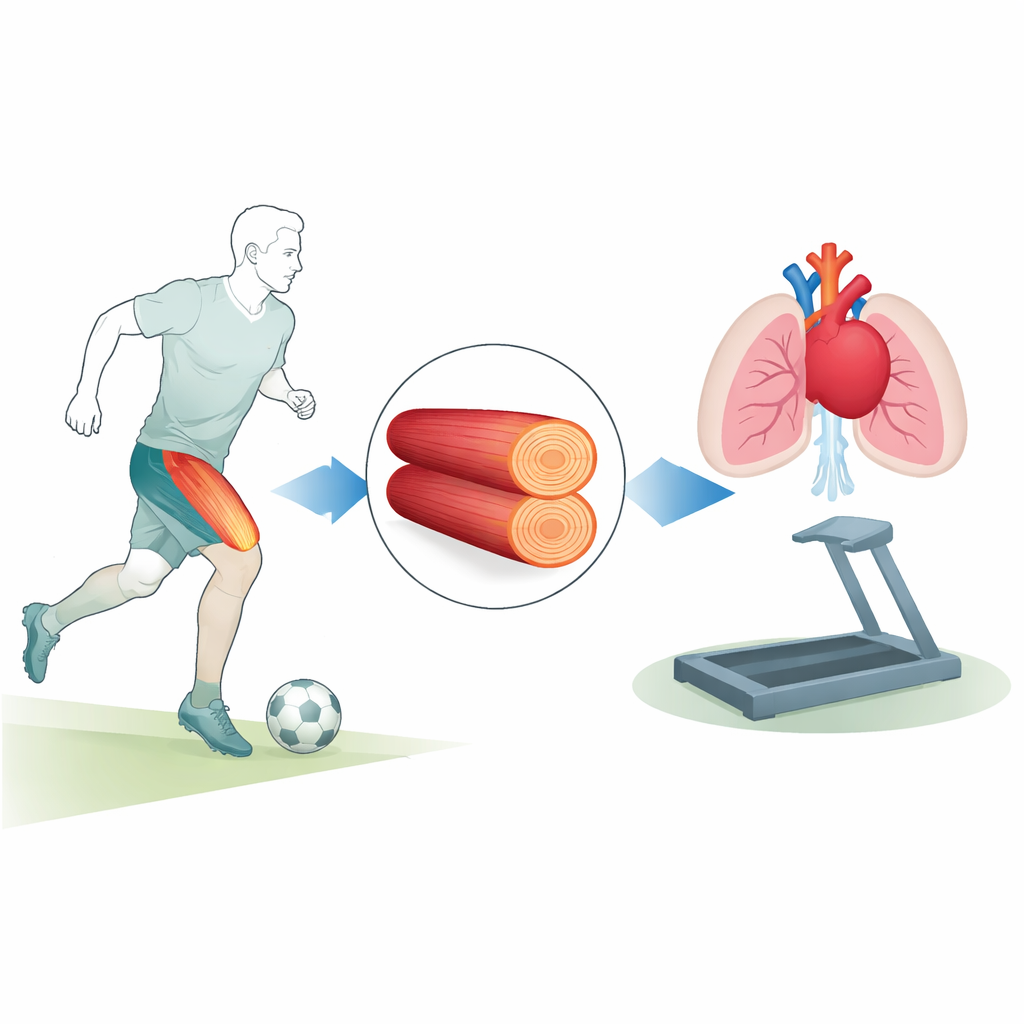
Putting Muscles and Lungs to the Test
To link muscle thickness with real-world performance, the players also completed a demanding treadmill test that gradually increased in speed and then incline until each athlete reached their limit. During the test, the researchers measured how much oxygen the players’ bodies used at peak effort (a key marker of cardiorespiratory fitness) and how effectively their breathing cleared carbon dioxide, summarized by a measure called ventilatory efficiency. Lower values of this efficiency measure indicate that the lungs and circulation are working in a more economical way, delivering and exchanging gases without wasting effort. The scientists also recorded basic lung function and body composition to ensure that any links they found were not just due to general size or lung health.
Thicker Thighs, Fitter Hearts and Lungs
When the team compared results, a clear pattern emerged: players with thicker thigh muscles tended to have higher peak oxygen uptake and more efficient breathing during exercise. These relationships held not only for each individual muscle, but also for the combined thigh thickness. Importantly, the associations remained even after taking into account age, body mass index, and baseline lung function, suggesting that the legs themselves carry unique information about fitness beyond simple body size or lung capacity. In players grouped into thirds by muscle thickness, those in the thicker-muscle groups generally showed better oxygen use and more favorable breathing responses on the treadmill.
How Leg Muscles Might Shape Breathing
The study cannot prove cause and effect, but it offers several plausible explanations. Larger thigh muscles may have more blood vessels and a higher capacity to use oxygen, pushing the heart and lungs to adapt and work more efficiently during training. Thicker muscles might also support smoother, more powerful strides and allow athletes to sustain deeper, slower breathing, which can reduce wasted breaths and improve gas exchange. The authors note that signals sent from working leg muscles to the brain and circulation during exercise may help fine-tune heart rate and breathing; stronger, more developed muscles could influence these signals in ways that favor better overall performance. 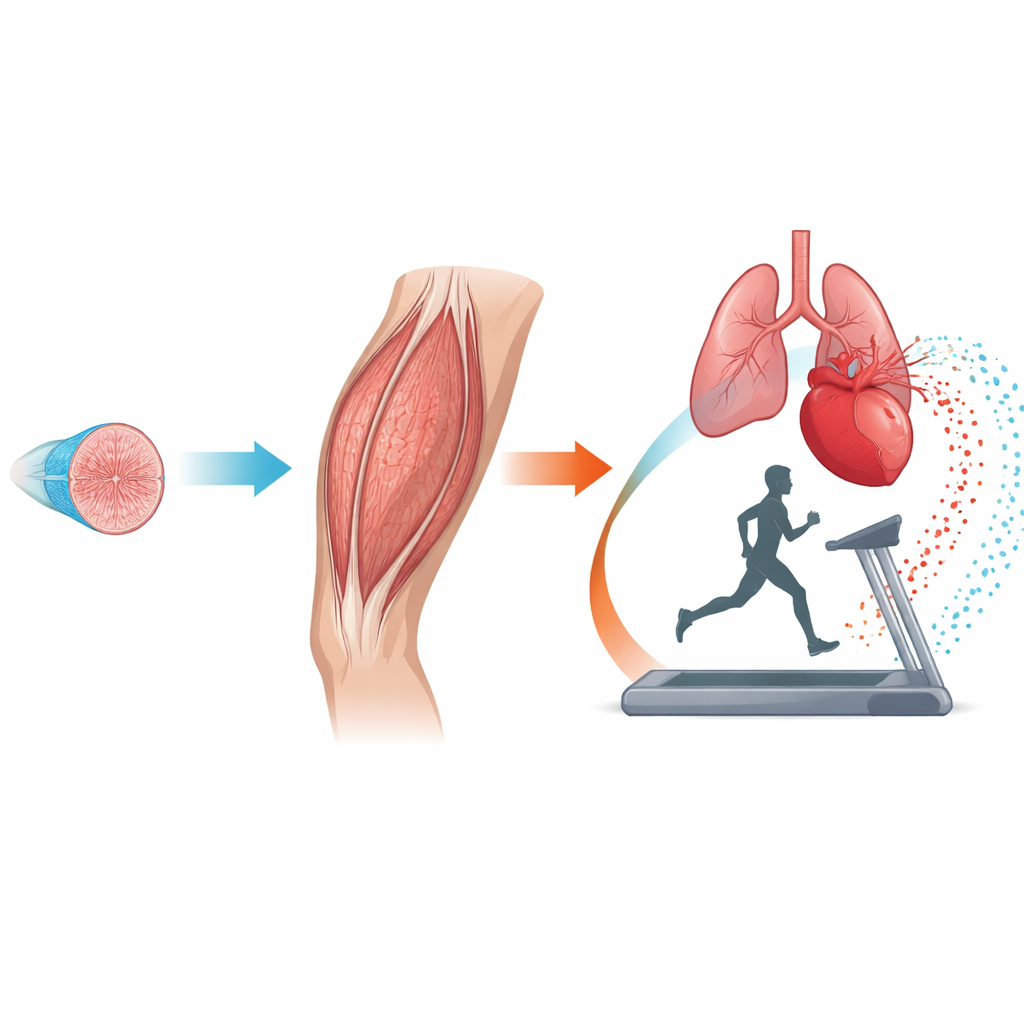
What This Means for Players and Coaches
For everyday readers, the takeaway is straightforward: in these male soccer athletes, bigger is better when it comes to key thigh muscles and endurance-style fitness. A quick ultrasound scan of the front thigh may offer a convenient, radiation-free way to estimate how well an athlete’s heart and lungs will cope with intense exercise, potentially helping tailor training and monitor progress. Still, the study involved only young male soccer players and captured a single point in time, so it does not yet tell us whether building thicker thigh muscles will directly boost fitness, or whether naturally fitter athletes simply grow larger muscles. Future research following athletes over time, including women and competitors from other sports, will be needed to turn this promising association into practical training guidance.
Citation: Komici, K., Parente, A., Di Trolio, R. et al. Associations of thigh muscle thickness with cardiorespiratory fitness and ventilatory efficiency in male soccer athletes. Sci Rep 16, 9115 (2026). https://doi.org/10.1038/s41598-026-38770-7
Keywords: soccer fitness, thigh muscle, ultrasound, aerobic capacity, ventilatory efficiency