Clear Sky Science · en
Somatosensory evoked potentials and high-frequency oscillations after transcranial static magnetic stimulation over the primary somatosensory cortex
Gently Nudging the Brain with a Simple Magnet
Modern neuroscience is exploring ways to change brain activity without surgery or drugs, in hopes of easing pain, improving movement, or sharpening thinking. This study looks at one especially simple approach: placing a strong permanent magnet on the scalp to slightly alter how the brain responds to touch. By tracking tiny electrical signals in volunteers’ brains, the researchers asked a basic but important question: can a quiet, constant magnetic field subtly reshape how touch information travels from the arm to the brain?
Why a Static Magnet on the Head Matters
Transcranial static magnetic field stimulation, or tSMS, uses a powerful neodymium magnet held over the head to influence brain cells. Unlike more familiar brain-stimulation tools that pass electric current through the skull, tSMS is silent, does not tingle, and uses no electricity. Earlier work showed that tSMS can reduce the excitability of the motor cortex, the region that controls movement. That has sparked interest in using it to help people with conditions such as Parkinson’s disease or after a stroke. But it was still unclear whether tSMS changes how the brain processes touch, a function handled largely by the primary somatosensory cortex, a strip of tissue that maps sensations from the body.
Listening In on the Brain’s Response to Touch
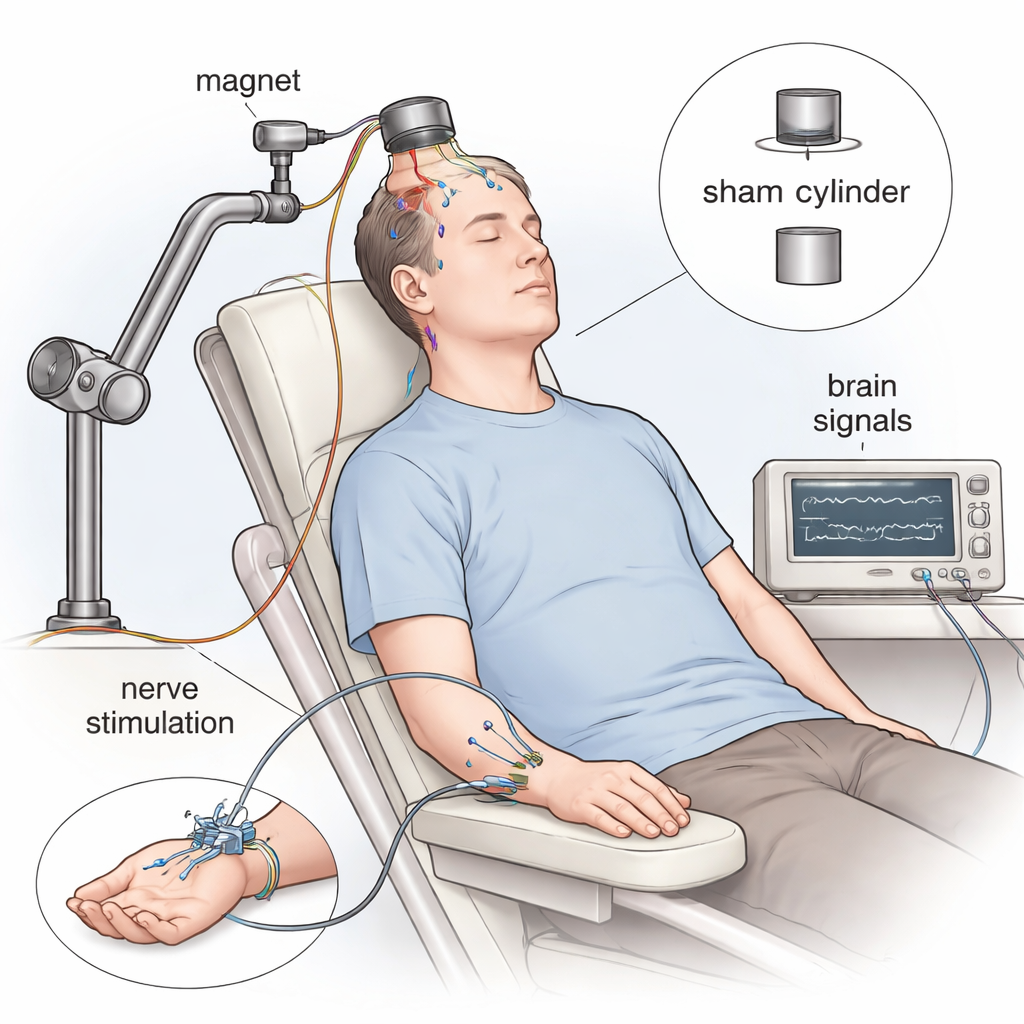
To probe this, the team recruited twenty healthy young adults. Each person took part in two sessions on different days: one with real tSMS and one with sham stimulation using a visually identical but non-magnetic metal cylinder. In both sessions, a device delivered mild electrical pulses to the median nerve at the wrist, a standard way to stimulate the sense of touch in the hand. Sensitive electrodes on the scalp recorded somatosensory evoked potentials—brief waves of electrical activity that ripple through the brain when a touch signal arrives. The researchers focused on well-known features of these waves, called N20 and P25, and also on much faster, tiny ripples riding on top of them known as high-frequency oscillations.
Fast Hidden Ripples Reveal a Selective Effect
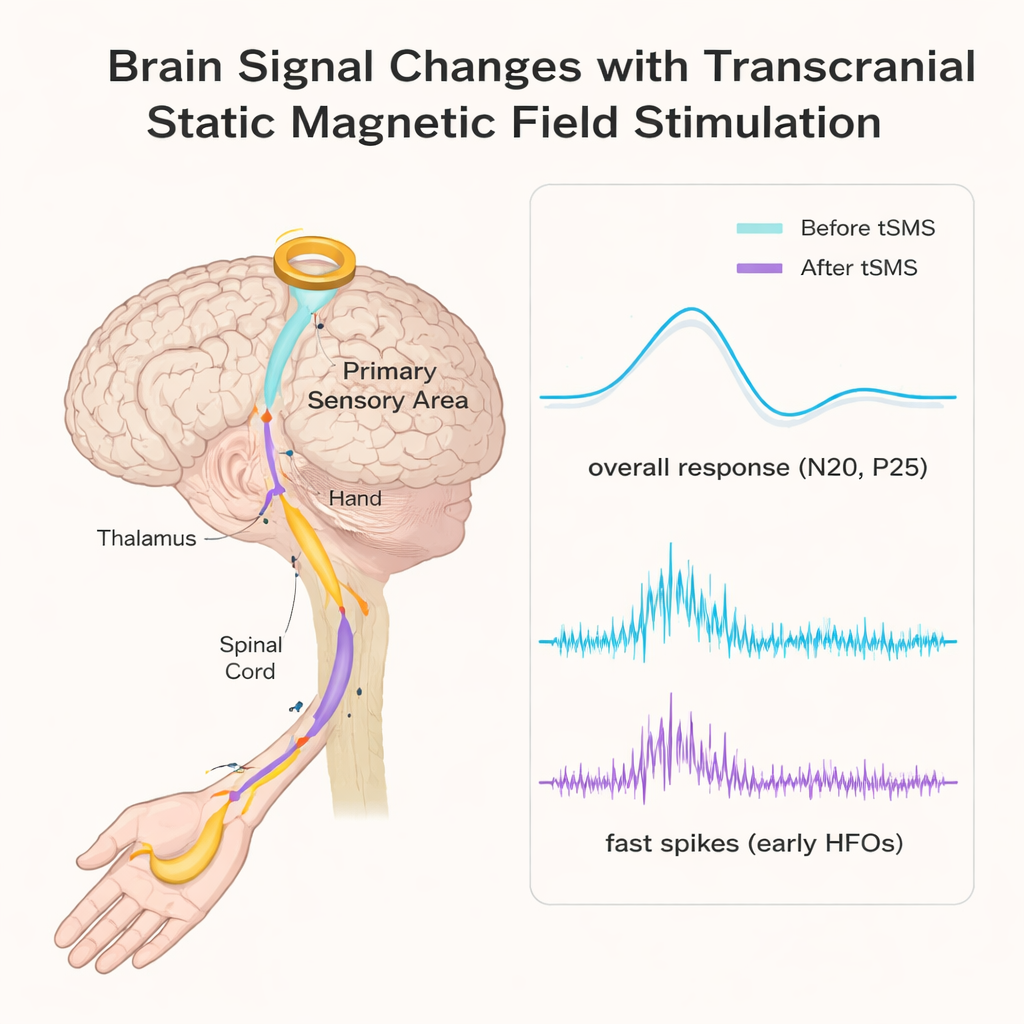
The fast ripples, called somatosensory high-frequency oscillations, were separated into “early” and “late” parts based on when they occurred relative to the N20 peak. Earlier work suggests that the early ripples mainly reflect the incoming volley of signals traveling from deep brain relay stations (the thalamus) into the sensory cortex, while the later ripples are more tied to activity of local inhibitory nerve cells that help fine-tune the signal. The scientists compared brain responses recorded before stimulation, immediately afterward, and 20 minutes later for both the real and sham conditions. Statistical tests showed that after 20 minutes of real tSMS over the sensory cortex, the size of the early fast ripples dropped, while the later ripples and the larger, slower N20 and P25 waves stayed essentially unchanged.
What the Pattern Tells Us About Brain Circuits
This selective change offers a clue about how a static magnet might influence the brain. The fact that only the early fast ripples shrank suggests that tSMS dampens the incoming thalamocortical signals—the first burst of activity arriving from deeper brain areas—rather than strongly altering the local circuits that shape and inhibit that activity. The authors discuss several possible physical mechanisms: static magnetic fields may subtly distort cell membranes, shifting the behavior of ion channels that control the flow of charged particles into and out of nerve cells. Even small shifts in these channels can make it harder for signals to fire in rapid bursts, which fits with the reduction in early high-frequency activity. At the same time, the resilience of the N20 and the later ripples suggests that the basic outline of touch processing in the cortex is preserved.
Implications for Future Gentle Brain Therapies
For non-specialists, the main takeaway is that a simple permanent magnet held over the head can quietly and selectively soften one particular step in the brain’s handling of touch signals—how incoming messages from deeper structures first enter the sensory cortex—without obviously disturbing the broader pattern of cortical activity. This makes early high-frequency ripples a sensitive marker of tSMS effects and hints that future therapies could target specific pathways while leaving others intact. Although this study involved only healthy young adults and one specific stimulation setting, it lays groundwork for exploring tSMS as a gentle tool to fine-tune abnormal sensory processing in neurological disorders.
Citation: Tanaka, Y., Takahashi, A., Ishizaka, R. et al. Somatosensory evoked potentials and high-frequency oscillations after transcranial static magnetic stimulation over the primary somatosensory cortex. Sci Rep 16, 7397 (2026). https://doi.org/10.1038/s41598-026-38767-2
Keywords: brain stimulation, somatosensory cortex, magnetic fields, sensory processing, evoked potentials