Clear Sky Science · en
Miniaturized flexible skin moisture sensor with optimized coil for enhanced wireless power efficiency
Why A Tiny Skin Patch Matters
Staying hydrated is not just about how much water you drink—your skin’s moisture tells a rich story about health, recovery, and disease. This paper presents a coin-sized, battery‑free patch that sticks to the skin and wirelessly tracks moisture levels in real time. By carefully redesigning the patch’s hidden “loop of copper” that harvests power from a nearby reader, the researchers show how to shrink wearable health sensors without sacrificing comfort, safety, or reliability.
A Small Patch With Big Ambitions
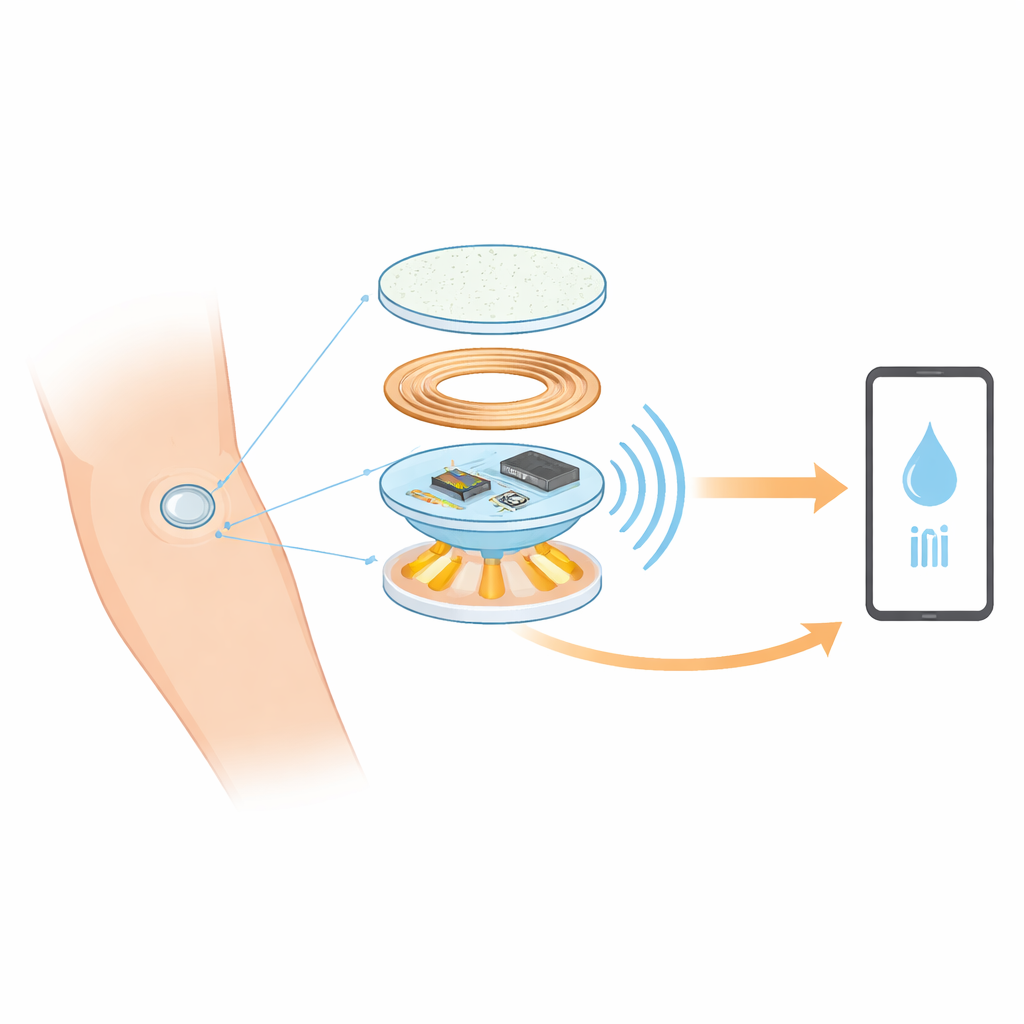
The heart of the work is a thin, flexible moisture sensor about 1.8 centimeters across and roughly 1 millimeter thick. It rests gently on the skin and talks to nearby devices using near‑field communication, the same basic technology that lets phones tap to pay. Instead of a bulky battery, the patch draws energy wirelessly from an external antenna and sends back data about how damp or dry the skin is. Gold electrodes on the underside sit directly on the skin and sense moisture by how it changes the electrical resistance between their comb‑shaped fingers.
Power From Thin Air
Making such a small device work reliably hinges on the performance of its copper loop, or coil, which captures the incoming radio‑frequency energy and handles wireless data. Shrinking this coil usually means weaker signals and shorter range. The team systematically tested different coil diameters—18, 27, and 36 millimeters—and studied how well each received power and stayed tuned to the operating frequency while the patch was bent, twisted, or moved away from the reader. Surprisingly, the smallest 18‑millimeter coil delivered the best balance: it preserved strong magnetic coupling, showed a clean resonance signature, and still provided enough power for smooth communication, even when bent to match the curves of a wrist.
Built To Bend, Breathe, And Get Wet
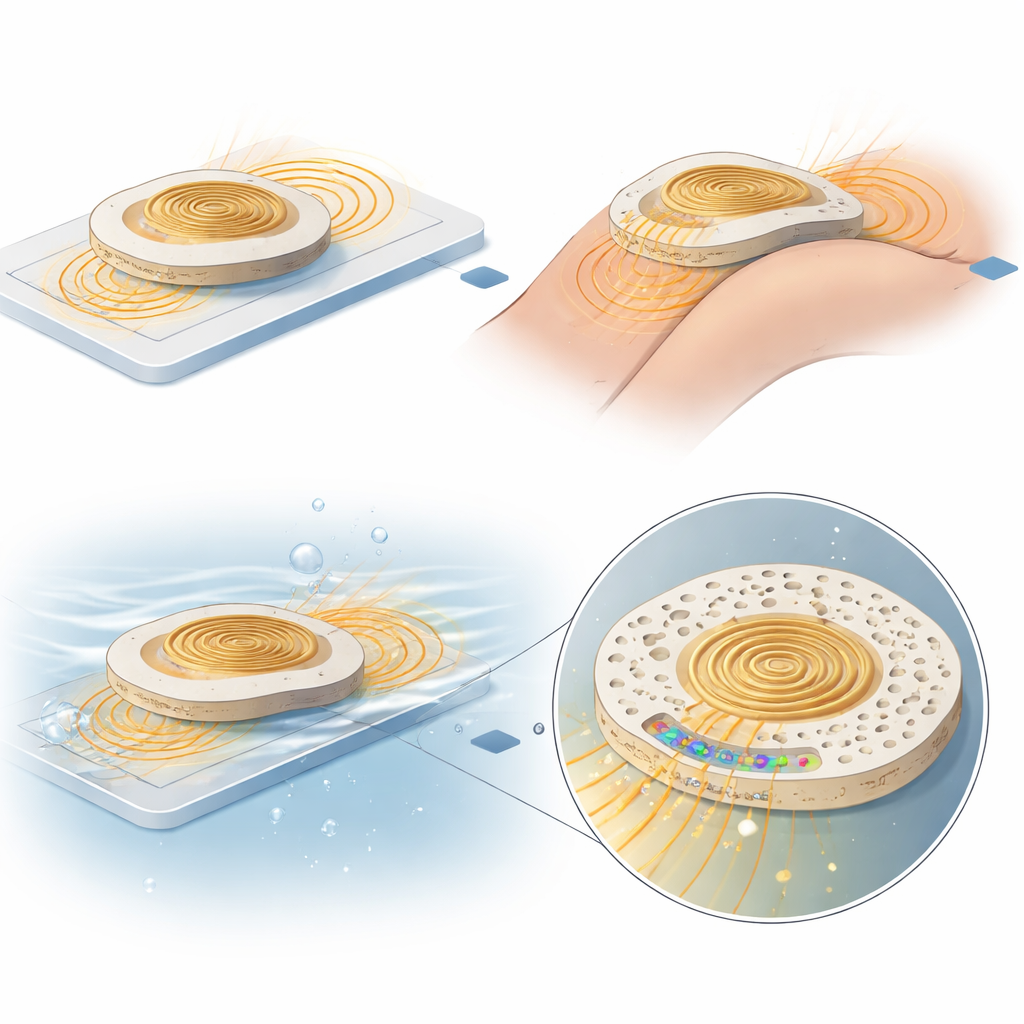
Comfort and durability are just as important as electronics. To make the patch feel natural on the body, the researchers encased it in a soft silicone material called PDMS and then engineered this layer to be full of microscopic pores. These pores are created by mixing water and alcohol into the liquid silicone; as the mixture cures and the droplets evaporate, tiny holes are left behind. Detailed imaging and mechanical tests showed that the porous films are more flexible, stretch and twist more easily, and let roughly twice as much water vapor pass through as solid silicone. That means the skin can “breathe” under the patch, reducing sweat buildup and irritation, while still keeping the electronics dry and protected—even when the entire device is immersed in water.
Following Skin Moisture In Everyday Life
To see how the system performs in the real world, volunteers wore the patch on their wrist and tapped it with an external antenna to read out data. In controlled tests, tiny droplets placed on the sensing area caused step‑by‑step increases in the signal, and the patch tracked the gradual drying of a droplet over about ten minutes, mimicking natural water loss from skin. Over a week of daily use, readings taken before and after showers consistently showed sharp jumps in moisture right after washing, and the patch kept working despite repeated exposure to water. Additional tests at different temperatures revealed that while the electronics themselves were largely unaffected by environmental changes, the readings rose in hot conditions once the patch touched the skin, in line with increased sweating.
What This Means For Future Wearables
Taken together, the study shows that careful coil design and breathable packaging can make a very small, battery‑free patch that still works reliably on moving, sweating, and even submerged skin. For non‑experts, the key message is that the team has solved a crucial power problem for tiny wearables while keeping them comfortable enough for long‑term use. This approach could pave the way for everyday skin‑mounted devices that quietly monitor hydration, guide recovery after exercise, or support the care of people with chronic conditions—without ever needing to be plugged in or charged.
Citation: Kim, J., Kim, S., Yeo, C. et al. Miniaturized flexible skin moisture sensor with optimized coil for enhanced wireless power efficiency. Sci Rep 16, 8114 (2026). https://doi.org/10.1038/s41598-026-38764-5
Keywords: wearable sensors, skin hydration, wireless power, NFC patch, porous PDMS