Clear Sky Science · en
Analytical evaluations using neural network-based method for wave solutions of combined Kairat-II-X differential equation in fluid mechanics
Why waves and neural networks matter
From ocean swells and plasma bursts to light pulses in optical fibers, many natural and engineered systems are governed by waves that do not behave in a simple, linear way. These "nonlinear" waves can form sharp solitary pulses, repeating patterns, or even complex localized structures that strongly influence energy transport and stability. The paper summarized here explores how a new kind of neural‑network-based mathematical technique can uncover exact wave patterns in a particular nonlinear wave model used in fluid mechanics and related areas.
A special equation for complex waves
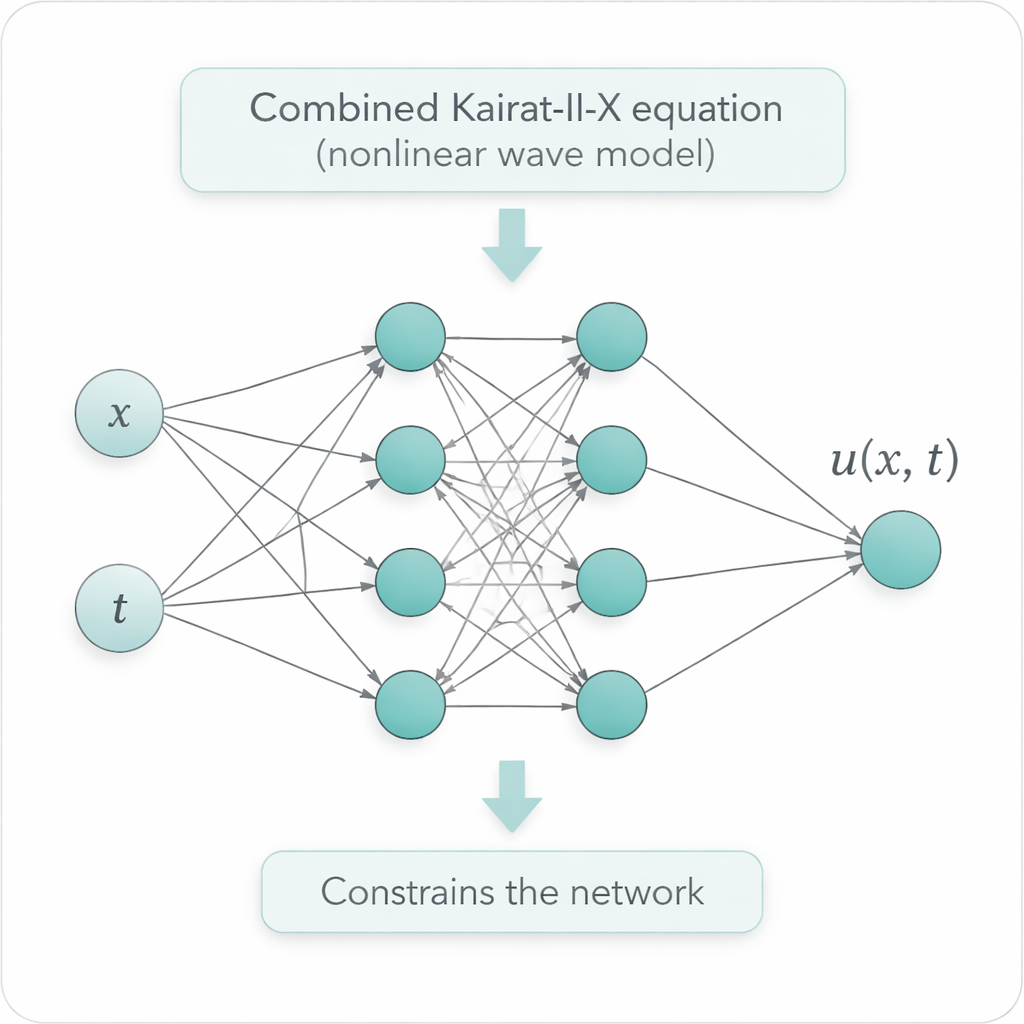
The authors focus on a mathematical model called the combined Kairat‑II‑X equation. This equation merges two earlier wave equations (Kairat‑II and Kairat‑X) into a single framework that captures how certain disturbances move and spread in media such as fluids, plasmas, or nonlinear optical materials. Unlike simple textbook equations, this model includes several competing effects—dispersion, nonlinearity, and geometric constraints—which together can generate a wide variety of wave shapes. Understanding its exact solutions helps researchers predict when a pulse will remain stable, break up, or interact in surprising ways with other waves.
Using neural networks as exact calculators
In conventional machine learning, neural networks are trained on data to approximate unknown functions, and their inner workings remain largely opaque. Here, the authors turn this idea on its head: they design small, carefully structured neural networks whose outputs are written down explicitly as mathematical formulas. Instead of adjusting the network by trial-and-error training, they choose activation functions like hyperbolic tangents, exponentials, sines, cosines, and related functions that are already known building blocks of wave solutions. These network outputs are then substituted directly into the Kairat‑II‑X equation. By demanding that the equation be satisfied exactly, the team derives algebraic conditions on the network’s weights and biases. Solving these conditions yields closed‑form expressions for the waves—exact solutions rather than numerical approximations.
An improved network inspired by new mathematics
To enrich the range of possible waves, the authors introduce an "improved" neural‑network framework inspired by Kolmogorov‑Arnold Networks, a recent development in theory that shows any multivariable function can be built from repeated combinations of single‑variable functions and addition. In practice, this means that instead of simple, fixed activation functions at each neuron, they allow more intricate combinations and compositions of functions along the network connections. This added flexibility lets them capture more exotic wave shapes with fewer parameters. The result is a symbolic computation method that blends classical mathematical analysis with modern neural‑network structures, all implemented in the Maple computer algebra system.
A zoo of wave patterns
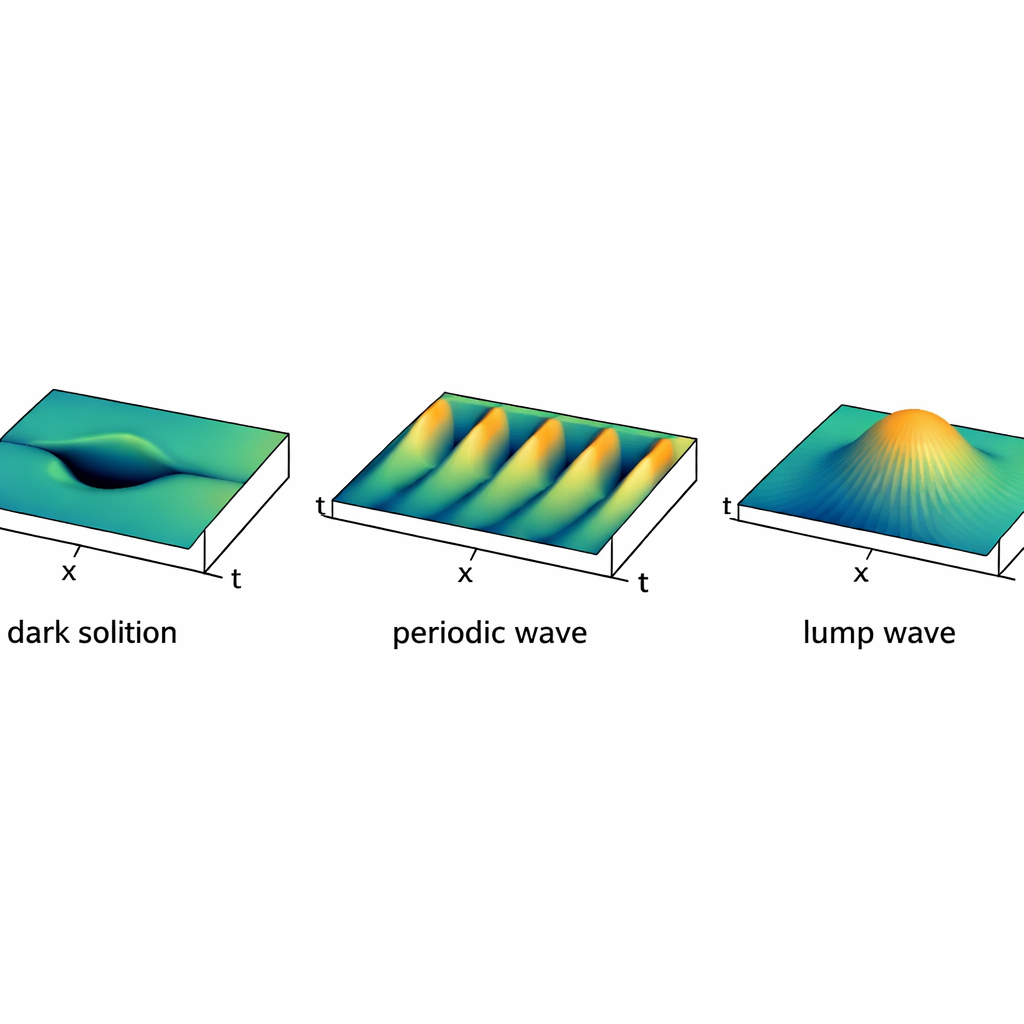
Applying these basic and improved neural‑network constructions, the authors obtain a large family of exact solutions to the combined Kairat‑II‑X equation. These include dark solitons (localized dips in an otherwise uniform background), singular solitons (waves with very sharp or diverging peaks), periodic waves, and hybrids such as "breather" waves that oscillate in both space and time. They also find lump solutions—isolated, hill‑like structures—and mixed forms where lumps coexist with periodic backgrounds or solitary pulses. By choosing different parameter values in the equation and in the network, they can tune how fast these structures travel, how wide they are, and how they interact. The paper illustrates these behaviors through a series of three‑dimensional surfaces, contour maps, and density plots that track how the waves evolve in space and time.
What this means for real systems
Although the work is highly mathematical, its implications are practical. Many advanced models in fluid dynamics, plasma physics, and nonlinear optics share features with the Kairat‑II‑X equation and are notoriously difficult to solve. The authors show that neural networks, used not as black‑box predictors but as structured symbolic tools, can systematically generate new exact wave solutions. These solutions clarify how energy and momentum move through nonlinear media and how different kinds of wave patterns can emerge or interact. In simple terms, the study provides a new recipe for using neural‑network ideas to crack hard wave equations, opening avenues to analyze and control complex wave phenomena in engineering and physics.
Citation: Zhou, P., Manafian, J., Lakestani, M. et al. Analytical evaluations using neural network-based method for wave solutions of combined Kairat-II-X differential equation in fluid mechanics. Sci Rep 16, 7753 (2026). https://doi.org/10.1038/s41598-026-38761-8
Keywords: nonlinear waves, neural networks, solitons, fluid mechanics, mathematical physics