Clear Sky Science · en
Experimental study and engineering application of bolt support based on large-scale sliding coal bump in coal body
Holding Back the Underground
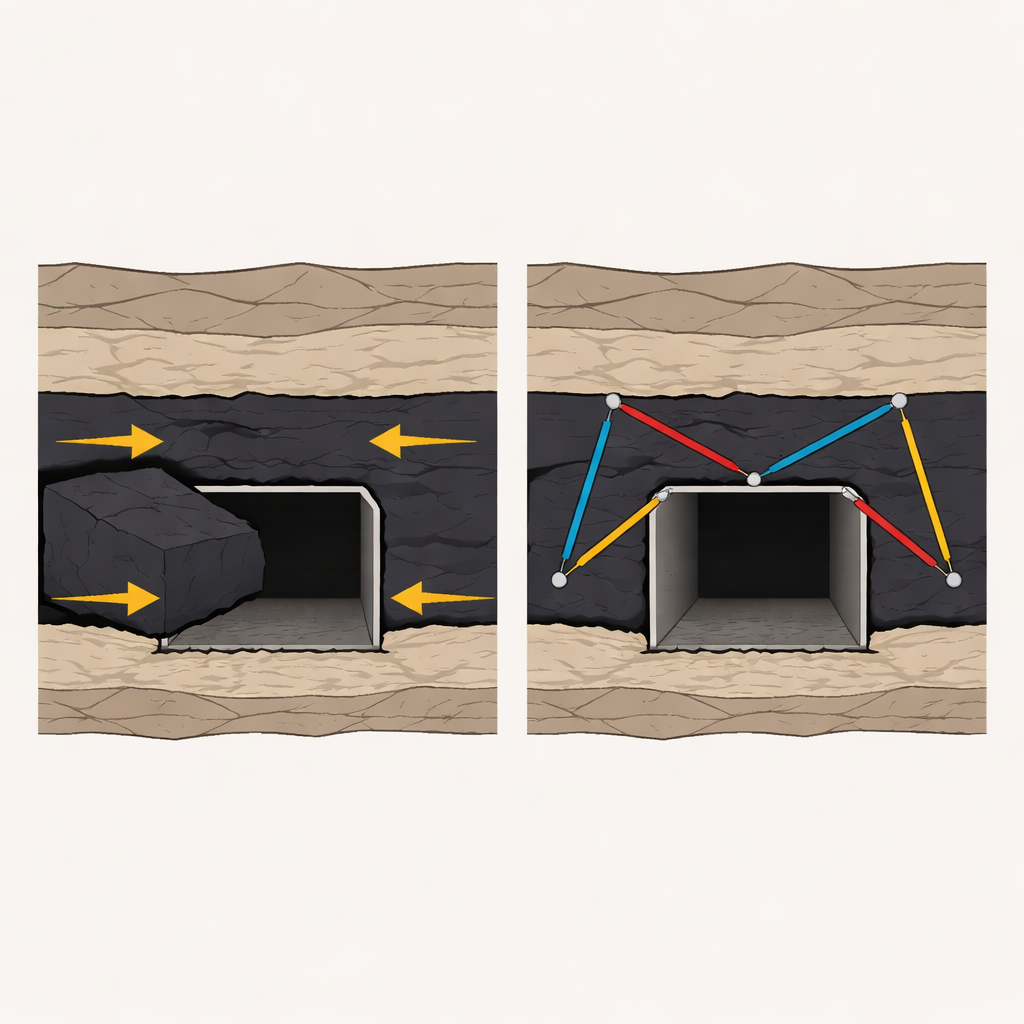
Deep underground, coal mines are not quiet, stable places. Layers of rock squeeze and shift, and sometimes the coal wall beside a tunnel suddenly surges inward in a dangerous jolt known as a coal bump. This study looks at a particular kind of event where a big slab of coal slides into the tunnel while the roof and floor stay almost untouched. The authors show that the way metal bolts are installed in the coal wall—especially their angle and thickness—can make the difference between a violent collapse and a stable roadway, and they test a new support design in a real mine.
When Coal Slides Like a Rug
In the type of accident examined here, the entire coal wall next to the tunnel can suddenly rush forward, blocking the passage without crushing the roof or floor. The bolts and mesh that were installed in the coal may even look largely undamaged. The problem lies at the hidden contact surface between the coal and the surrounding rock: when stress builds up and is suddenly released, the coal can slide along this smooth plane, much like a carpet slipping on a polished floor. To keep miners safe, the support system needs to strengthen this contact surface and soak up some of the released energy instead of simply trying to pin the coal in place.
Testing Bolts in the Lab
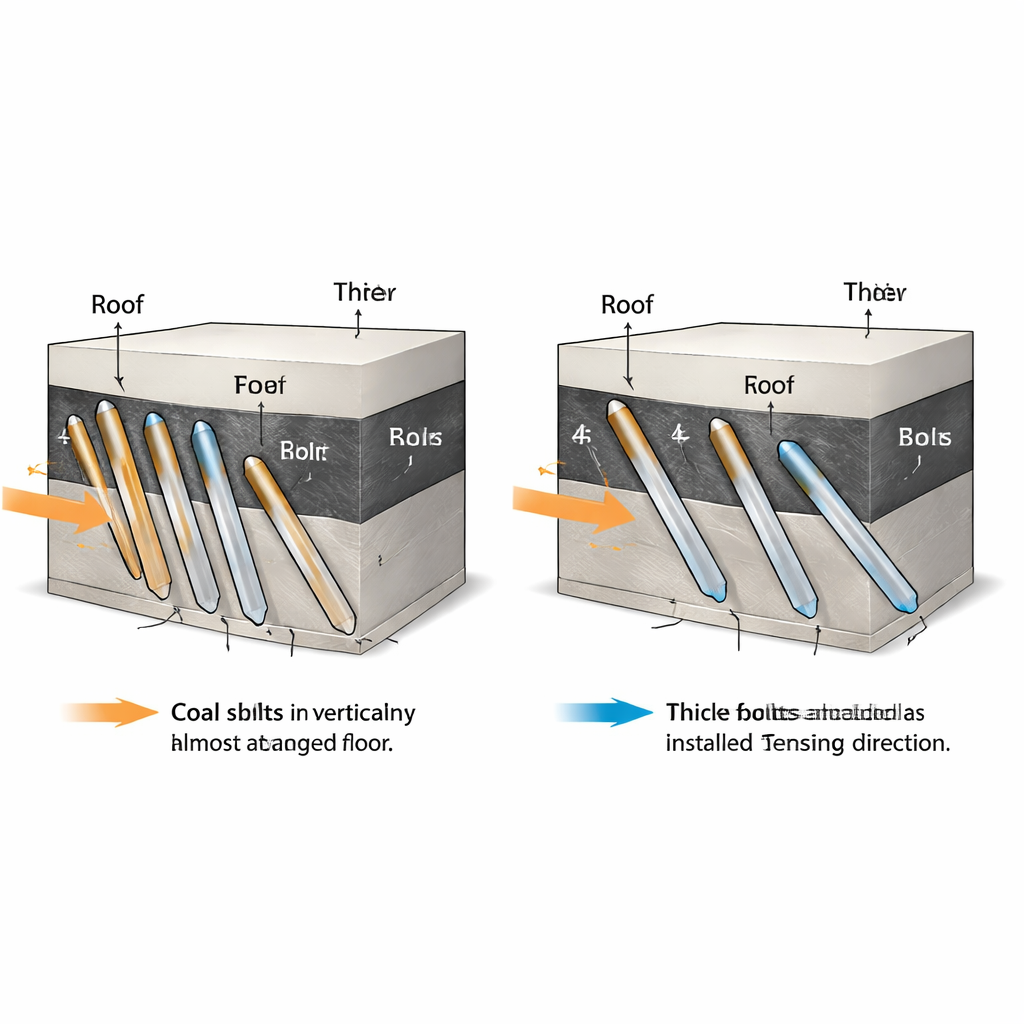
To understand how bolt design can better resist this sliding, the researchers built a steel mold that mimics two blocks of rock with a gap between them standing in for the coal–rock interface. They used metal rods made from two alloys to represent bolts, in three different thicknesses, and ran controlled pulling tests. The rods were installed at four angles relative to the sliding direction: 30°, 45°, 60°, and straight across at 90°. By pulling the mold halves apart in a testing machine, they could watch how the rods failed and measure how much force and energy each setup could withstand before breaking.
Why Angle and Thickness Matter
The experiments revealed a clear pattern. When the rods were set at 30° or 45° to the sliding direction, they tended to stretch and finally snap in tension, much like a wire being pulled until it breaks. In this case, the rods carried higher loads and absorbed more energy before failing. At steeper angles of 60° and 90°, the rods tended to be cut across by sliding, a shear-type failure that required less force and stored less energy. Across all angles, thicker rods consistently carried more load and soaked up more energy than thinner ones. Among all the tested configurations, rods placed at about 45° provided the best overall performance, combining a favorable failure mode with high strength and energy absorption.
From Model to Mine
The team then applied these insights to the 7305 working face in the Kongzhuang Coal Mine in China, a deep operation with strong ground stresses and a known risk of coal bumps. The return airway—a key tunnel for ventilation and access—was originally supported with a standard pattern of roof bolts, side bolts, cables, and steel mesh. Drawing on their tests, the engineers redesigned the bolt layout so that many of the bolts intersected the coal–rock contact plane at angles no greater than 45°, and their anchoring sections reached solid roof or floor rock. This created a three-dimensional cage around the coal wall, increasing friction along the sliding plane, spreading out concentrated stresses, and providing a built-in way for the bolts to stretch and absorb energy during a jolt rather than snapping in a brittle fashion.
Safer Roads Underground
Field use of the new support scheme significantly reduced large coal slides into the tunnel and improved the stability of the roadway, all without adding exotic new devices or major cost. For non-specialists, the main message is straightforward: by carefully choosing how thick the bolts are and, more importantly, at what angle they cross the likely sliding surface, mine engineers can turn a rigid, failure-prone support system into one that behaves more like a shock absorber. While the approach still needs to be tested for other types of coal bumps, it offers a practical path toward safer, more reliable underground roadways in deep coal mines.
Citation: Wang, C., Ma, S. Experimental study and engineering application of bolt support based on large-scale sliding coal bump in coal body. Sci Rep 16, 9766 (2026). https://doi.org/10.1038/s41598-026-38743-w
Keywords: coal bump, rock bolts, underground roadway support, mine safety, energy-absorbing support