Clear Sky Science · en
Edge machine learning over IoT for chipless RFID environmental sensing in smart agriculture
Farming Without Batteries
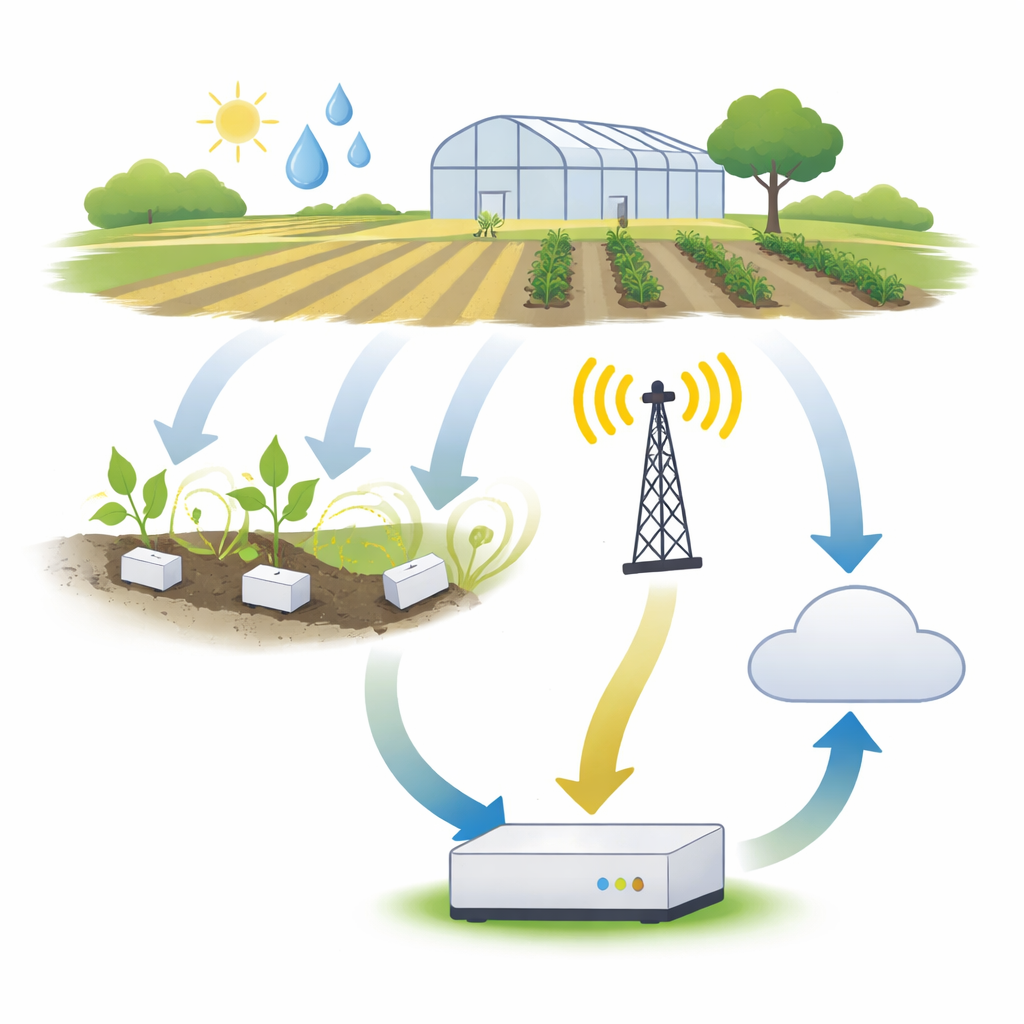
Modern farms increasingly depend on data: how hot it is between crop rows, how humid it is inside a greenhouse, and when soil or air conditions might stress plants. But covering large fields with battery-powered sensors is expensive and requires constant maintenance. This paper explores a different path—tiny, battery-free radio tags that can both identify locations in the field and sense temperature and humidity, with smart algorithms at the farm’s edge turning raw radio echoes into useful advice for growers.
Tiny Tags That Talk Back
Instead of using silicon chips and batteries, the authors design “chipless” tags made from patterned metal shapes on a plastic-like board. When a nearby reader sends out a radio signal, each tag reflects a small part of that energy back. Because of its pattern of T-shaped resonators, a tag imprints a unique series of dips at specific radio frequencies into the reflected signal. These dips act like a barcode in the air, allowing a reader to recognize which tag it is looking at and where in the farm that tag has been placed.
Turning Weather Into Radio Fingerprints
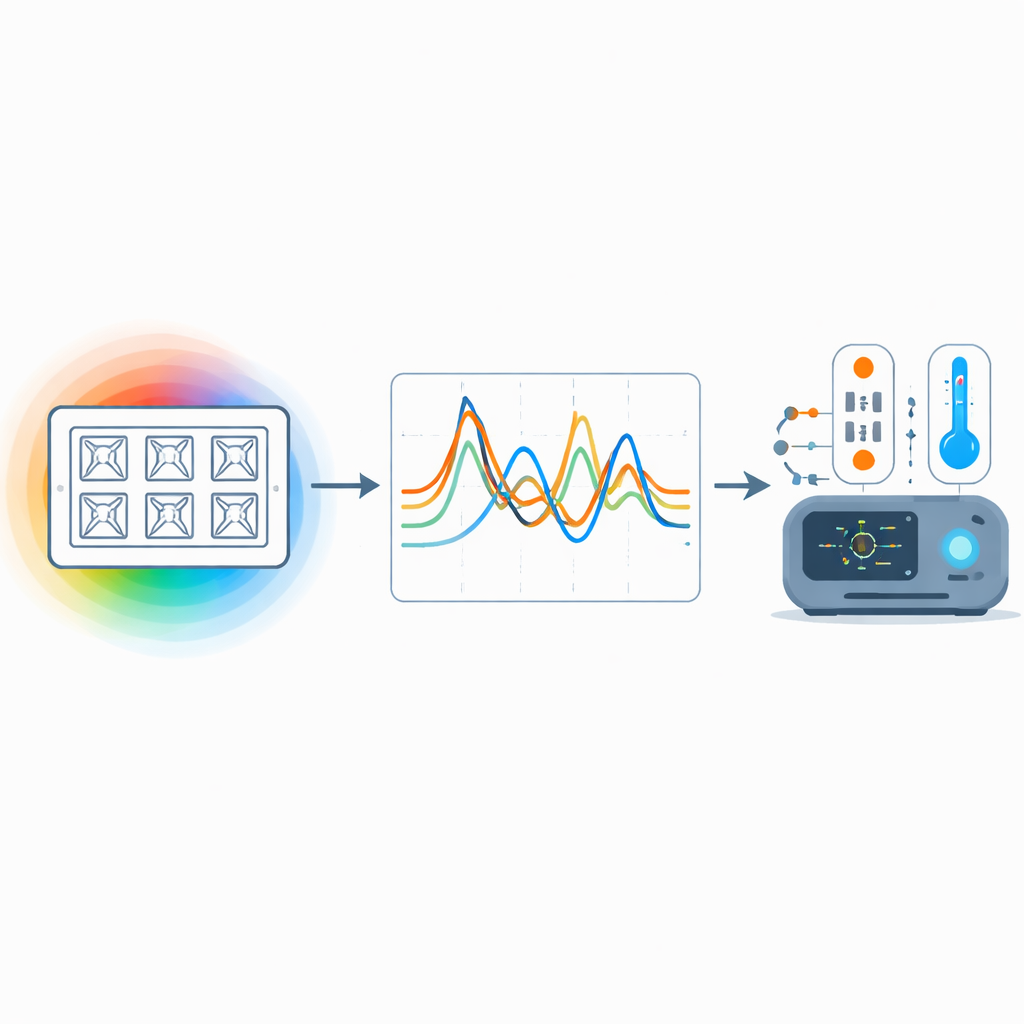
The same patterned tags are then adapted to sense the local microclimate. For temperature, the resonators are built on a material whose electrical properties shift slightly as it warms or cools. For humidity, one resonator is coated with a thin film that soaks up water from the air. As temperature or humidity changes, the frequencies of specific dips in the reflected signal slide upward or downward by measurable amounts. By reserving enough space between these frequency slots, the design avoids overlaps, so the tag can report both its identity and the surrounding conditions at the same time, all without any onboard power source.
Smart Decoding at the Farm’s Edge
The radio echoes from these tags are not measured in pristine laboratory air but in the messy real world, where other wireless systems, reflections from structures, and changing distances can distort signals. To handle this, the authors do not feed raw radio spectra into heavy, opaque neural networks. Instead, they first extract a small set of physically meaningful features: where each dip sits in frequency, how deep it is, and how sharp it appears, along with how quickly it shifts as the environment changes. These features are sent to lightweight machine-learning models running on a nearby gateway device, which sits between the field readers and the cloud. Using ensembles of decision trees and support vector methods, the system learns to map those features to temperature and humidity, and to spot unusual or faulty readings.
Reliable Readings With Minimal Energy
Tests using detailed simulations and carefully controlled measurements show that the approach is both precise and robust. A 24-resonator tag can reliably encode many bits of identification data, while a 12-resonator sensor version tracks temperature within about one degree Celsius and relative humidity within a few percentage points, even when the radio signal is artificially distorted. An added anomaly detector helps flag strange patterns that might indicate interference, damaged tags, or unexpected field conditions. Because the heavy number crunching happens at the gateway, the tags themselves remain simple and energy-autonomous, and only compact summaries—not bulky raw data—need to be forwarded to cloud services or farm management software.
Toward Self-Aware, Low-Maintenance Fields
In plain terms, the work shows how a farmer could blanket a greenhouse or field with inexpensive stickers that never need charging, yet still provide both location and microclimate information. Nearby readers and small computing boxes translate subtle shifts in radio reflections into trustworthy temperature and humidity maps, which larger systems can then use to schedule irrigation, ventilation, or disease-prevention actions. By uniting clever tag design, responsive materials, and interpretable machine learning at the network edge, this framework points toward smart agriculture that is both highly instrumented and practically maintenance-free.
Citation: Mekki, K., Ghezaiel, N., Slimene, M.B. et al. Edge machine learning over IoT for chipless RFID environmental sensing in smart agriculture. Sci Rep 16, 9512 (2026). https://doi.org/10.1038/s41598-026-38742-x
Keywords: smart agriculture, chipless RFID sensing, edge machine learning, environmental monitoring, battery-free IoT