Clear Sky Science · en
Coumarin-1,2,4-Triazole hybrids as potential agents against Brassicogethes aeneus (Fabricius 1775)
Why protecting crops and bees matters
Farmers rely on oilseed rape—a bright yellow-flowering crop used for cooking oil, animal feed and biodiesel—but it is under constant attack from the pollen beetle. Traditional insecticides are losing their punch as beetles evolve resistance, and some chemicals can also harm honey bees, which are vital pollinators. This study explores a new group of lab-made molecules that aim to kill the beetles quickly while keeping honey bees safe, pointing toward insect controls that work with, rather than against, the environment.
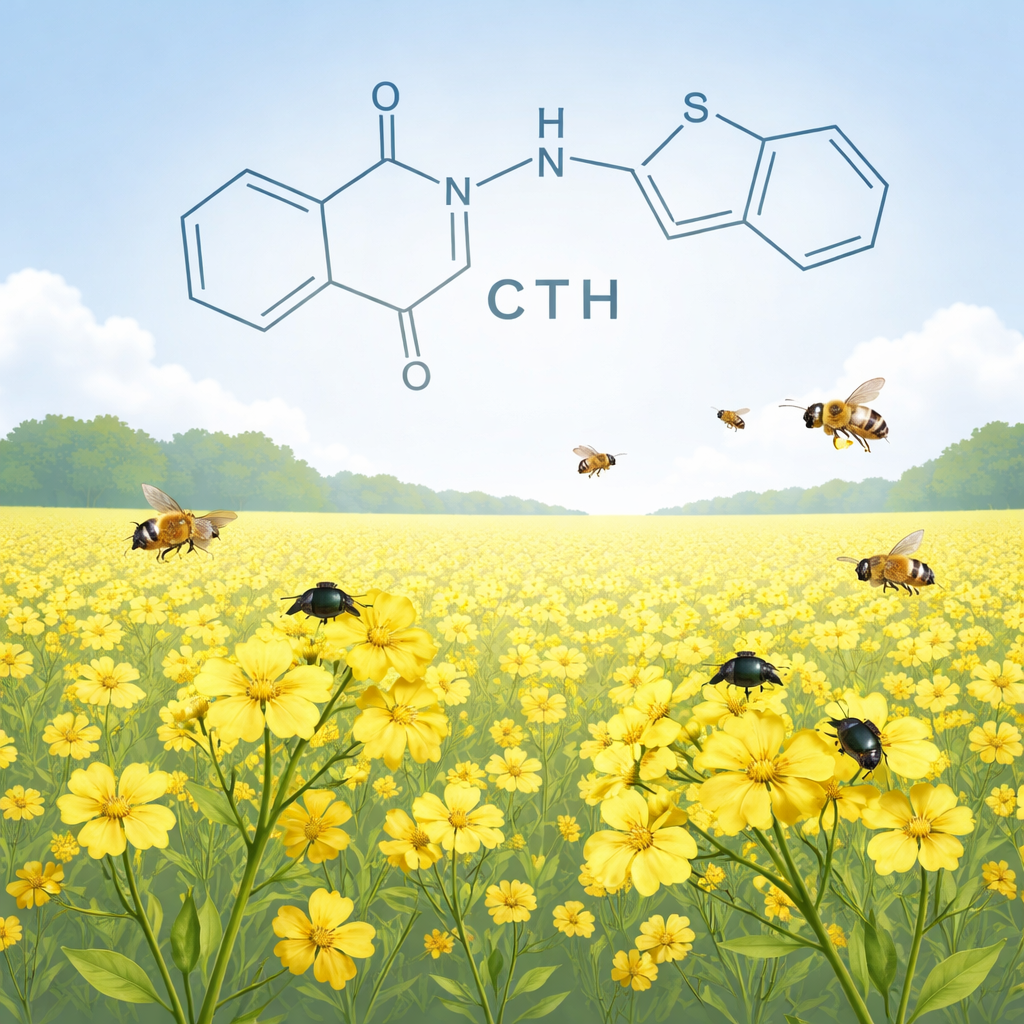
A troublesome beetle in a global food chain
The pollen beetle Brassicogethes aeneus feeds on the flower buds of oilseed rape, destroying blossoms before they can set seed. That damage reduces yields in Europe and North America and deepens Europe’s dependence on imported oil and protein feeds for livestock. At the same time, many widely used insecticides face tight restrictions in the European Union because of environmental and pollinator risks, and pollen beetles have already evolved resistance to key products such as certain pyrethroids. This double pressure—rising resistance and stricter regulation—has created an urgent need for new active ingredients that are both effective and safer for beneficial insects.
Designing greener, smarter test chemicals
The researchers focused on coumarin-1,2,4-triazole hybrids (CTHs), compounds that join two well-known bioactive building blocks into a single molecule. They synthesized 33 different CTHs using a one-step, “green chemistry” method in a recyclable, low-toxicity solvent, avoiding harsh reagents and wasteful by-products. Each hybrid shared the same basic scaffold but carried slightly different small chemical groups, allowing the team to see how subtle tweaks changed performance. These compounds had already shown promise against plant-damaging fungi, raising hopes that some might also work as insecticides suitable for plant protection products.
Putting beetles and bees to the test
To measure beetle control, adult pollen beetles collected from Croatian oilseed rape fields were placed in glass vials coated with a thin film of each CTH. The most striking results came within the first 24 hours: one compound with no extra group at a key nitrogen position (named 2o), and another bearing a benzyl group (2c), both killed 100% of beetles as fast as a neem oil standard. Several others with small, water-repelling (hydrophobic) groups—such as fluorophenyl and p-tolyl—also acted strongly and quickly. By 72 hours, all tested CTHs reached complete mortality, but these early standouts showed special promise as rapid-acting candidates for managing pollen beetle outbreaks.
Guarding the honey bee
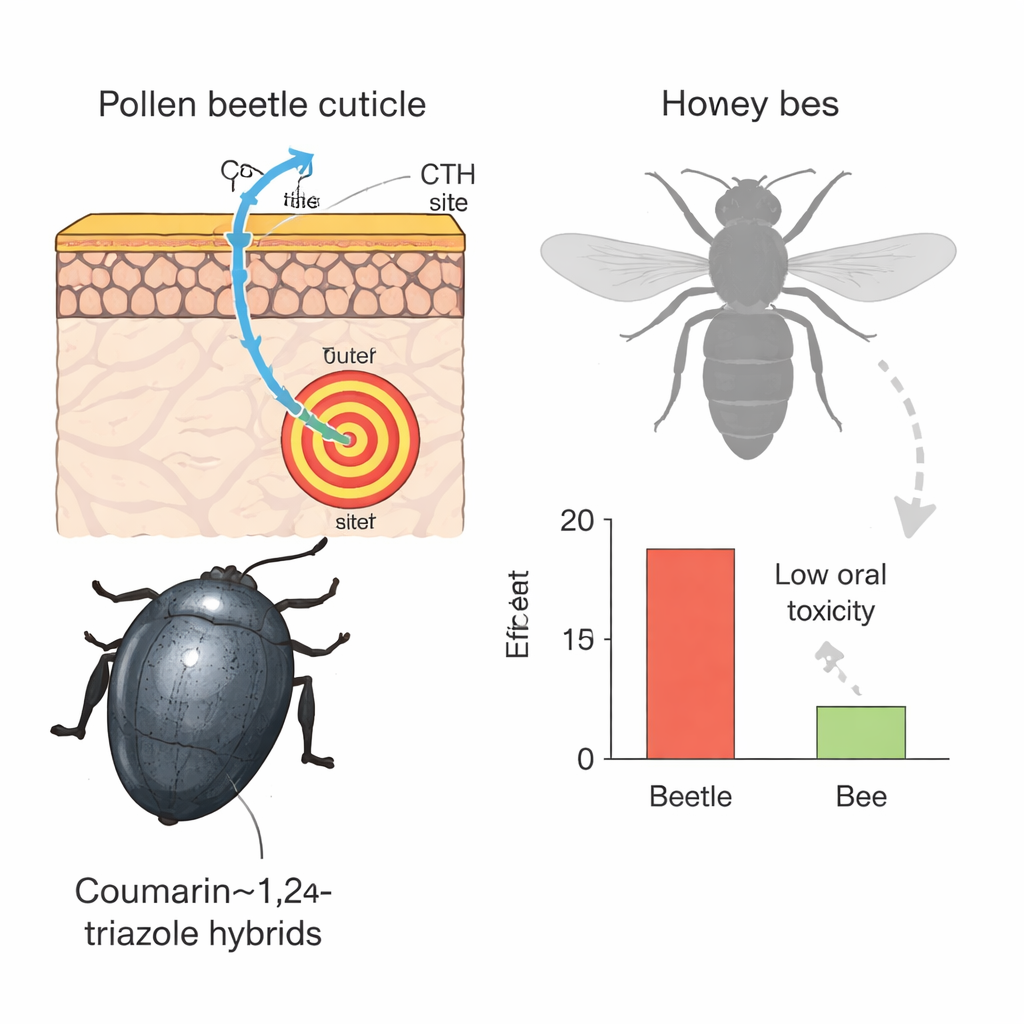
Because honey bees are essential pollinators and already under stress from pesticides, disease and climate extremes, the team evaluated bee safety in two stages. First, they used an artificial-intelligence web tool, BeeToxAI, which predicted that all 33 CTHs would be non-toxic by the standard measure of acute oral exposure, in contrast to the commercial insecticide spinosad, which was flagged as toxic. The scientists then selected ten CTHs, including some of the more active beetle killers, for direct feeding tests on young worker bees in the laboratory. Over the usual 96-hour observation period, none of the compounds caused acute oral toxicity. Only after ten days of continuous exposure did some molecules begin to produce delayed bee deaths, suggesting that any future field use would still need careful long-term risk assessment.
Using data to predict better molecules
Beyond simple testing, the researchers built a quantitative structure–activity relationship (QSAR) model—a kind of statistical map linking a molecule’s three-dimensional features to its insect-killing power. By analyzing mathematical descriptors of size, shape and how atoms are arranged, they found that higher lipophilicity (a tendency to mix with fats) at specific sites on the triazole ring improves how well CTHs penetrate the beetle’s waxy outer shell and reach their biological targets. Compounds with small hydrophobic groups, such as benzyl or fluorinated rings, were especially effective, while those with bulkier atoms like bromine often acted more slowly. The refined model met strict validation criteria, meaning it can be used to design yet-untested CTHs that are likely to be even more potent against beetles while preserving favorable safety profiles.
What this means for future pest control
In everyday terms, this work shows that it is possible to craft new insecticides that hit pests hard but spare bees—at least in the short term. Several of the coumarin-1,2,4-triazole hybrids killed pollen beetles as effectively as current products yet showed no immediate harm to honey bees in oral tests. The modeling work explains why these molecules work so well and offers a blueprint for improving them. Before any real-world use, scientists must still study long-term bee effects and confirm precisely how these compounds disrupt insect nerve function. Nonetheless, the study points toward a new generation of crop protection tools that combine strong beetle control, greener synthesis and a more balanced relationship with the pollinators our food systems depend on.
Citation: Šubarić, D., Rastija, V., Molnar, M. et al. Coumarin-1,2,4-Triazole hybrids as potential agents against Brassicogethes aeneus (Fabricius 1775). Sci Rep 16, 7283 (2026). https://doi.org/10.1038/s41598-026-38738-7
Keywords: pollen beetle control, bee-safe insecticides, oilseed rape pests, coumarin triazole compounds, environmentally friendly crop protection