Clear Sky Science · en
Prediction of spallation induced transmutation rates for long-lived fission products via proton accelerator
Turning Problem Waste into Something Safer
Nuclear power plants generate electricity without releasing carbon dioxide, but they also produce a small amount of waste that remains radioactive for incredibly long periods of time. A handful of these long‑lived ingredients dominate the long‑term hazard and make it hard to convince the public that nuclear power can be clean for future generations. This paper explores a high‑tech idea: using a powerful particle accelerator to bombard a metal target, creating a flood of neutrons that can "reshuffle" the atoms in this waste into forms that decay much more quickly, easing the burden on future storage sites.
Why a Few Atoms Cause Most of the Trouble
Not all nuclear waste is equal. The authors focus on six specific "long‑lived fission products" that stay radioactive for hundreds of thousands to millions of years and dominate the residual toxicity after other materials are recycled. These are particular forms of selenium, zirconium, technetium, tin, iodine, and cesium. Because they primarily emit invisible beta radiation and remain dangerous for so long, they drive demand for extremely secure repositories. If even a fraction of these atoms could be converted into safer, shorter‑lived forms, the overall time and complexity of waste storage could be dramatically reduced.
Using a Proton Hammer to Make Helpful Neutrons
The proposed approach relies on a process called spallation. A high‑energy beam of protons, traveling at nearly the speed of light, is fired into a very dense metal target such as lead or depleted uranium. When each proton strikes a heavy nucleus, it triggers a violent internal cascade that ejects a spray of neutrons. These neutrons are far more numerous and energetic than those typically released in a reactor. By surrounding the target with rods containing the long‑lived waste and threading the spaces with heavy water and a beryllium reflector, the system turns the accelerator into a custom neutron "forge." The neutrons slow down as they scatter in the moderator, and depending on their energy, they can be captured by the waste atoms, transforming them into new, often much less troublesome, isotopes. 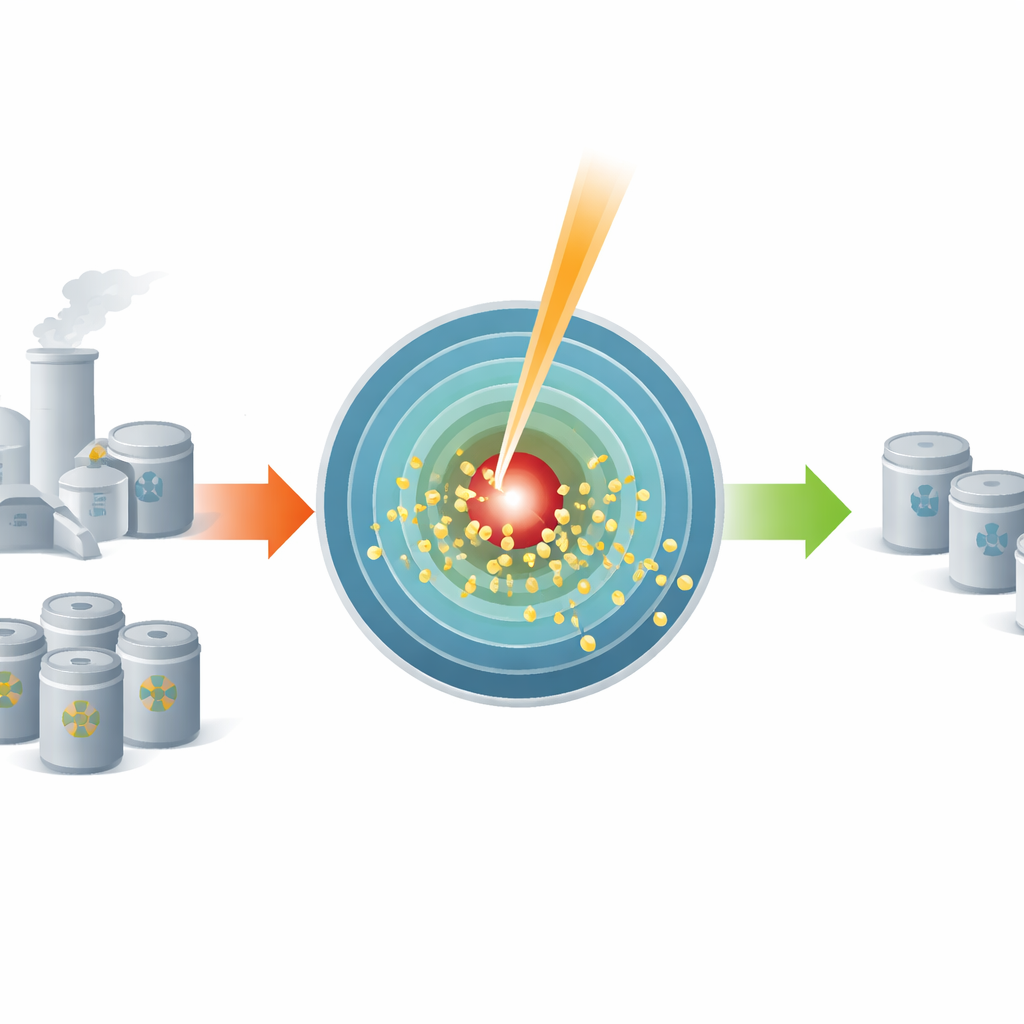
Finding the Best Target and Layout
To test how well this concept works, the team used detailed computer simulations that track individual particles and nuclear reactions. One set of calculations examined different spallation target metals. Depleted uranium produced roughly twice as many neutrons per incoming proton as lead, boosting the transmutation rates of all six waste types by about 10–25%. However, that extra performance comes with trade‑offs: uranium itself undergoes fission in the beam, generating additional heat, new waste, and a steady trickle of the very long‑lived products the system is trying to remove. The researchers also studied how to place the various waste rods around the target. Because the neutron energy changes with distance, some isotopes perform better close to the target in a "hotter" spectrum, while others benefit from cooler, more thermalized neutrons farther out.
Which Waste Atoms Are Worth the Effort?
The simulations reveal a varied landscape of behavior. Technetium, iodine, and selenium respond very well to this treatment, seeing large fractions of their mass converted over five years of continuous irradiation. Tin is more stubborn but still gains from being placed in regions where neutrons have slowed down. Zirconium, by contrast, is almost transparent to neutrons: even with careful tuning of the spectrum, it burns away slowly and would be expensive to treat. Cesium turns out to be tricky for another reason—its more common cousins soak up neutrons first, so the problematic form actually increases for several years before net reduction begins. When all six are packed into a single tank, the "easy" nuclides still transmute efficiently, but the demanding pair, cesium and zirconium, drag down overall performance and drastically raise the cost per kilogram treated. 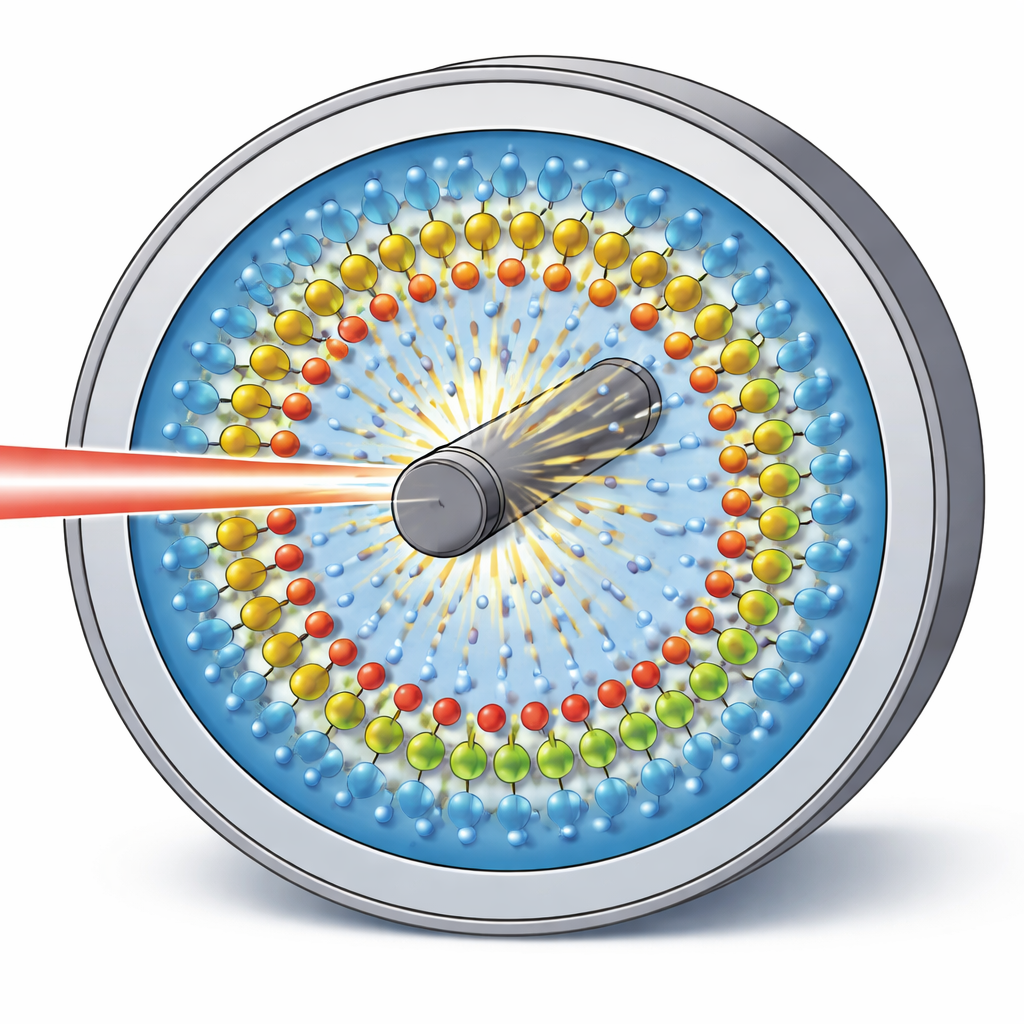
The Balance Between Physics and Price
Running a 1‑gigaelectron‑volt accelerator at the needed intensity is not cheap. In the scenario studied, powering the accelerator would divert around 100 megawatts of electricity from a typical large reactor on the same site, representing roughly a tenth of its output and tens of millions of dollars in annual lost revenue. When these energy costs are spread over the simulated transmutation rates, technetium emerges as the most economically attractive target, while cesium and zirconium are prohibitively costly. The authors argue that a realistic strategy might focus on the easier isotopes or treat the harder ones in dedicated systems, rather than mixing everything together.
What This Means for Future Nuclear Waste
In everyday terms, this study shows that it is technically possible to use a powerful particle beam to chip away at some of the longest‑lasting components of nuclear waste, turning them into less worrisome forms. The work also makes clear that not all waste responds equally: a few isotopes are promising candidates for accelerator‑driven clean‑up, while others remain stubborn or too expensive to treat this way. By mapping out these trade‑offs in detail, the authors provide a blueprint for smarter designs that combine physics, engineering, and economics. If future experiments confirm these predictions and accelerator technology becomes more efficient, such systems could significantly shrink the long‑term hazard of nuclear waste, helping nuclear power look more like a truly sustainable energy option.
Citation: Tukharyan, G., Kendrick, W.R., Yu, J. et al. Prediction of spallation induced transmutation rates for long-lived fission products via proton accelerator. Sci Rep 16, 8585 (2026). https://doi.org/10.1038/s41598-026-38736-9
Keywords: nuclear waste, spallation, transmutation, proton accelerator, long-lived fission products