Clear Sky Science · en
A new adaptive federated learning approach for privacy preserving UAV anomaly detection under non-IID distributions
Why safer skies matter
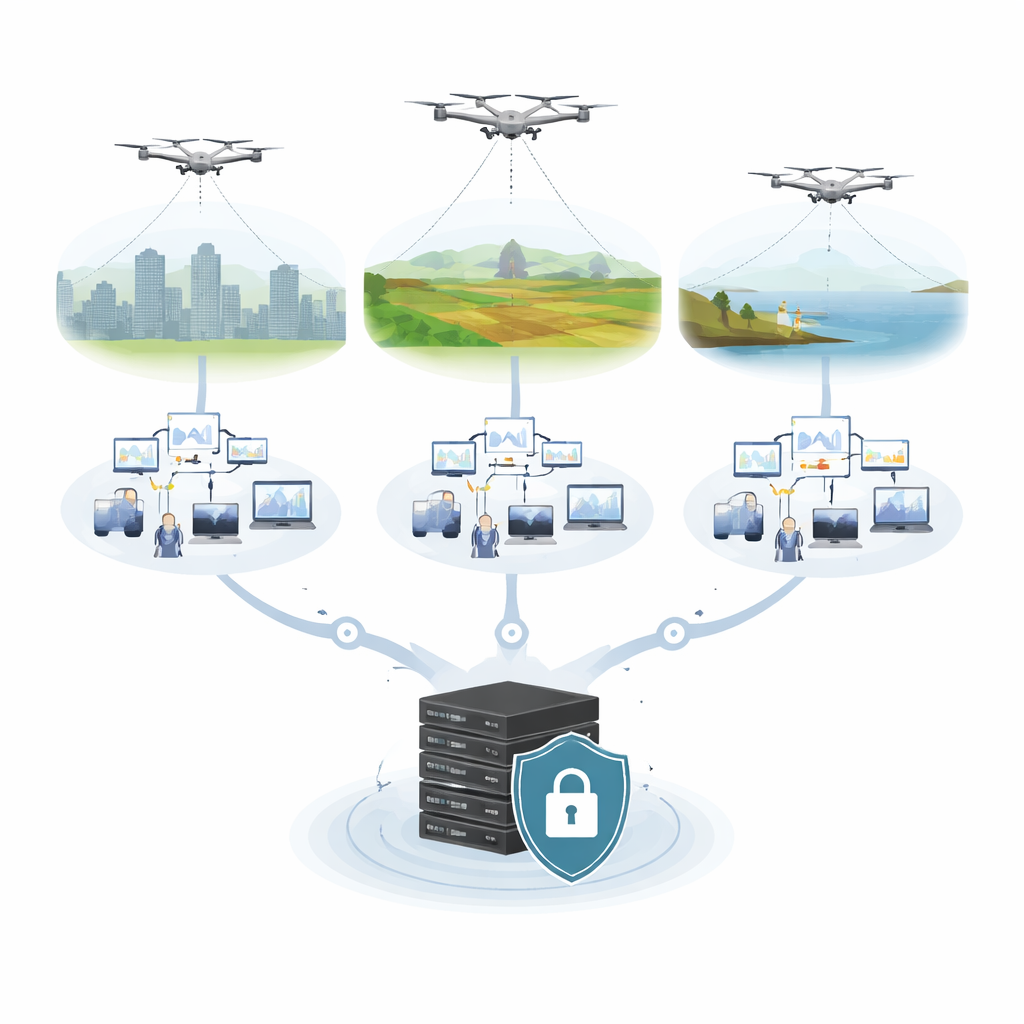
Small unmanned aircraft are rapidly becoming part of everyday life, from package delivery and crop monitoring to disaster response and border security. But as more drones take to the air, their wireless links become tempting targets for hackers. A single compromised drone could expose sensitive video feeds, disrupt emergency operations, or help attackers sneak into critical infrastructure. This study explores how to spot such digital break-ins inside drone networks while keeping the raw flight data private.
The problem with watching from one place
Today, most systems that look for odd or dangerous behavior in network traffic work in a centralized way: all the data streams back to a single server, which trains a machine-learning model to tell normal patterns from suspicious ones. For drones, this is a poor fit. Their flight paths, missions, and wireless conditions differ widely, so each drone generates its own unique data patterns. Piling all of that sensitive information into one place raises privacy risks and can make the model less accurate, especially when each drone’s data looks quite different from the rest. The result can be unstable performance and too many false alarms or missed attacks.
Letting drones learn together, but privately
The authors propose BANCO-FL, a new framework that lets many drones learn a shared security model without ever sending their raw data to a central server. Each drone, or ground station acting on its behalf, trains a small, lightweight neural network locally on its own traffic records, which include millions of examples of both normal connections and attacks such as denial-of-service floods, password guessing, replay attempts, and bogus control messages. Instead of sharing the underlying packets, each participant only sends updated model parameters to a coordinating server. The server combines these updates and sends back an improved global model. This approach, known as federated learning, is designed to preserve privacy and scale to large fleets.
Balancing uneven data across many flyers
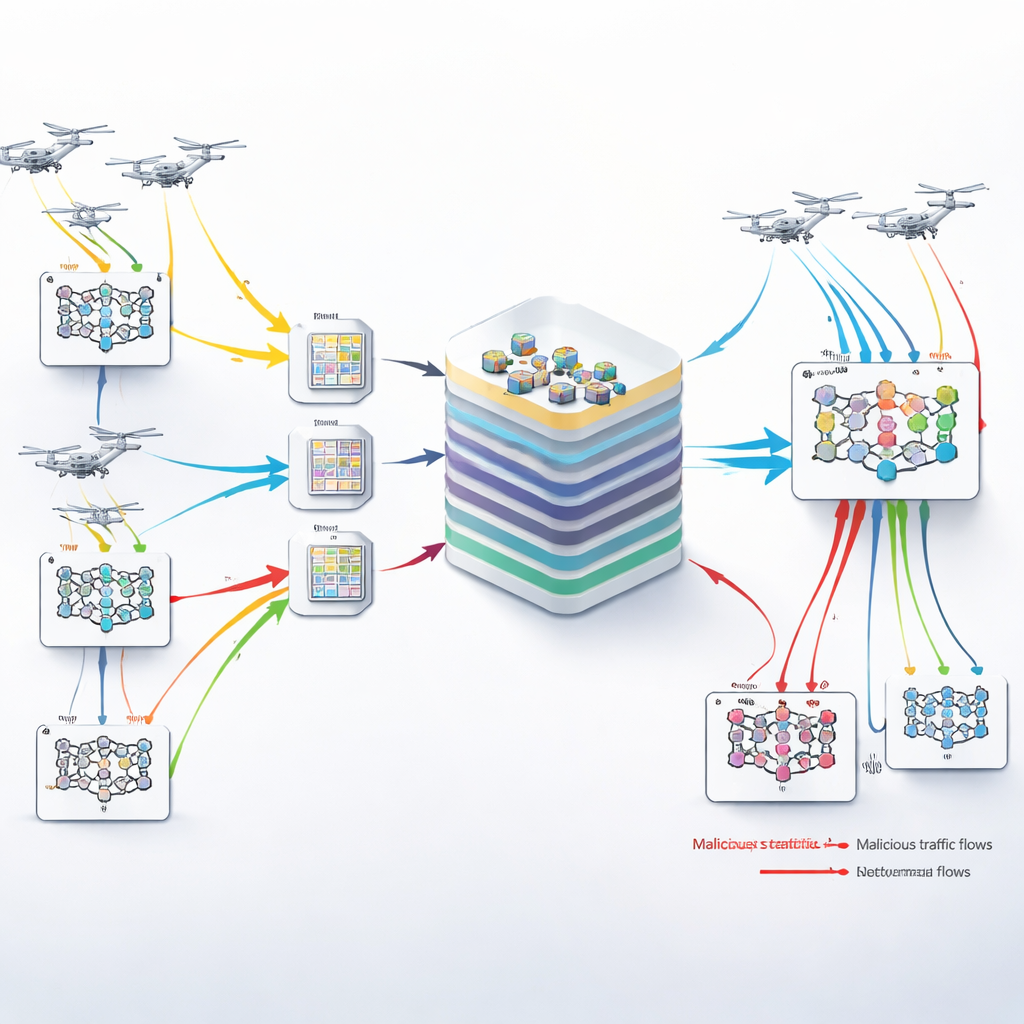
A key difficulty is that some drones may see mostly routine traffic while others face particular types of attacks, creating highly uneven data across participants. BANCO-FL tackles this by carefully balancing how many normal examples each client receives and by explicitly simulating challenging setups: one with three clients that each see very different mixes of attacks, and another with nine clients where each specializes in a single attack type. The framework also settles on a simple two-layer neural network that works well with tabular network statistics and is light enough to run on resource-limited devices on the edge.
Smarter ways to agree on a global model
Not all ways of merging the local models are equal. The study compares several strategies for combining client updates, including standard averaging, proximity-based correction, adaptive optimization (FedAdam), median-based aggregation, and clustering similar clients together (ClusterAvg). Across both three- and nine-client scenarios, the adaptive and clustering-based methods consistently reach top performance faster and with more stable behavior across clients. BANCO-FL attains around 99.98% accuracy, precision, recall, and F1-score, and cuts misclassifications by more than a third compared with earlier centralized and federated schemes. Importantly, these gains hold even when clients see very different attack patterns, showing that the system remains fair and reliable across the fleet.
What this means for everyday security
In plain terms, BANCO-FL shows that drone fleets can learn to recognize cyberattacks extremely well without pooling their raw communication logs in one place. By using a lightweight model, carefully balanced data sharing, and smarter ways to blend what each drone learns, the framework delivers near-perfect detection of harmful traffic while respecting privacy and reducing network overhead. As drones become more common in civilian and military roles, approaches like BANCO-FL point toward a future where the skies stay safer thanks to many devices learning together quietly in the background, rather than relying on a single, vulnerable watchtower.
Citation: Bithi, M., Masud, M.E. & Hossain, M.A. A new adaptive federated learning approach for privacy preserving UAV anomaly detection under non-IID distributions. Sci Rep 16, 8451 (2026). https://doi.org/10.1038/s41598-026-38732-z
Keywords: UAV security, federated learning, anomaly detection, privacy-preserving AI, cybersecurity