Clear Sky Science · en
Aniracetam restores the excitation-inhibition balance of neurotransmitters in the prefrontal cortex of mice with ADHD
Why balancing brain signals matters for ADHD
Attention-deficit/hyperactivity disorder (ADHD) is often described in terms of behavior—restlessness, impulsive decisions, and trouble focusing. But behind these outward signs lies a delicate chemical balance in the brain. This study in mice takes a close look at that balance in the prefrontal cortex, a region crucial for planning and self-control, and asks whether a memory-boosting drug called aniracetam can help restore order when this system goes awry.
A mouse model that mimics core ADHD traits
The researchers used a genetically engineered mouse that lacks a protein called TARP γ-8, which normally helps control certain glutamate receptors that carry fast excitatory signals between brain cells. Without this protein, adolescent mice show hallmark ADHD-like behaviors: hyperactivity, impulsivity, anxiety, and learning problems. Previous work suggested that standard ADHD drugs can ease these symptoms in this model, making it a useful tool for probing what actually goes wrong in the brain and how new treatments might work.
Probing brain chemistry in real time
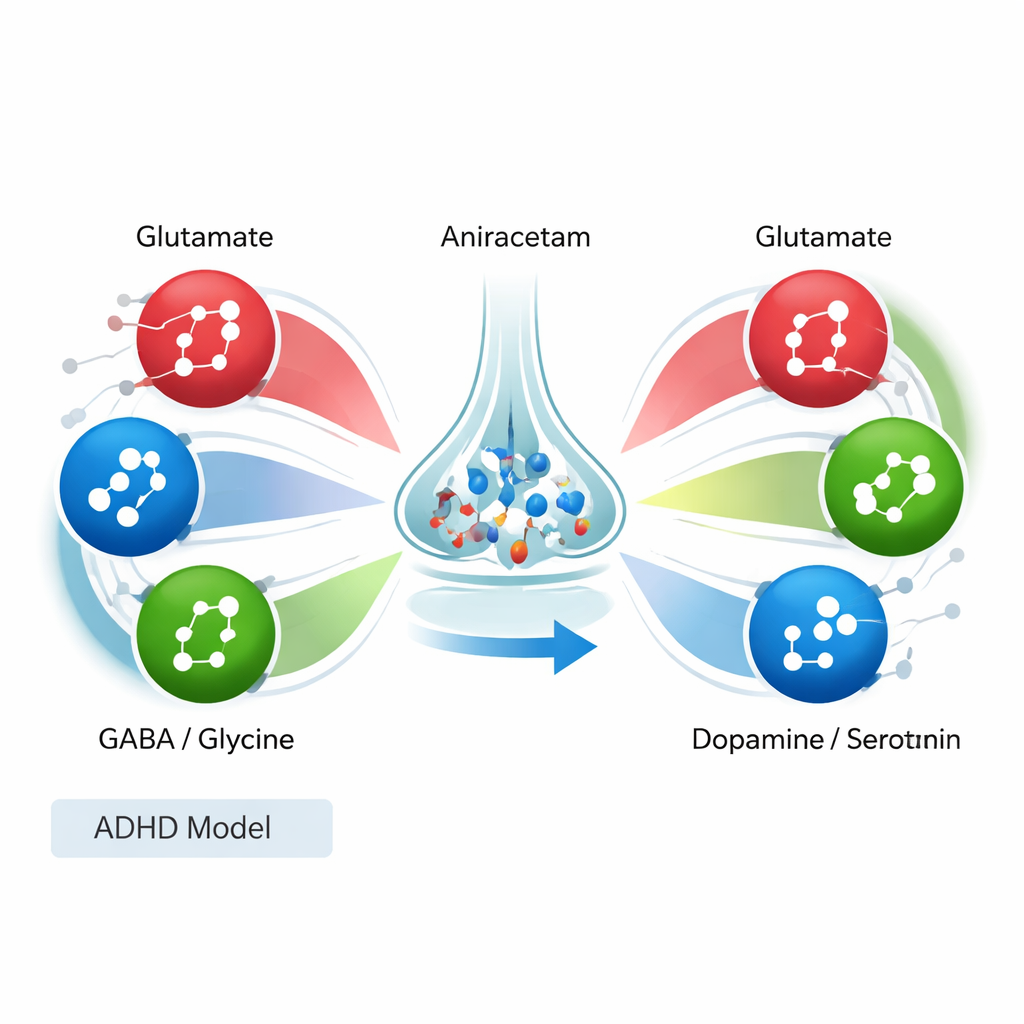
To understand what happens at the level of brain chemicals, the team implanted tiny sampling probes into the prefrontal cortex of three groups of mice: normal mice, TARP γ-8 knockout mice, and knockout mice treated with aniracetam for a week. Using microdialysis combined with highly sensitive chromatography and mass spectrometry, they measured levels of key neurotransmitters in the fluid outside brain cells, including glutamate (the main excitatory signal), GABA and glycine (important inhibitors), and the mood- and motivation-related chemicals dopamine and serotonin, plus a serotonin breakdown product. They also examined gene activity for several receptors and transporters that control how these chemicals are released, sensed, and removed.
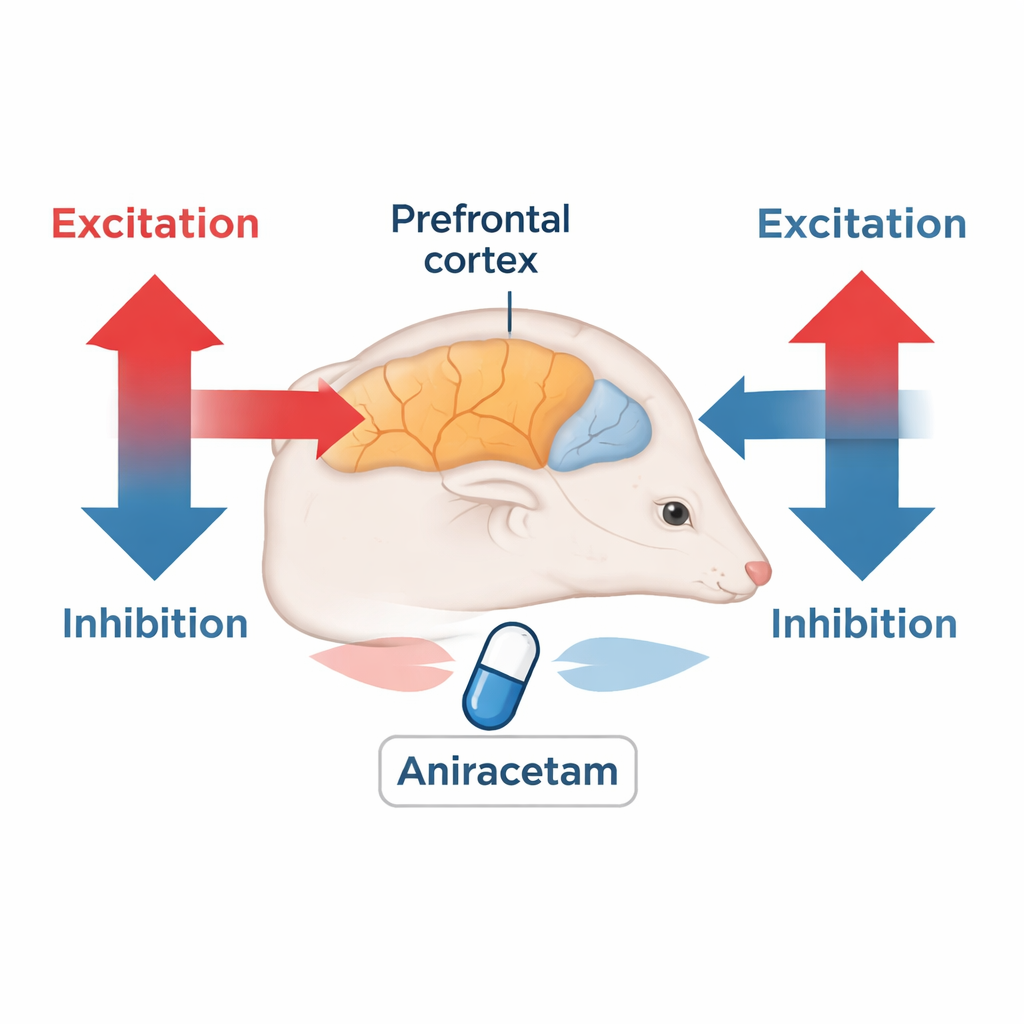
Too much “go,” not enough “stop”
The TARP γ-8 deficient mice showed a striking pattern. Glutamate levels in the prefrontal cortex were abnormally high, suggesting an overactive “go” signal. In contrast, GABA and glycine—two of the brain’s main braking systems—were reduced, and the genes for their receptors and transporters showed changes consistent with weaker inhibition. At the same time, dopamine and serotonin, which help support focus, emotional control, and impulse regulation, were both significantly lower, while the genes for their transporters were more active, indicating that these chemicals were being cleared away too quickly. Together, these shifts paint a picture of an excitation–inhibition imbalance: circuits in the prefrontal cortex are pushed too hard by excitatory signals and not sufficiently restrained or stabilized by inhibitory and modulatory systems.
Aniracetam nudges multiple systems back toward balance
When TARP γ-8 knockout mice received aniracetam, many of these abnormalities moved back toward normal. Glutamate levels dropped, and the genes encoding several AMPA-type glutamate receptor subunits became more active, consistent with more efficient and better-regulated excitatory signaling rather than simple overdrive. GABA and glycine levels rose, along with expression of a key GABA receptor subunit, suggesting a stronger inhibitory “brake.” Dopamine and serotonin, as well as the serotonin metabolite, increased in the prefrontal cortex, while the genes for their transporters and for the main glycine transporter were dialed down, implying slower clearance and more sustained signaling. Rather than acting on a single target, aniracetam appeared to trigger a coordinated reset across several neurotransmitter systems that together support attention and self-control.
What this could mean for future ADHD treatments
For a non-specialist, the central message is that ADHD may not stem from just one faulty chemical, but from a network-wide misalignment of brain signals—too much push, not enough pull, and weakened support from systems that fine-tune mood and motivation. In this mouse model, aniracetam helped restore a healthier balance by improving how excitatory receptors work and, in turn, normalizing inhibitory and monoamine systems. Although these findings are preclinical and limited to male mice, they suggest that drugs which subtly enhance specific glutamate receptors could, indirectly, stabilize several other chemical pathways at once. This work supports the idea of targeting AMPA-type receptors as a fresh strategy for ADHD and positions aniracetam as a promising multi-target candidate that warrants further study, including in female animals and eventually in human trials.
Citation: Cui, J., Sun, XL., Shi, S. et al. Aniracetam restores the excitation-inhibition balance of neurotransmitters in the prefrontal cortex of mice with ADHD. Sci Rep 16, 7528 (2026). https://doi.org/10.1038/s41598-026-38725-y
Keywords: ADHD, aniracetam, neurotransmitters, prefrontal cortex, glutamate GABA balance