Clear Sky Science · en
Reliable determination of the Hoek brown Mi parameter in brittle rocks using the maximum secant modulus criterion in multistage triaxial test
Why testing rocks matters for everyday life
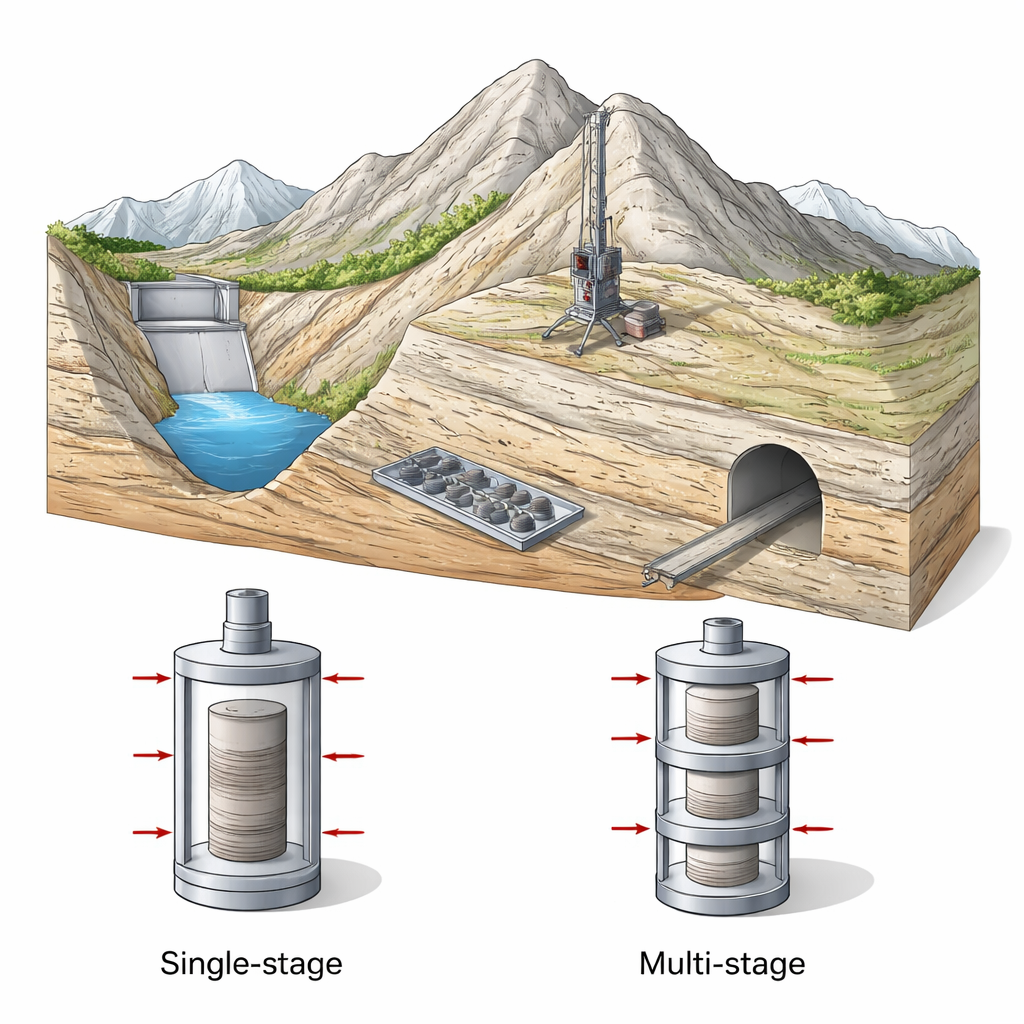
From subway tunnels and mountain highways to dams and underground power plants, many structures we rely on are carved into solid rock. Engineers have to know how that rock will behave deep underground, where it is squeezed from all sides. This article explores a smarter way to test brittle carbonate rocks, like certain limestones and dolomites, so that designers can better predict the risk of cracking and collapse while still working within the limits of ordinary laboratories.
Rocks that crack without warning
Brittle rocks fail suddenly rather than bending gently, which makes them especially challenging for underground construction. A key number used by engineers to describe this behavior is a parameter called “mi” from the widely used Hoek–Brown failure model. In simple terms, mi tells you how strongly a rock gains strength when it is squeezed from all directions, as it is around a tunnel. Getting mi wrong, even slightly, can lead to unsafe designs or overly conservative and costly ones. Yet traditional test methods demand many nearly identical rock samples and sophisticated equipment, which is not always available, especially when cores come from great depth or complex formations.
A more efficient way to squeeze rock
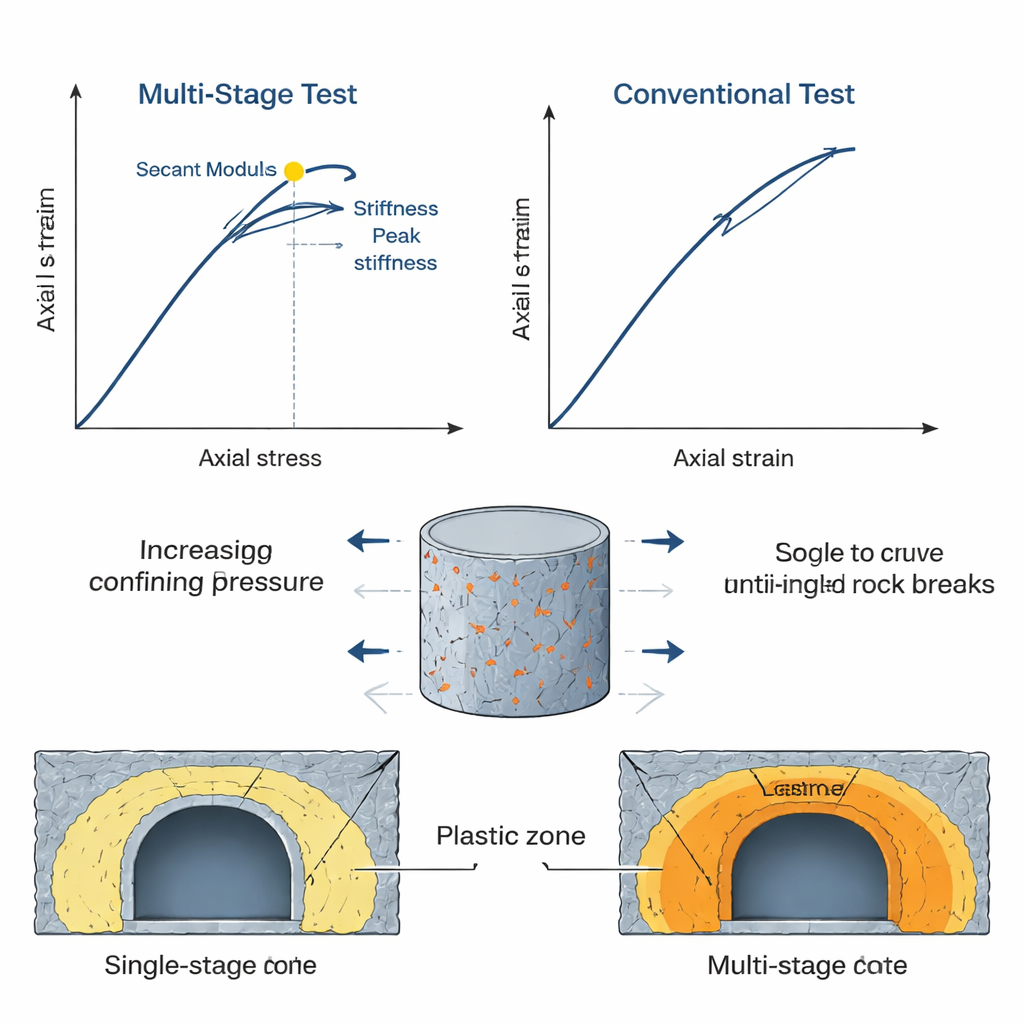
To tackle this problem, the authors developed an optimized version of the multistage triaxial compression test. Instead of loading many separate specimens once each until they fail, a single cylindrical sample is loaded in several stages under gradually higher surrounding pressure. The innovation lies in using the “maximum secant modulus” as a stopping point for each stage—that is, halting and resetting the test right at the point where the rock is stiffest, just before it begins to soften and accumulate large permanent damage. This criterion can be tracked in real time using a simple computer interface and does not require exotic instruments or fully automated control systems. Two versions of the method were tried: one with continuous loading and another in which the sample is unloaded between stages to reduce damage.
Putting the method to the test
The researchers applied their approach to dolomitic limestone from western Iran, a rock type common in many engineering projects. They first measured basic properties such as compressive strength, tensile strength, stiffness, and several brittleness indexes, confirming that the material tends to fail in a brittle manner. They then ran nine traditional single-stage triaxial tests and seven multistage tests under both continuous and loading–unloading schemes. The multistage tests were remarkably data-rich: from just seven specimens they obtained 49 distinct stress conditions, compared with only nine from nine specimens in the conventional method. This higher data density allowed a more reliable fit of the Hoek–Brown model and a sharper estimate of mi for the same rock.
What the rock revealed under repeated loading
The results showed a systematic difference between the two approaches. Multistage tests produced higher mi values—on average about 9.7, close to or above the range recommended for similar rocks—while single-stage tests gave a lower value of 6.8. Because multistage tests follow one evolving crack network in a single specimen, they filter out much of the natural variability from sample to sample and better capture how the rock’s strength grows with confinement. At the same time, repeated loading does cause tiny cracks to accumulate, so the apparent basic compressive strength measured by the multistage method was slightly lower than in the single-stage tests. A statistical analysis confirmed that the difference in mi between methods is not just random noise but a real effect.
From lab numbers to tunnel safety
To see what these differences mean in practice, the authors built a computer model of a circular tunnel in intact dolomitic limestone and ran simulations using parameters from each test method. When they used the multistage-derived numbers, the model predicted a larger zone of inelastic deformation around the tunnel and greater downward movement of the roof. In engineering terms, this is a more conservative and arguably safer prediction: it warns designers to expect more rock loosening and deformation than the single-stage data would suggest. The authors argue that such conservatism is desirable when working with brittle rocks that can fail without much warning.
What this means for real-world projects
For non-specialists, the key message is that how we test rock in the laboratory strongly influences how safe we believe our tunnels, caverns, and foundations will be. This study shows that a carefully controlled multistage test—using a simple stiffness-based rule to decide when to pause and re-load—can extract much more information from limited samples and yield rock parameters that err on the side of safety. Although the method still depends on skilled operators and was demonstrated on one rock type, it offers a practical, low-cost pathway for many laboratories to improve their estimates of rock strength, especially when only a handful of valuable core specimens are available.
Citation: Kordloo, V., Talkhablou, M. & Sheikhani, F.A. Reliable determination of the Hoek brown Mi parameter in brittle rocks using the maximum secant modulus criterion in multistage triaxial test. Sci Rep 16, 7575 (2026). https://doi.org/10.1038/s41598-026-38702-5
Keywords: brittle rocks, triaxial testing, Hoek–Brown parameter, tunnel stability, dolomitic limestone