Clear Sky Science · en
Menstrual cycle does not change sagittal plane segments coordination variability during deadlift, a nonlinear dynamical analysis approach
Why this research matters
Many active women wonder whether their menstrual cycle should change how they train, especially when lifting weights. This study examined whether different phases of the menstrual cycle actually alter how the body moves during a standard deadlift, a cornerstone exercise in both gyms and rehabilitation clinics. The findings help clarify whether coaches, clinicians, and women themselves need to time or tailor deadlift training around their cycles.
The big question
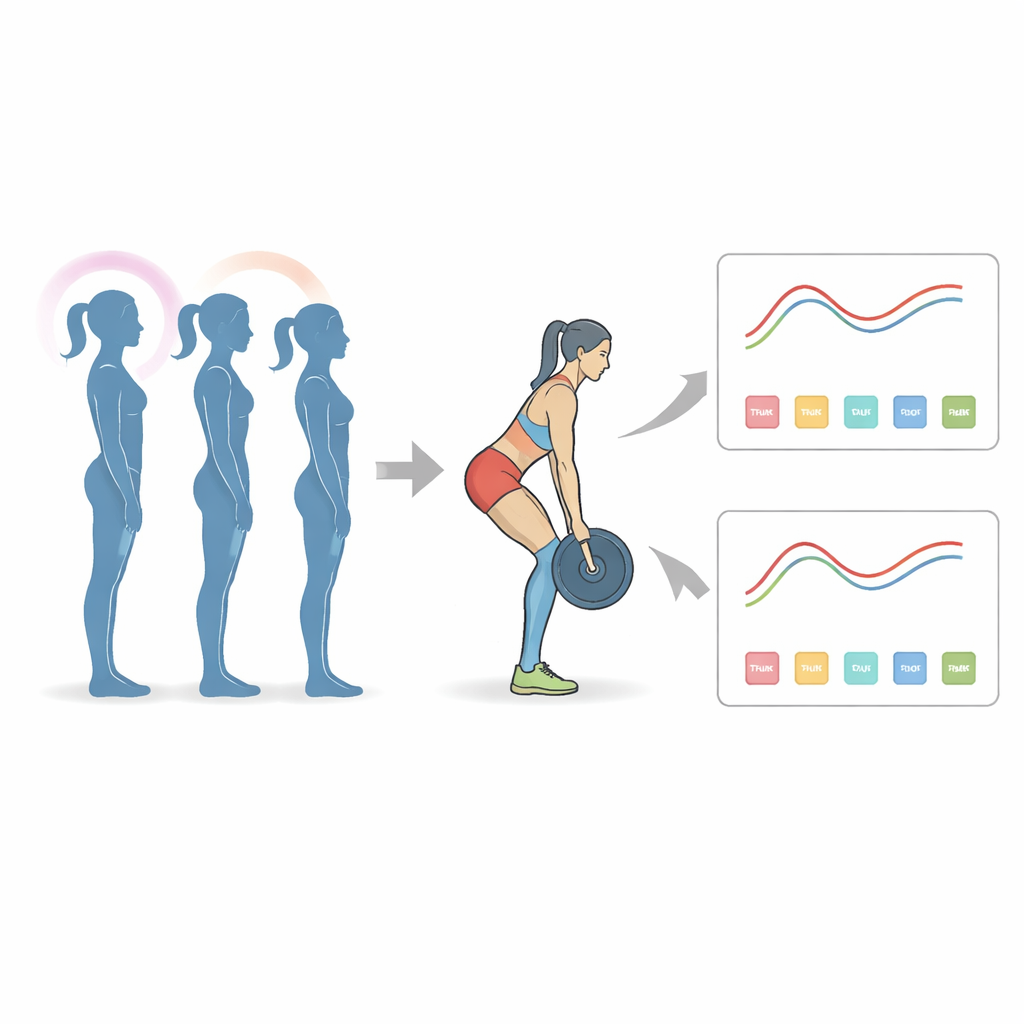
The menstrual cycle involves shifting levels of hormones like estrogen and progesterone, which can influence muscles, joints, and the nervous system. Some athletes report feeling weaker, stiffer, or less coordinated at certain times of the month, and past research has suggested that cycle phase might affect injury risk, especially around the knee. However, results have been mixed, and very few studies have looked closely at how different body segments move together during strength exercises. This study focused on a simple but important question: does the menstrual cycle change how the trunk, hips, knees, and ankles coordinate during a deadlift?
How the study was done
Ten healthy, recreationally active women with regular cycles performed conventional barbell deadlifts during three self-reported phases: early in menstruation, around ovulation, and in the middle of the luteal phase. At each visit, they completed sets of deadlifts with only their body weight and with an added load equal to half of their body weight. Instead of using a large camera-based lab, the researchers attached small motion sensors to the trunk, pelvis, thigh, shank, and foot. These sensors tracked how each body segment moved in the forward–backward plane during each lift. The team then used a mathematical method to describe how pairs of segments moved together—whether they turned in the same or opposite directions and which segment tended to lead the motion.
Looking at movement “flexibility”
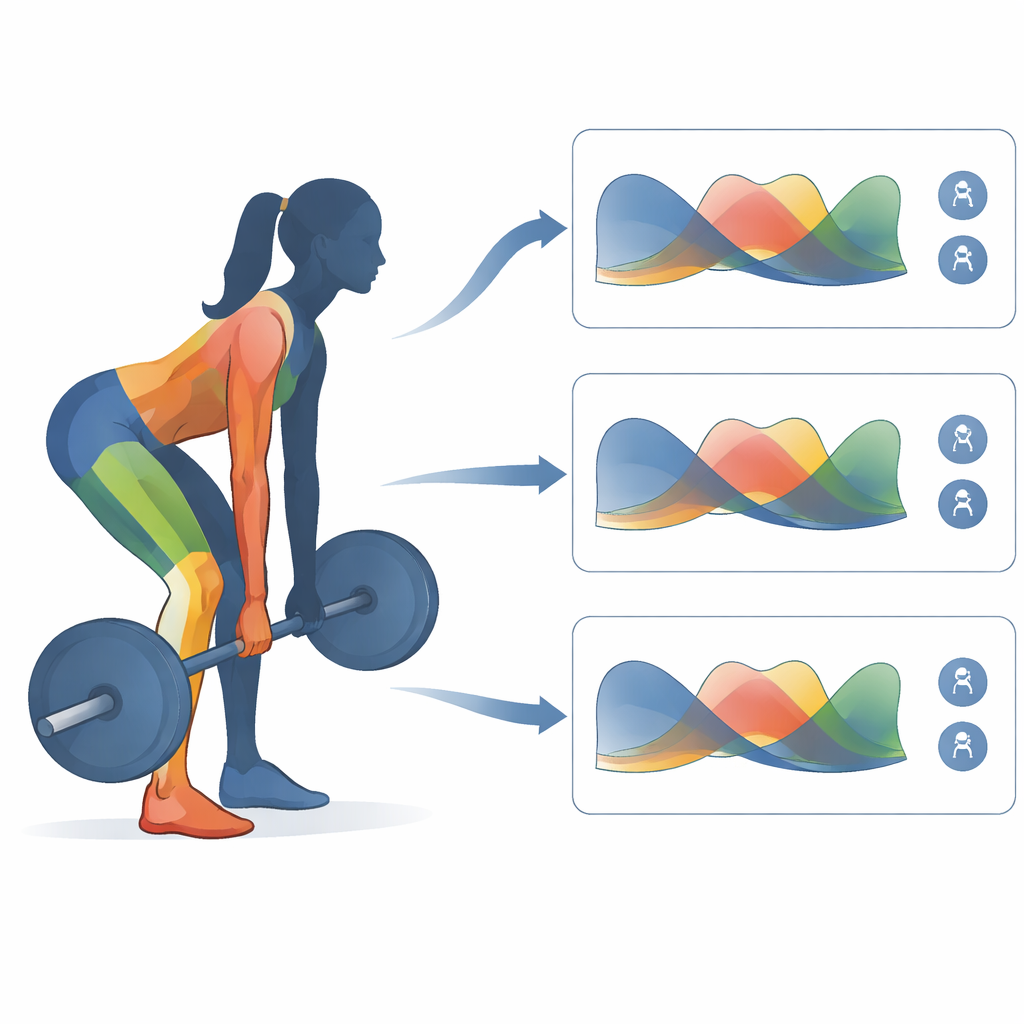
Beyond the basic movement pattern, the researchers were especially interested in movement variability—how much the coordination between segments naturally changed from one repetition to the next. Too little variability can mean a rigid, potentially stressful pattern, while too much can signal a lack of control. By examining how much the coordination angles fluctuated over the course of many deadlifts, the team created a detailed picture of each participant’s movement “fingerprint” in each phase of her cycle and under each loading condition. They then compared these fingerprints across the three menstrual phases and the two levels of weight.
What the researchers found
Segment ranges of motion tended to increase slightly when women lifted the heavier load, and there was a small, non-significant trend toward greater knee bend and ankle flexion in the luteal phase. However, none of these differences reached statistical significance. More importantly, the way segments coordinated—how the spine, pelvis, thigh, shank, and foot shared the work—looked remarkably similar across all phases of the menstrual cycle. The degree of repetition-to-repetition variability in this coordination was also stable. In other words, the internal organization of the deadlift did not meaningfully change with cycle phase or with the moderate increase in load.
What this means in everyday terms
For healthy, recreationally active women, this study suggests that the deadlift is a robust, stable movement that is not easily disturbed by normal hormonal shifts across the menstrual cycle. The body seems to preserve a consistent and well-practiced coordination strategy when performing this bilateral, grounded lift, even when the weight increases moderately. Practically, this means coaches, therapists, and athletes probably do not need to restructure deadlift training around specific cycle days. At the same time, the authors note that their sample was small and that other, more dynamic or unstable tasks may show stronger cycle-related effects. Larger studies using direct hormone measurements and examining movement in multiple directions will be important to fully understand when the menstrual cycle matters most for performance and injury risk.
Citation: Abbasi, A., Ghanbari, M., Alijanpour, E. et al. Menstrual cycle does not change sagittal plane segments coordination variability during deadlift, a nonlinear dynamical analysis approach. Sci Rep 16, 7894 (2026). https://doi.org/10.1038/s41598-026-38698-y
Keywords: menstrual cycle, deadlift, movement coordination, women in sport, strength training