Clear Sky Science · en
Costs of maternal care revealed through body conditionin Northern Resident killer whales (Orcinus orca)
Why whale motherhood matters
For Northern Resident killer whales along the Pacific Northwest coast, motherhood is a marathon, not a sprint. These whales carry their calves for well over a year, nurse them for several more, and then continue feeding and protecting them for life. Understanding how this extended care affects mothers’ own health is crucial, both for grasping the biology of these remarkable animals and for shaping conservation plans aimed at keeping their populations healthy.

A long journey from pregnancy to weaning
Female Northern Resident killer whales invest heavily in each calf. Pregnancy lasts about 16 to 18 months, followed by roughly three years of nursing. Even after calves stop drinking milk, mothers keep sharing salmon with them, sometimes for decades. To see how this investment shapes maternal health, researchers used drones over ten years to photograph whales from above and measure subtle changes in body shape around the head—an established visual indicator of fat reserves and overall body condition.
Reading health from a whale’s eye patches
From the aerial images, scientists focused on the area just behind the head, where whales lose fat when they are under nutritional stress. Using the width and position of the distinctive white eye patches, they calculated a simple ratio that reflects how much fat is stored in this region. Lower values signal leaner whales that, in other studies, have been more likely to die. By tracking these measurements for 66 reproductive-age females across different stages—early pregnancy, late pregnancy, and the first three years after birth—the team could follow how body condition rose or fell through the reproductive cycle.
Motherhood’s short-term highs and lows
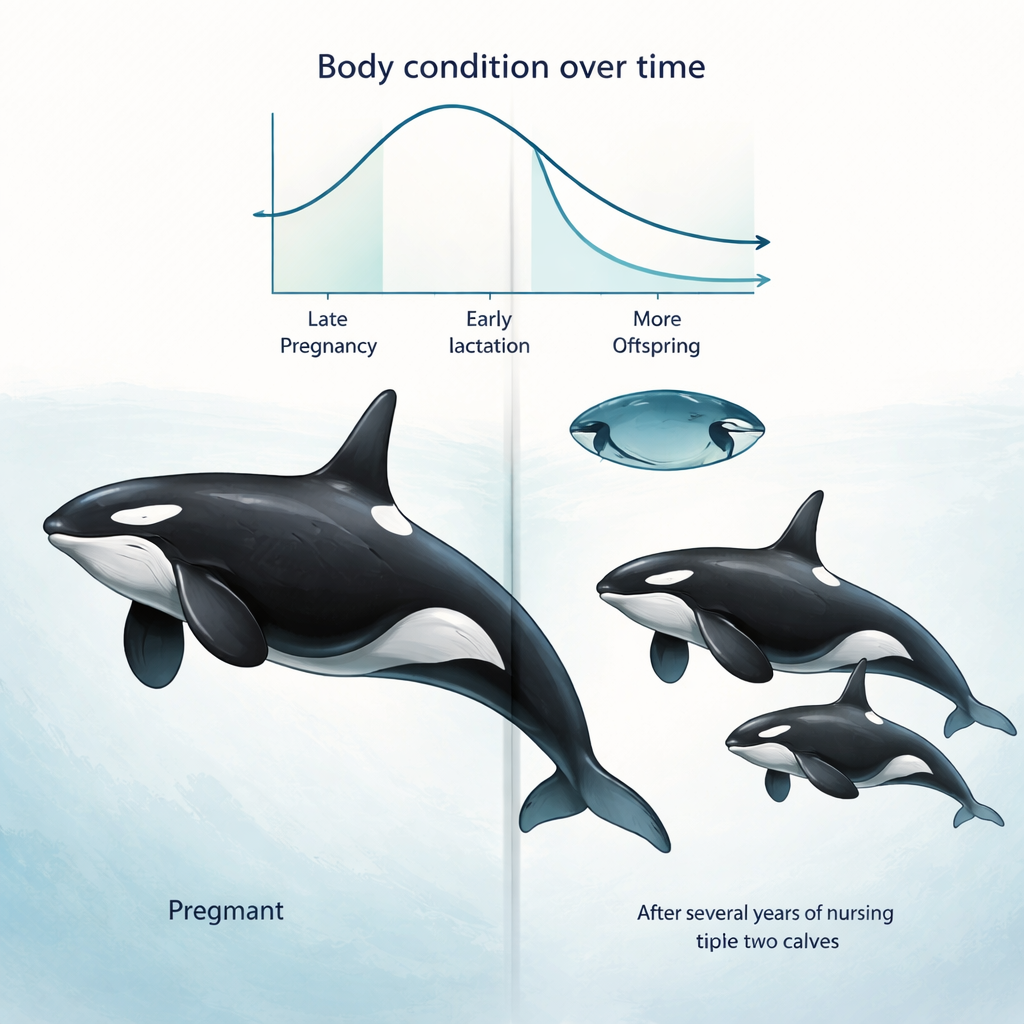
The images showed a clear pattern. In the later stages of pregnancy, females were in their best condition, carrying more fat than non-pregnant whales. This likely reflects a buildup of energy reserves as the fetus grows rapidly and mothers prepare for the demands of nursing. After calves were born, however, mothers’ condition dropped sharply during the first year of lactation and stayed low into the second year, before rebounding by about the third year, when calves are typically weaned. These swings suggest that nursing and caring for young calves are energetically costly, and it takes years for mothers to fully recover.
Lifetime care leaves lasting marks
The study also looked beyond single pregnancies to the long haul of motherhood. Using data from 75 adult females, the researchers compared body condition with each whale’s total number of births and the number of offspring still alive and living with her. Mothers with more living offspring tended to be in poorer condition, even when salmon abundance was taken into account. The total number of births also showed a negative trend but was a weaker predictor than the count of living offspring. This supports the idea that the ongoing effort of feeding and supporting adult sons and daughters—not just giving birth—gradually wears down mothers’ reserves. Surprisingly, there was no strong evidence that raising sons was more costly than raising daughters, at least in terms of body condition.
What this means for whales and conservation
To a layperson, the takeaway is that killer whale mothers pay a real, measurable physical price for their care. They get fatter late in pregnancy, become leaner during the first years of nursing, and, over a lifetime, those with more surviving offspring tend to be in poorer shape. Because body condition is linked to survival and future reproduction, these hidden costs of care may limit how often females can have calves and how long they remain productive. For conservationists, this means that protecting food supplies and reducing stress in the ocean environment is not just about keeping whales alive today; it is also about easing the burden on hard-working mothers whose lifelong care underpins the health of the entire population.
Citation: Kay, S.W., Rowley, A.G., Visona-Kelly, B.C. et al. Costs of maternal care revealed through body conditionin Northern Resident killer whales (Orcinus orca). Sci Rep 16, 5355 (2026). https://doi.org/10.1038/s41598-026-38696-0
Keywords: killer whales, maternal care, body condition, salmon prey, marine conservation