Clear Sky Science · en
High-capacity and secure inter-satellite optical wireless communication using 2D DPS-OCDMA
Bringing Faster Space Internet to Everyone
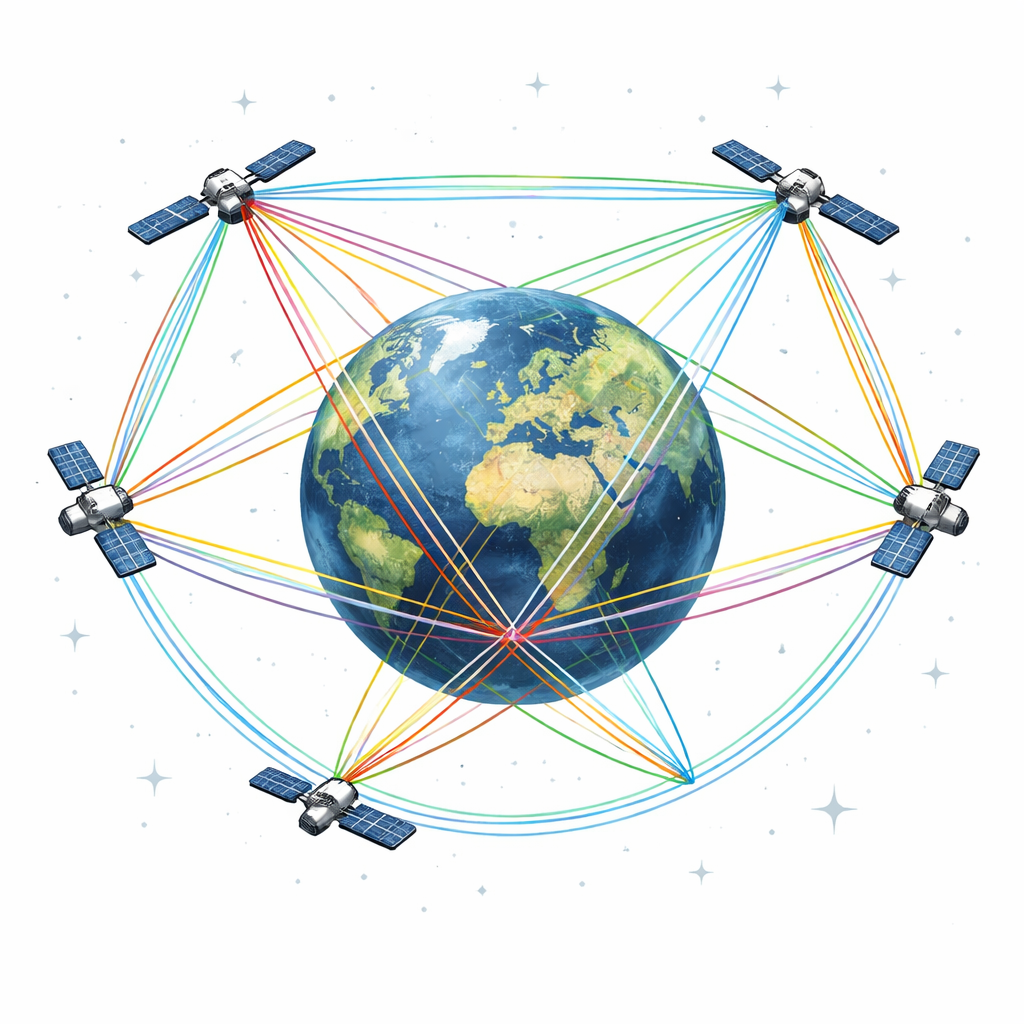
As our lives depend more and more on instant connectivity—video calls, cloud services, real-time maps—the communications backbone orbiting above us becomes just as important as the fiber cables under our streets. This paper explores a new way for satellites to talk to one another using tightly focused laser beams and smart "color-and-polarization" coding, aiming to move huge amounts of data securely between spacecraft thousands of kilometers apart, even under the harsh, jittery conditions of space.
From Radio Waves to Laser Highways
Today, most satellites still rely on radio waves to exchange information. Radio is reliable but crowded and relatively slow because there is only so much usable spectrum to go around. The authors focus on inter-satellite optical wireless communication, in which spacecraft exchange data using light, much like fiber-optic cables—but without the fiber. Laser links can carry far more information, are immune to radio interference, and use very narrow beams that reduce power needs and the risk of eavesdropping. The trade-off is that laser links are finicky: if two satellites drift or vibrate slightly out of alignment, the connection can quickly weaken or fail. The work tackles the challenge of making these links both high-capacity and robust over distances of up to 16,000 kilometers.
Sharing One Beam Among Many Users
To cram more data through a single optical link, engineers can divide the signal by color, frequency, or other properties so that multiple data streams travel at once. This study uses an approach called optical code division multiple access, where each data stream is assigned a unique pattern of light "on" and "off" across several colors. Instead of carefully lining up users in time or giving each a dedicated color, they all share the same resources but are separated by their code patterns. The authors extend an existing code family, known as diagonal permutation shift, into two dimensions: color and polarization (the orientation of the light waves). By duplicating each color pattern across horizontal and vertical polarizations, they effectively double the number of distinct users while keeping the code length short and the mutual interference low.
Building and Testing the Satellite Link Model
The team designs a full end-to-end model of a laser link between two satellites. On the sending side, each of six channels carries a 20-gigabit-per-second bit stream, which is transformed into a coded light pattern across four wavelengths and one of two polarizations. All channels are combined, boosted by an optical amplifier, and launched through space. On the receiving side, a polarization splitter separates the two orientations, and specialized optical filters implement the matching code and a companion "subtractive" code. Their outputs are compared before being turned back into an electrical signal, a trick that suppresses interference from other users sharing the link. The authors then simulate this system in detail, tracking how much power is received, how noisy the signal becomes, and how reliably bits can be distinguished as the satellites’ separation, pointing accuracy, and optical hardware are varied.
Surviving Misalignment, Distance, and Loss
Because a laser beam in space spreads only slightly, even microradian-scale pointing errors—a tiny angle far smaller than a degree—can cause big drops in received power. The simulations show how performance degrades as the receiving satellite’s aim drifts, as the distance between satellites stretches from 12,000 to 16,000 kilometers, and as lenses and optical components become less efficient. Key indicators such as bit error rate and Q-factor reveal that higher transmit power, larger receiving apertures, and better optical efficiency can all compensate for these challenges. For example, doubling the receiver lens diameter from 10 to 20 centimeters or raising optical efficiency from 70 to 90 percent sharply improves signal quality over all distances tested. Across these realistic conditions, the six coded channels together sustain a total of 120 gigabits per second while keeping error rates well below the common correction threshold.
Built-In Privacy Through Hidden Patterns
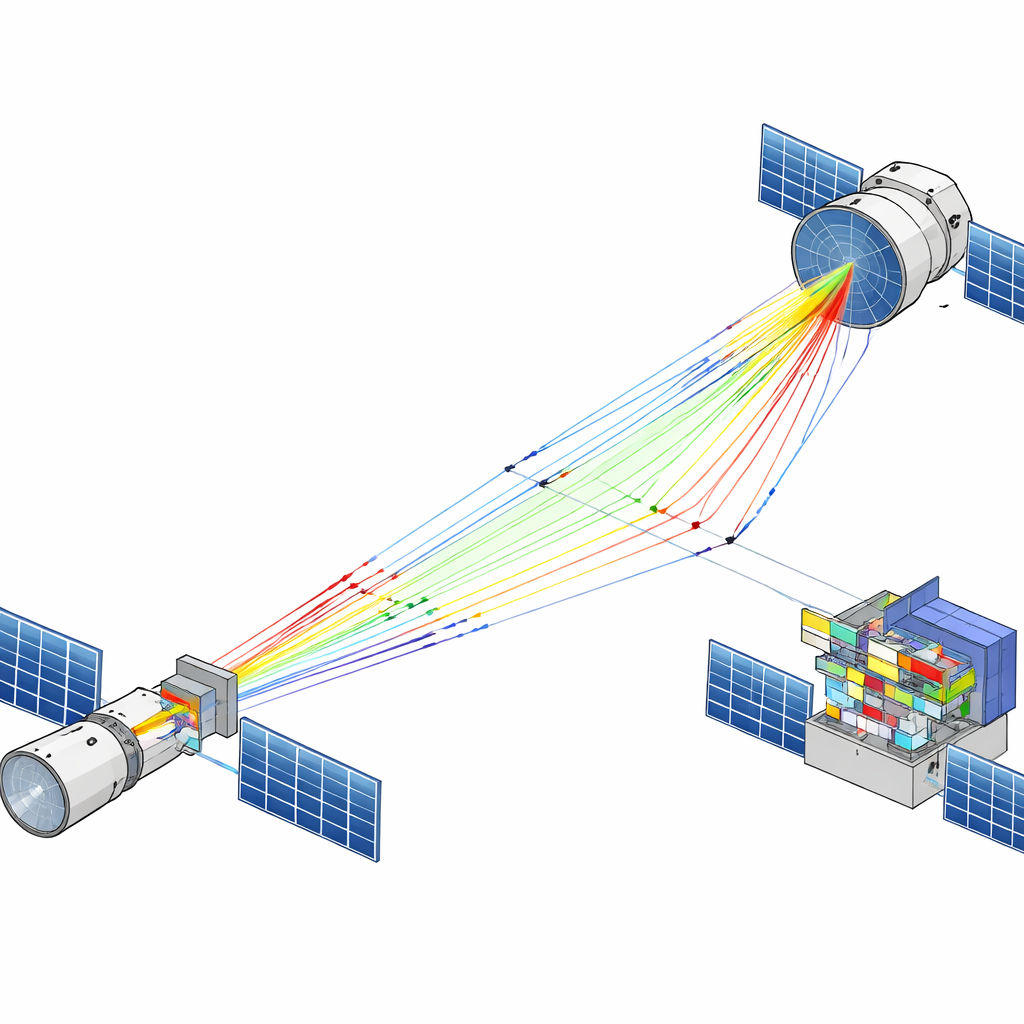
Beyond speed, the coding scheme offers an important side benefit: physical-layer security. Because each user’s data is woven into a specific two-dimensional pattern of colors and polarizations, only a receiver equipped with the exact matching code can unravel it into a clean signal. An unintended observer, even if positioned within the laser beam, would see a confusing blend of overlapping patterns. This makes the approach attractive for sensitive applications such as defense, strategic coordination, and future deep-space missions, where secure, high-throughput links between satellites form the backbone for sharing large volumes of imagery and scientific data.
What This Means for the Future of Space Networks
In plain terms, the study shows that a carefully coded laser link can let multiple satellite users share the same light beam, move data at fiber-like speeds, and stay connected across tens of thousands of kilometers, all while keeping their messages inherently hard to intercept. By combining two-dimensional code patterns with attention to pointing accuracy, lens size, and optical efficiency, the authors outline a practical recipe for next-generation space "backbones" that could eventually support global broadband, coordinated Earth observation constellations, and ambitious exploration missions. Future work will test these ideas against more real-world disturbances and explore intelligent control methods, but the core message is clear: smart coding of light may be the key to turning space into a fast, secure optical web.
Citation: Armghan, A., Abd El-Mottaleb, S.A., Aldkeelalah, S.S. et al. High-capacity and secure inter-satellite optical wireless communication using 2D DPS-OCDMA. Sci Rep 16, 7904 (2026). https://doi.org/10.1038/s41598-026-38694-2
Keywords: inter-satellite optical communication, laser satellite links, optical code division multiple access, secure space communications, high-capacity satellite networks