Clear Sky Science · en
Design and implementation of an open-access arsenic biosensor
Hidden danger in a glass of water
For millions of people who rely on private wells, a glass of water can hide a silent poison: arsenic, a naturally occurring element linked to cancers, heart disease, and other chronic illnesses. Because arsenic has no taste, smell, or color, families can drink contaminated water for years without knowing it. Laboratory tests exist, but they are often too expensive, too far away, or too technical for rural communities. This study presents a simple, low-cost, and open-access tool that lets non‑experts check their own water using a small device that turns blue when arsenic is present.
Why arsenic in wells is a serious problem
Arsenic contamination of groundwater is a worldwide issue, with major hotspots in Asia and the Americas. In Argentina alone, an estimated four million people—many in small towns and scattered rural areas—regularly drink water with arsenic levels above the World Health Organization guideline of 10 micrograms per liter. Because household wells are often never tested, or tested only once, dangerous exposure can go unnoticed for decades. Standard laboratory methods are extremely accurate, but they require sophisticated machines, trained staff, and centralized facilities, placing them out of reach for routine checks in low‑resource settings.
Turning bacteria into a living test strip
The researchers tackled this gap by transforming common laboratory bacteria, Escherichia coli, into tiny arsenic detectors. They introduced a genetic switch that responds to arsenic inside the cell. When arsenic is absent, the switch stays off. When arsenic enters, it flips on a gene that makes an enzyme capable of breaking down a colorless compound into a deep blue dye. To make the test field‑ready, the team soaked these engineered bacteria into small pieces of paper and then gently dried them with protective sugars. The result is a paper strip that can sit at room temperature for about a month and springs back to life when moistened with a water sample and a ready‑made mixture of nutrients and dye precursor. 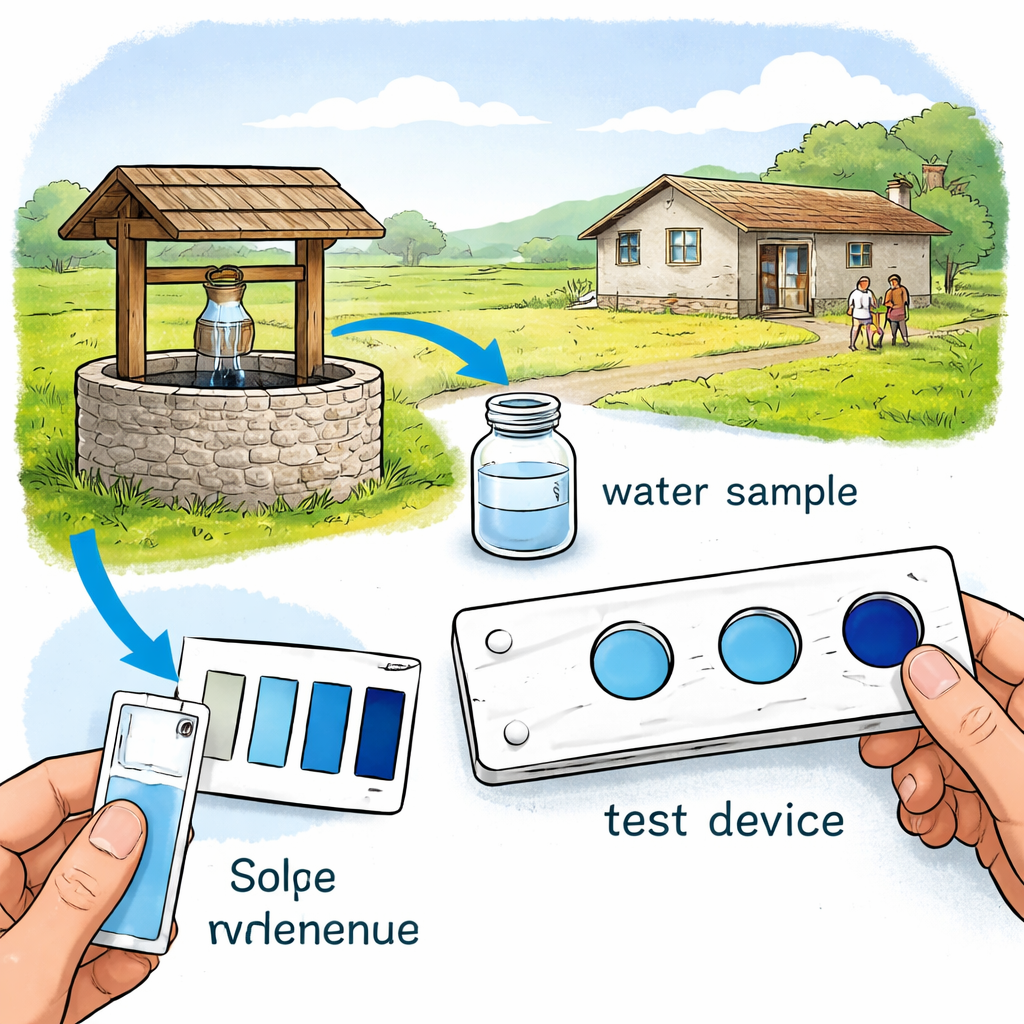
A pocket device that anyone can use
Biology alone is not enough: the scientists paired their living sensor with smart industrial design. They created a palm‑sized, 3D‑printed plastic housing that holds several paper strips. Users pour water from their well into simple wells on the device—one for the unknown sample, one for a clean blank, and one for a standard sample containing a known safe limit of arsenic. The water flows through the paper by capillary action, contacting the bacteria. After a timed step that brings the dye into contact with the cells, the reaction zones slowly turn blue if arsenic is present. The device stays sealed so users never touch the microorganisms, and used strips can be safely destroyed by soaking them in household bleach before disposal. The entire housing can be printed locally using low‑cost plastic filament and shared digital design files.
Reading color with a smartphone
While the blue color can be seen by eye, the team also built a companion Android app to make the result more objective and easier to compare across places and phones. The app guides the user to take a single photo of the blank, the standard, and the sample under the same lighting. A simple computer-vision script then measures how intense the blue color is in each zone and calculates a number that increases with arsenic concentration. By always including a standard at the 10 micrograms per liter guideline, the app can tell if the sample is clearly below or above the recommended limit, even if lighting conditions vary. In trials with 61 real water samples from the Buenos Aires region, the biosensor agreed closely with gold‑standard lab measurements, correctly classifying almost all samples with a sensitivity of about 98 percent and a specificity of about 99 percent. 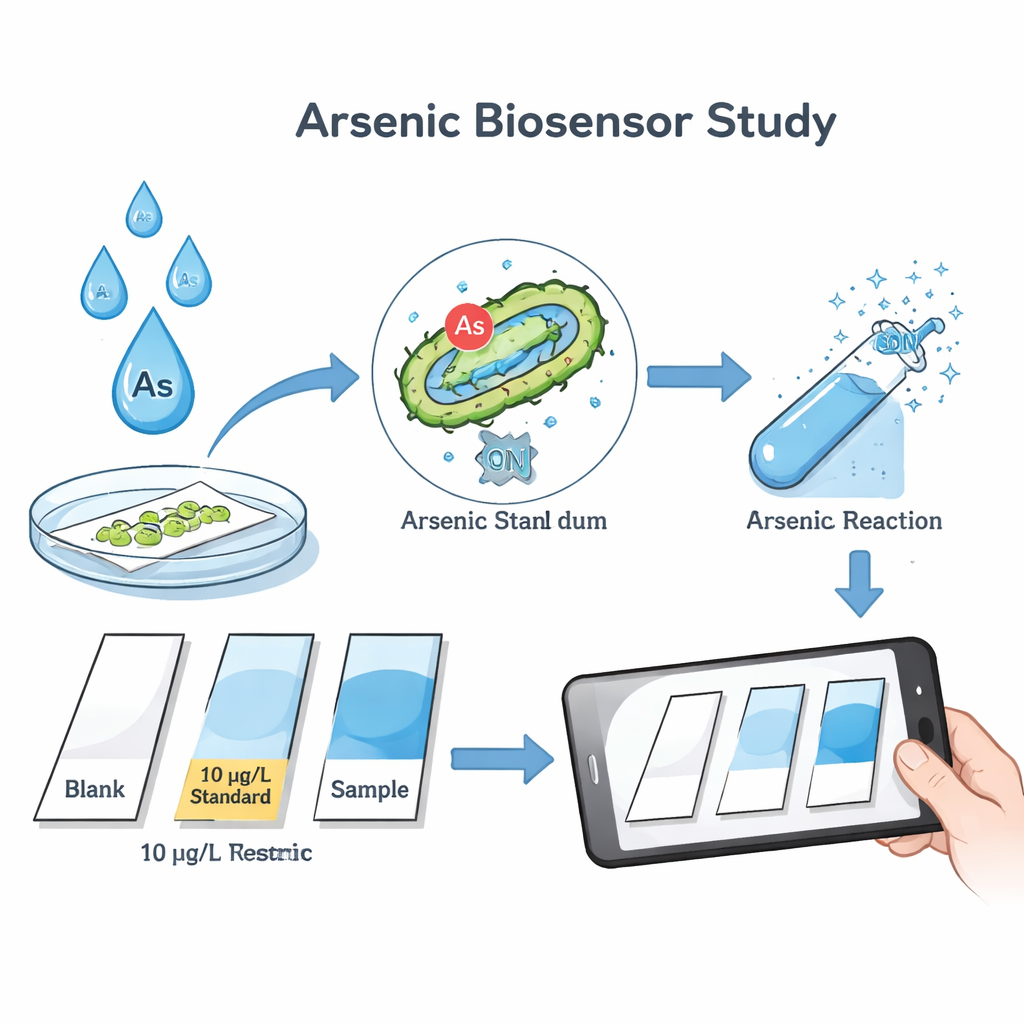
Open designs for global impact
Beyond technical performance, the project embraces an open‑access philosophy. All plasmid sequences, paper patterns, 3D‑printing files, and analysis code are freely available so that universities, non‑profits, and community labs can reproduce and adapt the system without paying licensing fees. Because the active component is living bacteria that grow easily in basic facilities, the kit can be manufactured in many countries using widely available materials. The authors stress that this tool is meant for on‑site screening and decision‑making—flagging wells that likely exceed safety limits—rather than replacing formal regulatory tests. With its low cost (less than one dollar per test in consumables), ease of use, and do‑it‑yourself documentation, the biosensor could help communities worldwide monitor their own water, push for targeted remediation, and ultimately reduce long‑term arsenic exposure.
Citation: Gasulla, J., Teijeiro, A.I., Alba Posse, E.J. et al. Design and implementation of an open-access arsenic biosensor. Sci Rep 16, 7668 (2026). https://doi.org/10.1038/s41598-026-38693-3
Keywords: arsenic in drinking water, biosensor, groundwater testing, open-source hardware, water quality monitoring