Clear Sky Science · en
Ultra-high sensitivity gas sensors employing Bloch-like surface waves in a metal-dielectric one-dimensional photonic crystal
Why Watching Thin Films Can Reveal Invisible Gases
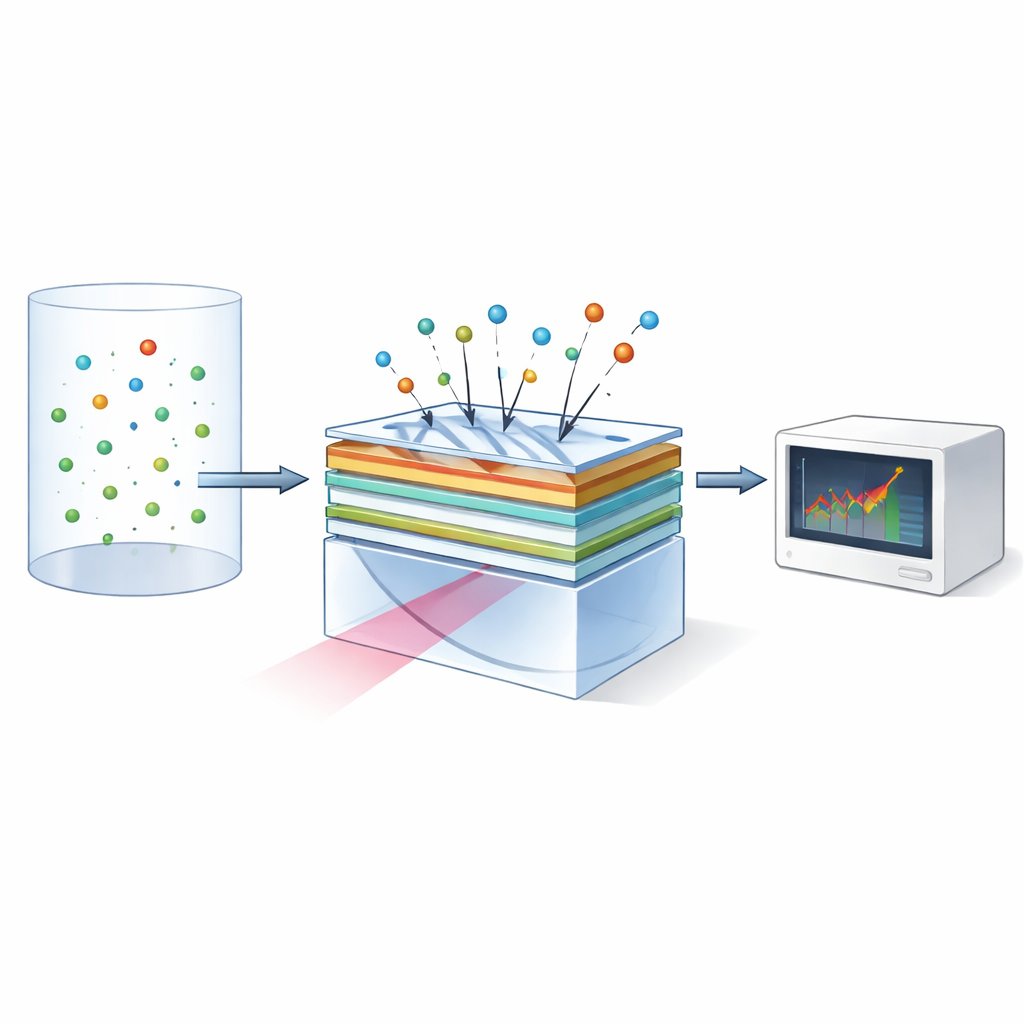
Modern industry, climate monitoring, and health care all need to detect trace amounts of gases quickly and reliably. From spotting tiny leaks in hydrogen pipelines to checking air quality in clean rooms, even minute changes in gas composition can matter. This paper presents a new way to build optical gas sensors that can notice extremely small changes in how gas bends light, without relying on fragile or slow materials, by harnessing special surface-bound light waves in an engineered stack of ultra-thin layers.
Riding Light Along a Carefully Built Surface
The core idea is to guide light along the outer surface of a man‑made crystal made from repeating layers of two materials—titanium dioxide and gold—on a glass base. When arranged in a strict one‑dimensional pattern, these layers form what physicists call a photonic crystal, which controls how light can move through it. At the outer boundary, where this stack meets the gas to be measured, certain light waves choose to travel right along the surface instead of passing through or bouncing away. The authors call these waves “Bloch‑like surface waves”, and they create very sharp dips in reflected light at specific colors that depend sensitively on the surrounding gas.
Turning Color Shifts into Gas Information
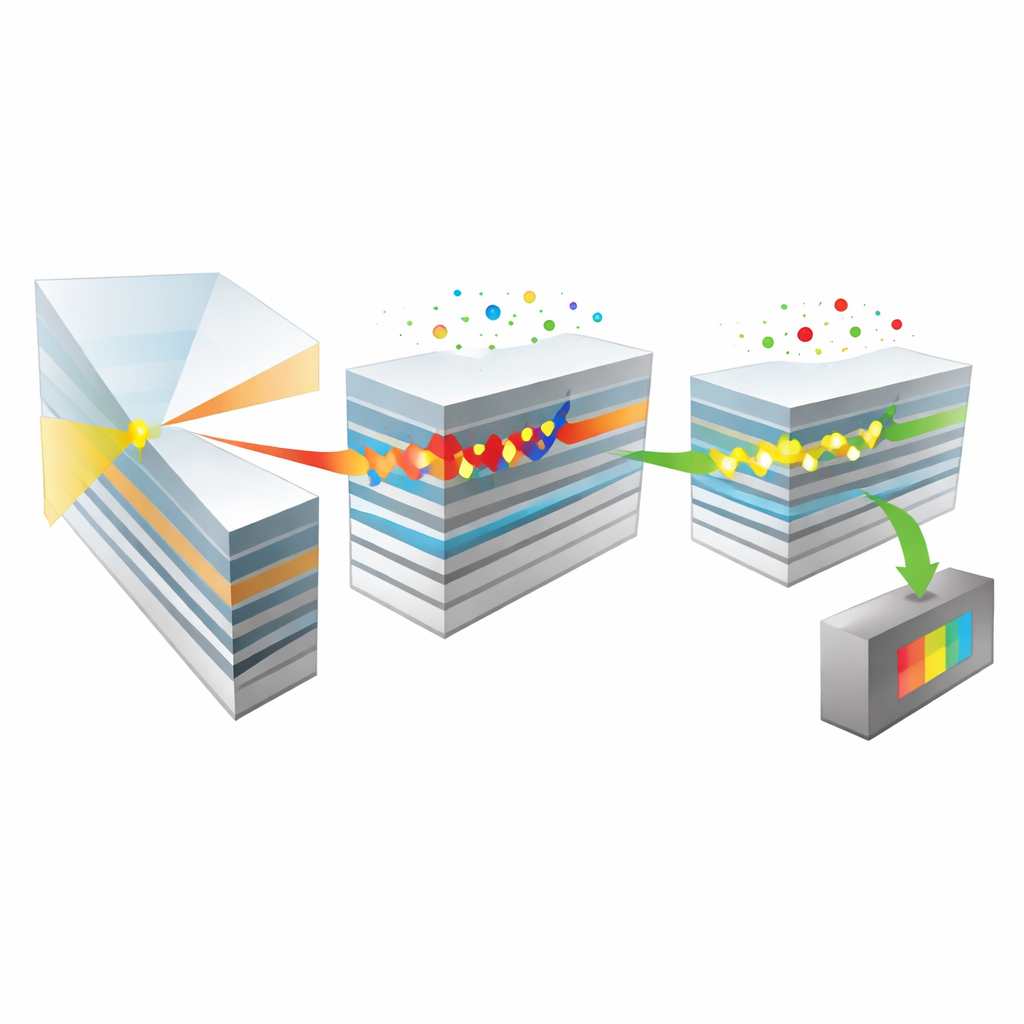
To read out these surface waves, the team uses a classic prism arrangement in which white light is sent through a glass block into the layered stack at a carefully chosen angle. Most colors reflect strongly, but at one very narrow color the surface wave is excited and light is drawn into the multilayer structure, creating a deep, sharp notch in the reflected spectrum. When the gas around the surface changes slightly—altering its refractive index by as little as a few millionths—this notch slides to a new color. By tracking that tiny color shift with a spectrometer, the sensor can infer how the gas has changed.
Designing Layers for Stronger Surface Waves
The researchers systematically explored how the thickness and number of titanium dioxide and gold layers shape the behavior of these surface waves. Using established optical modeling tools, they calculated how strongly light is confined near the surface and how deeply it penetrates into the gas. They found that adding thin metal layers greatly increases the contrast in optical properties between layers, which in turn tightens the resonance and boosts the electric field right at the gas interface. Carefully tuning the gold thickness and the number of repeated pairs allowed them to produce extremely narrow notches in the reflected spectrum, a key ingredient for both high sensitivity and precise measurement.
Pushing Sensitivity to Minute Changes
With optimized layer designs, the authors predict that their sensor can detect changes in refractive index—essentially, how strongly a gas bends light—over ranges relevant to real gases such as nitrogen. For one configuration, the notch color shifts by up to 10,900 nanometers per unit change in refractive index, and for a modified design this climbs as high as 28,000. Combined with a realistic spectrometer resolution, this translates into the ability to detect refractive‑index changes of only a few parts in a million. Their figure of merit, which combines how strongly the notch shifts with how narrow and deep it is, matches or outperforms many of the best published optical gas sensors, all while avoiding highly porous structures that can slow the response.
What This Means for Future Gas Sensors
In simple terms, the study shows that by stacking metal and glass‑like layers in the right way, it is possible to build a tough, compact optical surface that reacts strongly to even tiny changes in the surrounding gas. Light skimming along this surface acts like a touch‑sensitive skin, with its color pattern betraying minute shifts in the air above it. Because the structure does not rely on fragile pores and works for more than one polarization of light, it promises fast, robust sensing in harsh environments. With further refinements and the addition of advanced two‑dimensional materials, this approach could underpin a new generation of ultra‑sensitive gas sensors for environmental monitoring, industrial safety, and scientific measurements.
Citation: Gryga, M., Chylek, J., Ciprian, D. et al. Ultra-high sensitivity gas sensors employing Bloch-like surface waves in a metal-dielectric one-dimensional photonic crystal. Sci Rep 16, 7921 (2026). https://doi.org/10.1038/s41598-026-38689-z
Keywords: gas sensing, optical sensors, photonic crystals, surface waves, refractive index