Clear Sky Science · en
Machine learning based power control in cellular and cell-free massive MIMO systems
Why this research matters for everyday connections
As our phones, tablets, and smart devices compete for wireless bandwidth, networks struggle to deliver fast, reliable service without wasting energy. This paper explores how modern machine learning can help mobile networks decide, in real time, how much power each antenna should use when talking to each device. By doing this more intelligently than today’s standard methods, the approach promises smoother connections, better coverage in crowded areas, and lower delays—key ingredients for future 5G and 6G services such as virtual reality, remote control of machines, and ultra-reliable low-latency communication.
From big towers to many quiet helpers
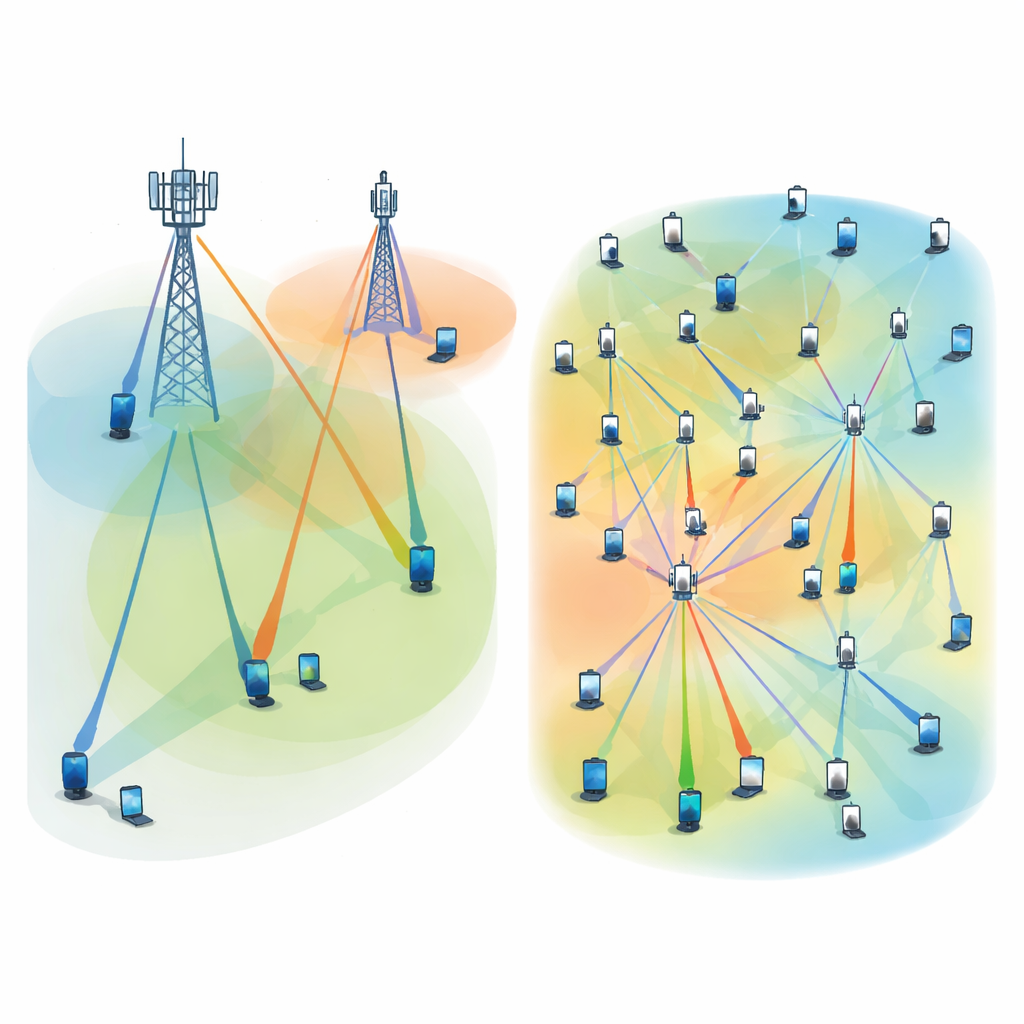
Traditional cellular networks are built around large base stations that each serve a fixed “cell.” A newer idea, called cell-free massive MIMO, replaces rigid cell borders with many small access points scattered across an area, all working together. Instead of a user belonging to one tower, any nearby antenna can help carry its signal. This shared approach shortens the distance between devices and antennas and can reduce dead zones. However, coordinating power levels among scores or hundreds of antennas and users becomes a complex puzzle—especially when we want to minimize interference while squeezing the most data through the air.
Teaching networks to share power smartly
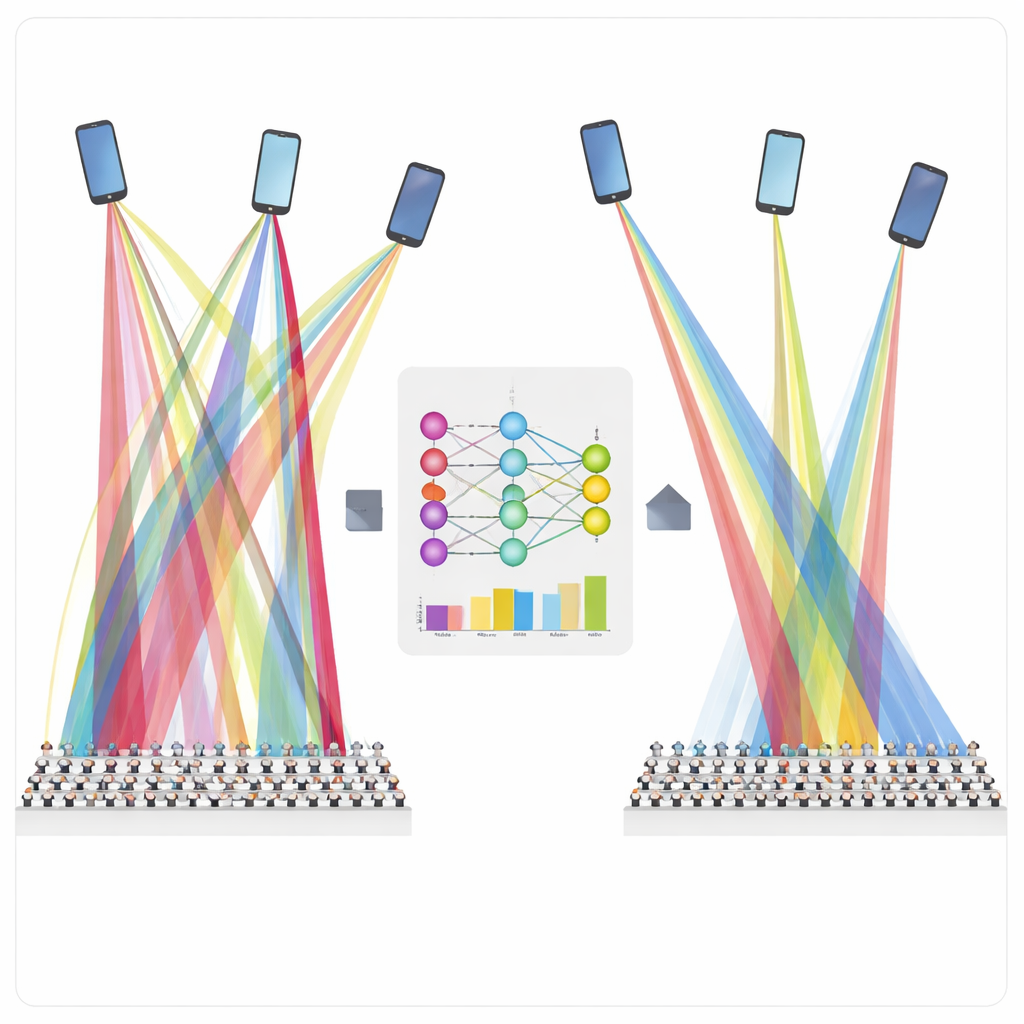
Engineers have long relied on mathematically heavy algorithms, such as a method known as WMMSE, to decide how much power each antenna should use. These methods are accurate but slow and resource-hungry, making them hard to apply in real time for large, dense networks. The authors instead train deep neural networks to imitate—and in some cases improve upon—this careful power tuning. They generate large simulated datasets that capture many combinations of user positions, antenna layouts, and channel conditions, then teach the neural network to predict good power settings directly from the wireless channel information.
A new way to score fairness and performance
Rather than looking only at the total data rate of the network, the study evaluates how well each individual user does. The authors introduce a compact metric called the “ΔAUC,” which measures the area between two curves describing how users’ data rates are distributed—one curve for the neural network and one for the traditional method. A positive ΔAUC means that, across the whole user population, the learning-based approach gives users at least as good, and often slightly better, data rates. This distribution-aware view helps reveal not just average gains but also fairness: whether the system serves many users well instead of just a few lucky ones.
What happens when networks grow
The team systematically varies three key ingredients: the number of users, the number of antennas per access point or base station, and the number of access points themselves. They test both conventional cellular layouts and cell-free layouts, and they also change how many simulated examples are used to train the neural network. Their findings show that simply adding more users has little effect on the neural network’s accuracy, but adding more antennas and more access points clearly helps. As the physical infrastructure becomes denser, the input information fed to the neural network becomes richer, allowing it to more closely match or surpass the traditional algorithm. Larger training datasets further sharpen its predictions, with improvements leveling off once enough examples have been seen. Across many scenarios, the neural approach boosts total data rates by several percent while keeping behavior consistent for individual users.
Speeding up decisions for the next generation of wireless
A crucial advantage of the neural network approach is speed. Once trained, it can produce good power settings in a fraction of the time taken by the iterative traditional algorithm—more than ten times faster in the tests performed. This makes it much more suitable for applications that cannot tolerate delays, such as industrial control, vehicle coordination, or mission-critical communications. By combining its new fairness-aware metric with error measurements, data-rate comparisons, and timing analysis, the study offers practical guidance on how dense the infrastructure should be and how much training data is needed to safely rely on machine learning for power control.
What this means for future wireless systems
The main takeaway is that carefully designed deep neural networks can stand in for, and sometimes improve on, heavyweight optimization routines in modern wireless networks. They can deliver slightly higher data rates, fairer service distribution, and much faster decisions, especially when many antennas and access points are available. This paves the way for smarter, more responsive 5G and 6G systems in which learning-based controllers quietly manage power behind the scenes, helping our everyday devices stay connected with less delay and more resilience.
Citation: Ahmadi, N., Akbarizadeh, G. Machine learning based power control in cellular and cell-free massive MIMO systems. Sci Rep 16, 8129 (2026). https://doi.org/10.1038/s41598-026-38685-3
Keywords: massive MIMO, power control, cell-free networks, deep learning, 5G and 6G