Clear Sky Science · en
A robust aminothiazole-based colorimetric sensor for visual detection of Fe3+ ions in environmental and pharmaceutical samples
Why watching water change color matters
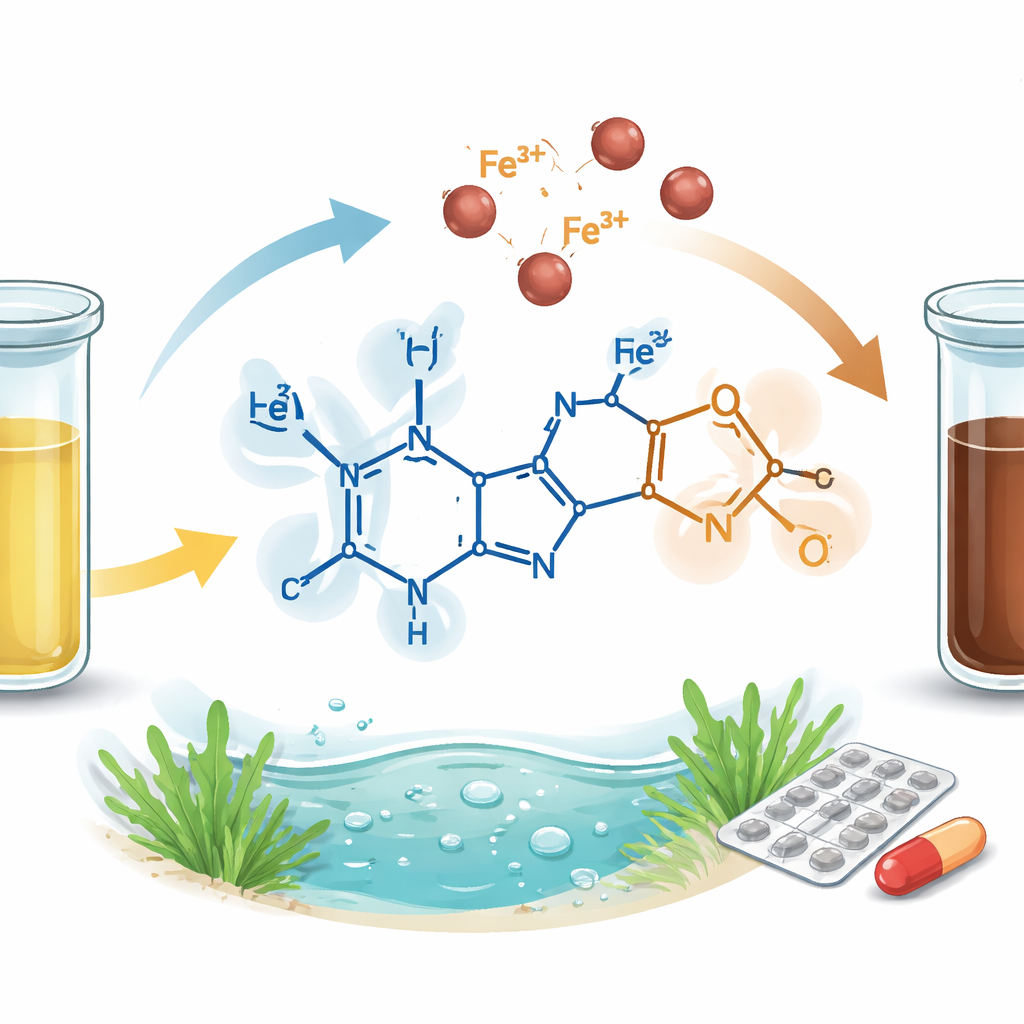
Iron is essential for life, but too much of it in drinking water or medicines can harm our bodies and damage pipes and ecosystems. Today, checking iron levels usually demands expensive machines and trained technicians in centralized labs. This study introduces a small organic molecule, called MPTP, that can simply turn a pale yellow solution brown when it encounters iron in its most common charged form (Fe3+). That visible color shift can be read by the naked eye or a basic light meter, making it far easier to monitor iron in rivers, tap water, and pharmaceutical products.
A tiny molecule that changes color
The researchers designed and synthesized MPTP from simple starting chemicals in a one-pot process, meaning all ingredients are combined in a single reaction step. The heart of MPTP is a thiazole ring, a compact ring-shaped structure that naturally attracts metal ions because it contains nitrogen and sulfur atoms, which act as gripping points. When MPTP is dissolved in ethanol, it appears pale yellow. As soon as Fe3+ ions are added, the solution shifts to a distinct brown color. That visible change reflects a rearrangement of electrons within the molecule as it binds iron, which alters how it absorbs light.
Seeing selectivity with the naked eye
For a practical test, a sensor must respond strongly to one target and ignore many look-alikes. The team challenged MPTP with a line-up of common metal ions, including copper, zinc, nickel, manganese, aluminum, and others. Only Fe3+ produced the striking brown color; all other samples stayed pale yellow. Light-absorption measurements backed this up: adding Fe3+ sharpened and slightly shifted MPTP’s main absorption band, and its intensity almost tripled, clear signs of a stable iron–sensor complex. The sensor also tolerated a wide range of acidity and alkalinity—from very acidic to quite basic water—while working best in the near‑neutral window typical of natural waters and biological fluids.
How firmly and how little it needs
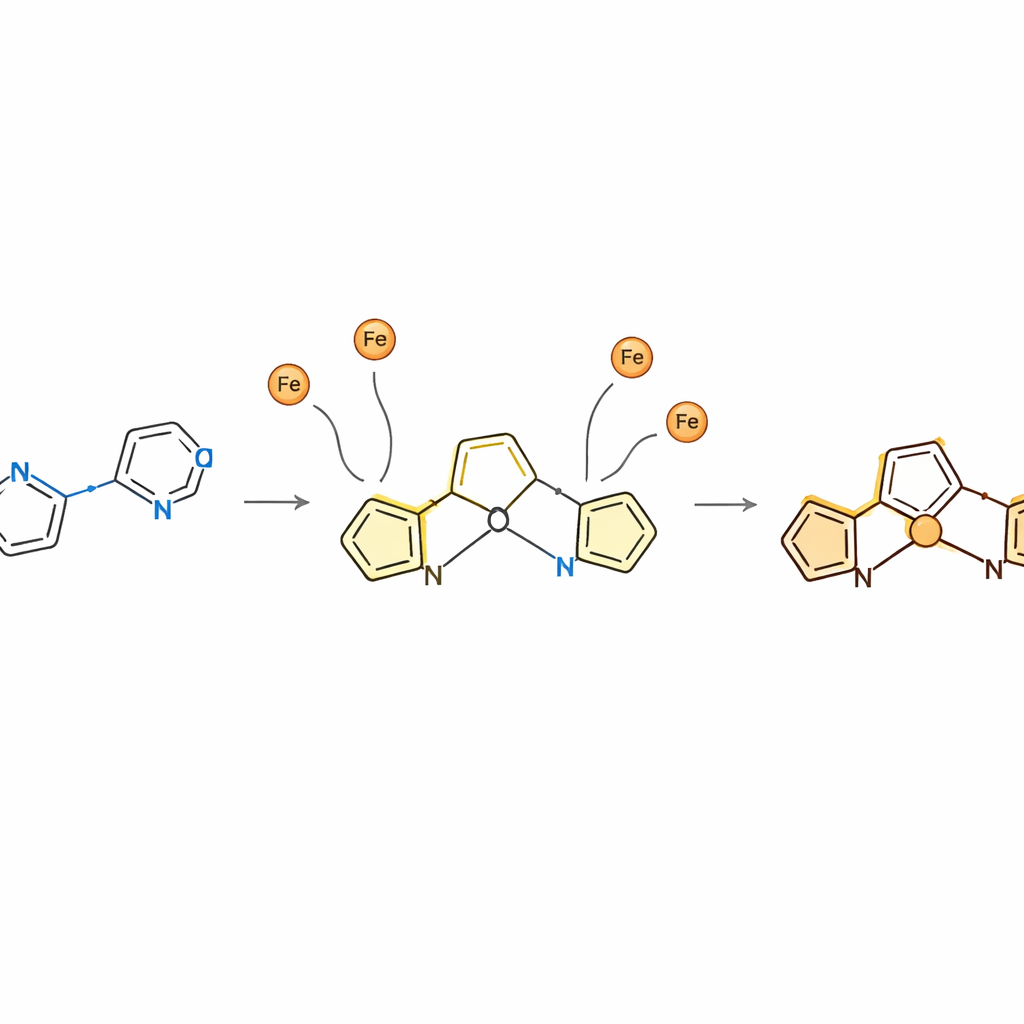
The team quantified how tightly MPTP holds onto Fe3+ and how little iron it can detect. Using a standard analysis of light-absorption changes as iron is added, they showed that one MPTP molecule binds one Fe3+ ion with a high binding strength. The smallest concentration it could reliably detect was about 0.27 micromoles per liter, well below the limit set for iron in drinking water by U.S. regulations. Importantly, the binding is not a one-way street: when a common cleaning agent, EDTA, is added, it steals the iron away and the solution turns back from brown to yellow. Re-adding Fe3+ restores the brown color. This reversible behavior means the same sensor solution or device can be used repeatedly.
From test tube to test strip
To move beyond the lab bench, the scientists soaked ordinary filter paper in an MPTP solution and let it dry. These strips looked off‑white to pale yellow at first. When dipped into water containing increasing amounts of Fe3+, they darkened stepwise from light beige to deep brown, creating a quick visual scale. Tests on real-world targets, including a commercial iron supplement tablet and simulated water samples, showed that the sensor recovered iron amounts very close to the known values (around 98–102% accuracy). Computer simulations of the molecule’s electron distribution supported the experimental picture, highlighting nitrogen-rich regions as the preferred binding sites for Fe3+ and explaining why the color change is so pronounced.
What this means for everyday testing
Taken together, the results show that MPTP is a robust, reusable, and easy‑to‑prepare color-changing probe for Fe3+. It responds quickly, works across a broad range of water conditions, picks out iron even when many other metals are present, and can be built into simple paper strips that require no power or instruments. For communities monitoring drinking water quality, manufacturers checking iron-containing medicines, or field workers surveying environmental sites, such a low-cost, visually read sensor offers a practical way to spot problematic iron levels before they become a risk.
Citation: Rakshitha, G.S., Karthik, C.S., Karuppasamy, K. et al. A robust aminothiazole-based colorimetric sensor for visual detection of Fe3+ ions in environmental and pharmaceutical samples. Sci Rep 16, 9399 (2026). https://doi.org/10.1038/s41598-026-38683-5
Keywords: iron sensing, colorimetric sensor, water quality, paper test strip, metal ion detection