Clear Sky Science · en
Headroom based adaptive droop control for regulating DC voltage and active power in MTDC grid with integrated renewable energy
Keeping the Lights On in a Renewable Future
As more electricity comes from wind farms and solar parks far from cities, power companies increasingly rely on high-voltage direct current (HVDC) “superhighways” to move that energy efficiently. But when clouds pass over a solar farm or a fault hits a converter station, sudden power swings can destabilize these DC grids and, in the worst case, trigger blackouts. This paper presents a smarter way for HVDC converter stations to automatically share the load and keep voltages steady, even when the grid is hit by major disturbances.
Why DC Power Highways Need Careful Steering
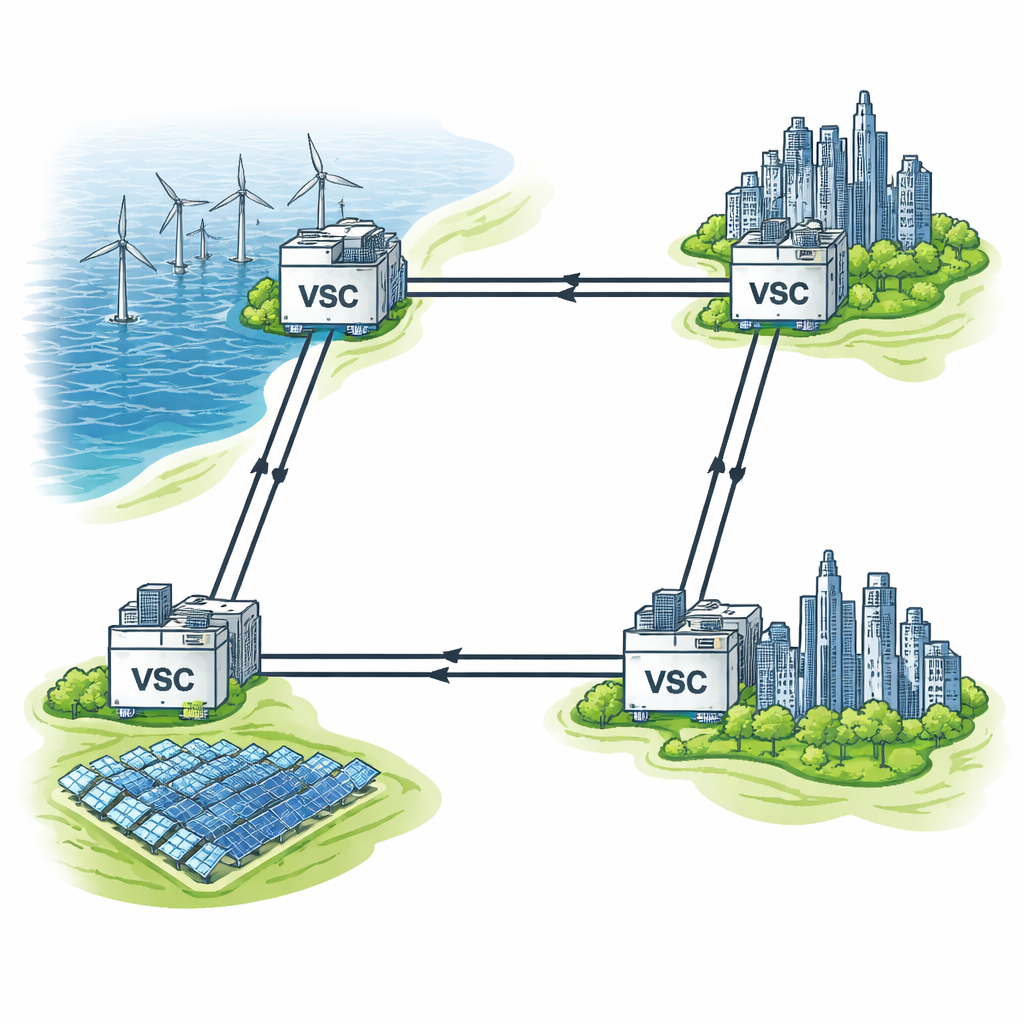
Today’s long-distance transmission often uses HVDC links built from voltage source converters (VSCs). When several such links are tied together, they form a multi-terminal DC (MTDC) grid that can collect power from multiple renewable sites and feed several AC networks at once. This setup promises flexibility and efficiency, but it also introduces a control challenge: every converter must decide, moment by moment, how much power to inject or absorb so that the common DC voltage stays within safe limits. Traditional “droop control” lets each station adjust its power based on the measured DC voltage, avoiding the need for fast communication between stations. However, in large disturbances—such as a sudden loss of a wind farm or a converter outage—this simple rule can push some converters beyond their rated capacity and cause dangerous DC voltage swings.
Limitations of Existing Smart Controls
Researchers have proposed more advanced control strategies, from hierarchical controllers to model predictive methods and so‑called variable droop control (VDC). Many of these methods still assume fixed rated capacities for the converters: they decide in advance how much each station should contribute to balancing the grid. Some newer schemes try to improve on this by including “headroom”—the unused capacity of a converter—but they often focus only on one side of the system (for example, the rectifier side that collects power from renewables), or they rely on communication networks that may fail during faults. As a result, when a big disturbance occurs, power can be shared unevenly and DC voltages can still overshoot or sag beyond safe boundaries.
A New Way: Using Headroom on Both Ends
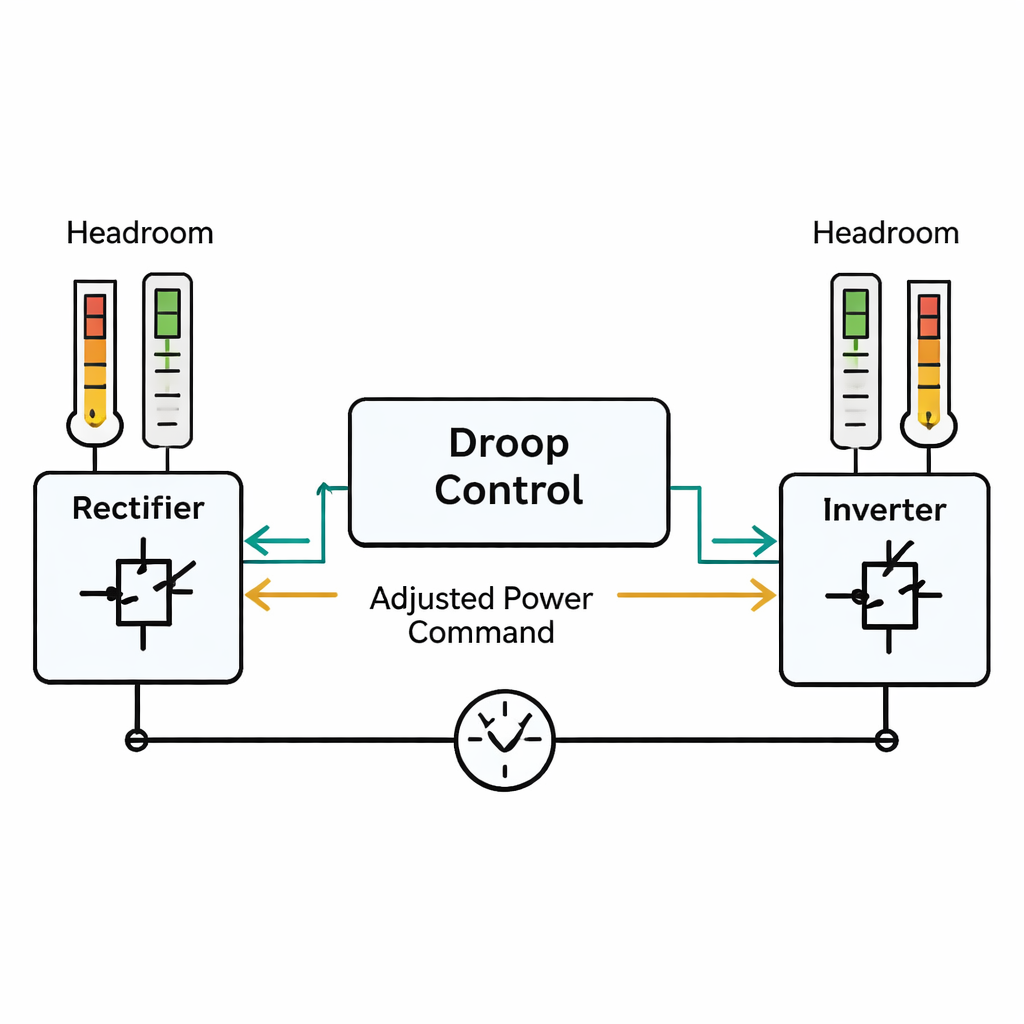
The authors propose a headroom-based adaptive droop control, or HR-ADC, that treats each converter’s remaining capacity as a key input to how it reacts to DC voltage changes. In simple terms, every rectifier (feeding power into the DC grid) and every inverter (taking power out) constantly checks how far it is from its own limits. That “headroom” value is then used to adapt the droop coefficient—the factor that converts a voltage deviation into a change in power output. Converters with more spare capacity automatically take on more of the balancing job, while ones close to their limits ease off. This adjustment happens locally at each station, using only its own measurements, so the method does not depend on fast communication links or a single “master” station.
Testing the Idea in a Virtual Power Grid
To see how the new control behaves, the team built a detailed computer model of a four-terminal MTDC grid operating at ±400 kilovolts. Two terminals represent renewable sources: a wind farm and a large solar plant. The other two connect to conventional AC grids. The researchers compared the proposed HR-ADC with a standard variable droop control using a series of demanding tests: sudden outages of each converter, and faults at the terminals of the wind, solar, and grid-side stations. In almost every scenario, the conventional scheme drove some converters to or beyond their rated power, leading to DC voltages rising above safe thresholds—sometimes up to 500 kilovolts or more. In contrast, HR-ADC automatically shifted operating modes and redistributed power according to available headroom, keeping DC voltage closer to its target band and avoiding severe overloads.
What Stable DC Voltage Means for Everyday Users
The study shows that by respecting each converter’s headroom and letting them react autonomously, HR-ADC can make DC grids that carry renewable energy more robust against faults and sudden power changes. For non‑experts, the key message is that this control method helps prevent the kind of voltage shocks and equipment overloads that can cascade into blackouts. While the approach still depends on reasonably accurate estimates of how much capacity each station has left, and it does not yet optimize for goals like minimizing losses, it already offers a practical way to make future offshore wind hubs and solar corridors more reliable. In short, smarter sharing of the load along our DC “superhighways” could make a renewable‑heavy power system both cleaner and more dependable.
Citation: Jiang, ZH., Raza, A., Ye, YD. et al. Headroom based adaptive droop control for regulating DC voltage and active power in MTDC grid with integrated renewable energy. Sci Rep 16, 7703 (2026). https://doi.org/10.1038/s41598-026-38678-2
Keywords: HVDC, multi-terminal DC grid, renewable integration, converter control, grid stability