Clear Sky Science · en
Effects of emotional motivation and cognitive control on prospective memory aftereffects of completed intention
Why our minds sometimes won’t let go
Most people know the feeling of double‑checking a locked door or almost sending a message that you already sent. This study explores why our brains sometimes cling to finished plans, causing us to repeat actions we no longer need to do. By looking at how emotions and mental control work together, the researchers show that “letting go” of completed intentions is not a simple on–off switch but a shifting balance that can either protect us from mistakes or push us into them.
Remembering to do things — and then to stop
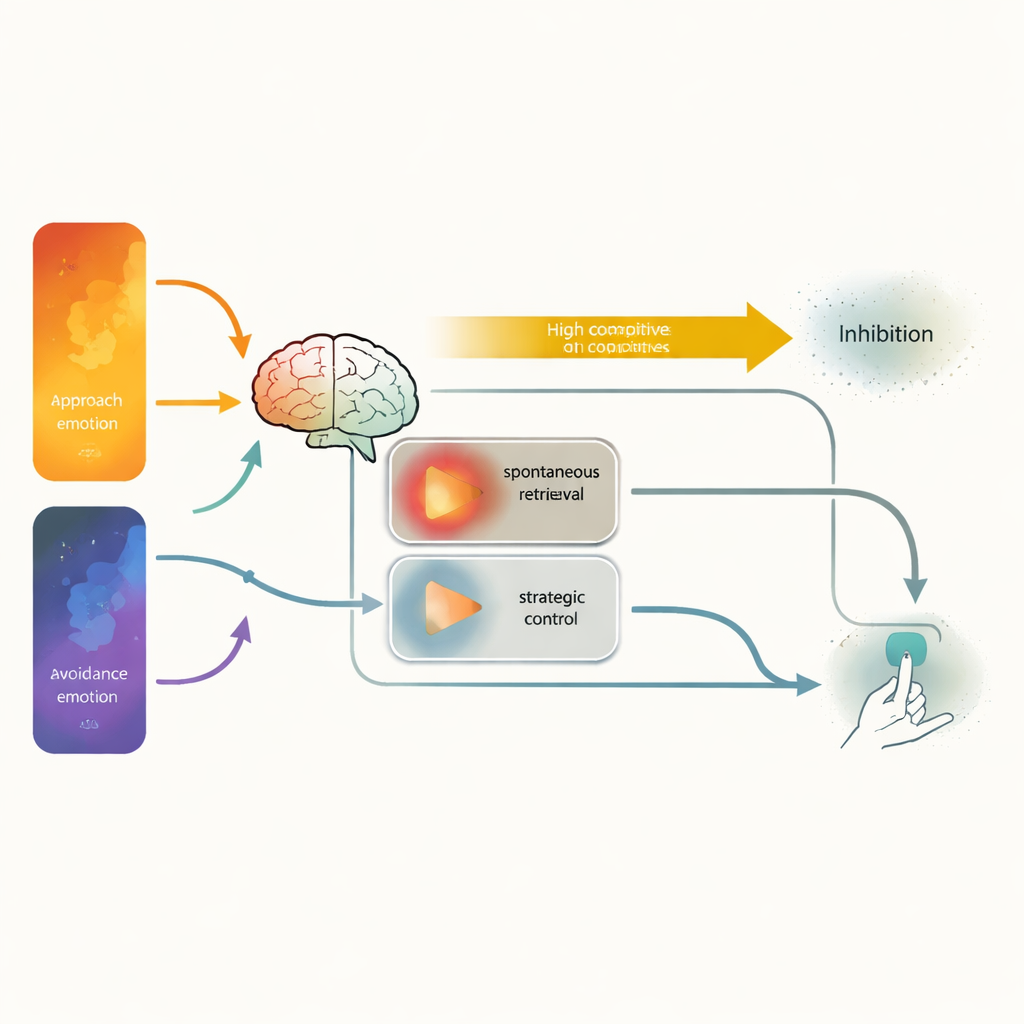
Psychologists call plans for the future “prospective memories,” such as remembering to take medicine at dinner. Once such a plan is carried out, its mental trace should fade or be turned off. Yet many experiments show that the old plan can stay active and even make people repeat the action by mistake. These “aftereffects” show up as slower reactions when people see an old reminder cue, or as outright commission errors, like pressing a special key even after being told that task is over. The authors build on theories that view these aftereffects as the product of two forces: automatic re‑awakening of the old plan when a cue appears, and deliberate control processes that try to shut it down.

How feelings in the background shape leftovers of plans
In the first experiment, volunteers performed a picture‑judging task while also remembering to press a key whenever certain special images appeared. Later, they were told that this prospective‑memory task had ended and they should ignore those images. Throughout, pictures with different emotional tones—some drawing people toward them (approach), others pushing people away (avoidance), and each at high or low motivational intensity—served as the background or as the special cues. The researchers found that positive, approach‑like backgrounds and calmer, low‑intensity scenes generally helped people perform both the ongoing task and the “finished” task more accurately and quickly. In contrast, strongly negative, avoidance‑type backgrounds slowed and disrupted performance, suggesting they soaked up mental resources.
When finished plans still grab priority
Even after the special task was declared over, old cues did not fully disappear from mind. Reaction times showed an “intention priority effect”: people responded more slowly to ordinary pictures than to the former target pictures, meaning the completed intention still claimed priority in processing. Moreover, commission errors were especially likely when a negative, avoidance‑type target cue appeared against a generally positive, approach‑like background. This pattern suggests that emotionally charged, threat‑like reminders can stand out and automatically re‑trigger the old plan, even when people otherwise have enough mental resources to perform well.
Zooming in on mental control
In the second experiment, the team focused on cognitive control—the mind’s ability to shift tasks, hold rules in mind, and inhibit actions. Here, some volunteers watched for specific target pictures (focal cues that closely matched the main task), while others watched for a less obvious signal: both picture borders turning green (non‑focal cues that required extra monitoring). At the same time, the background borders could be visually easy (congruent) or conflicting (incongruent). When cues were focal, people later showed stronger aftereffects: even after the task ended, old targets still triggered faster responses and more interference with the ongoing task. Congruent backgrounds, which demanded less control, allowed people in the completion phase to re‑direct extra mental resources to shutting down the finished intention, improving their performance compared with the activation phase.
A moving dial, not an off switch
Together, the two experiments paint a picture of completed intentions as lying on a sliding scale between fully active and fully shut down. Emotional motivation changes how loudly old cues “call out” to us and how many mental resources they consume, while cognitive control determines how much capacity remains to monitor and inhibit them. When emotional cues are strong or the task environment is demanding, automatic reactivation can win, leading to repeated actions. When the context is calmer and control resources are plentiful, strategic monitoring can quietly turn down the volume on old intentions. For everyday life, this means that both our emotional surroundings and our mental workload help decide whether we smoothly move on from a finished task—or find ourselves doing it again.
Citation: Duan, Y., Shen, L., Liu, W. et al. Effects of emotional motivation and cognitive control on prospective memory aftereffects of completed intention. Sci Rep 16, 9398 (2026). https://doi.org/10.1038/s41598-026-38675-5
Keywords: prospective memory, emotion and motivation, cognitive control, commission errors, intention deactivation