Clear Sky Science · en
Investigation into the mechanism of damage removal in the compaction zone using dynamic negative pressure perforation
Why cleaning tiny tunnels in rocks matters
Modern society leans heavily on underground energy systems—from oil and gas production to geothermal heat and even future carbon storage. All of these rely on small man‑made tunnels that connect a wellbore to deep rock layers so fluids can move freely. In reality, these tunnels often get clogged and squeezed shut right when they are created, choking off flow and wasting expensive wells. This study explores a newer technique called Dynamic Negative Pressure Perforation (DNPP), which uses a brief but powerful "suction" pulse to clean out that damage, and builds detailed models to understand how and when it works best.
How blasting a tunnel can block it
When engineers perforate a well, they use shaped explosive charges that fire a metal jet into steel casing, cement and rock at several kilometers per second. The jet rapidly drills narrow tunnels out into the reservoir, but it also crushes and compacts the surrounding rock. The result is a layered structure: loose debris in the tunnel, a tight compacted zone with much lower permeability, and untouched rock further out. The compacted zone behaves like a stiff, clogged skin that resists fluid flow, so even though the perforation reaches good rock, the well may underperform. Loose fragments and fine sand further block the pores, complicating later treatments such as water injection, acid stimulation, or hydraulic fracturing.
Using a brief suction pulse to clear the damage
DNPP tackles this problem by deliberately creating a short‑lived underpressure (suction) in the perforated interval right after the explosive fires. By lowering fluid levels and carefully sizing a gas‑filled chamber in the perforating gun, operators cause wellbore pressure to drop suddenly below the surrounding reservoir pressure. This makes formation fluids surge into the new tunnels, flushing away compacted debris. The authors first developed a mathematical model that tracks how pressure inside the wellbore and inside the perforating gun changes with time, as gas expands, fluid rushes in, and formation flow responds. Their calculations show that negative pressure peaks of roughly 20–50 MPa can arise over just 1–5 thousandths of a second, creating a strong but brief cleaning event. 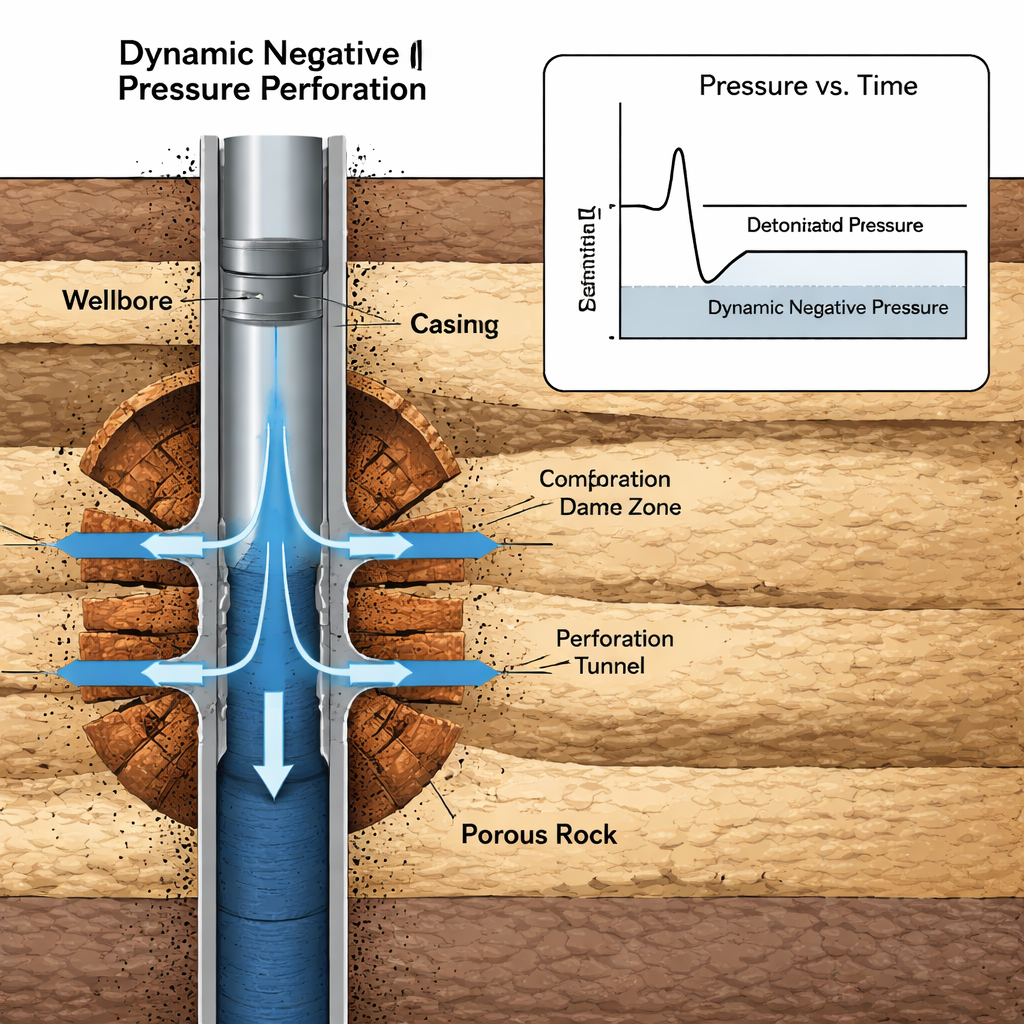
Peering inside the rock with virtual experiments
Because it is nearly impossible to reproduce all downhole conditions in the lab, the team turned to three‑dimensional computer simulations using a multiphysics tool. They built a model that couples rock mechanics with fluid flow through porous media to represent the wellbore, perforation tunnel and compacted zone. The rock behavior is described with equations that link stress, porosity, and permeability, while a failure criterion indicates when the compacted rock has been sufficiently weakened or broken so it effectively “lets go” and is considered cleaned. The simulations were run with realistic rock properties, stresses, and pressure histories, and were carefully checked for numerical stability and against published physical experiments, showing good agreement in how much damaged rock is removed.
What actually gets cleaned—and what doesn’t
The virtual experiments reveal that cleanup is strongest in the middle section of the perforation tunnel. At the moment of maximum negative pressure, fluid velocity in the compacted zone jumps by two to three orders of magnitude compared with its original state, with especially intense flow at mid‑depth. Most of the pressure drop occurs inside the damaged zone, so most incoming fluid originates in its pores, which enhances flushing there. Over tens to hundreds of milliseconds, the compacted rock in this region progressively fails and opens. Near the wellbore, cleanup is more limited, mainly stripping off the most compacted material. At the far tip of the tunnel, high confining stresses and lower flow make it hard for DNPP to remove damage, leaving this region as a persistent bottleneck. 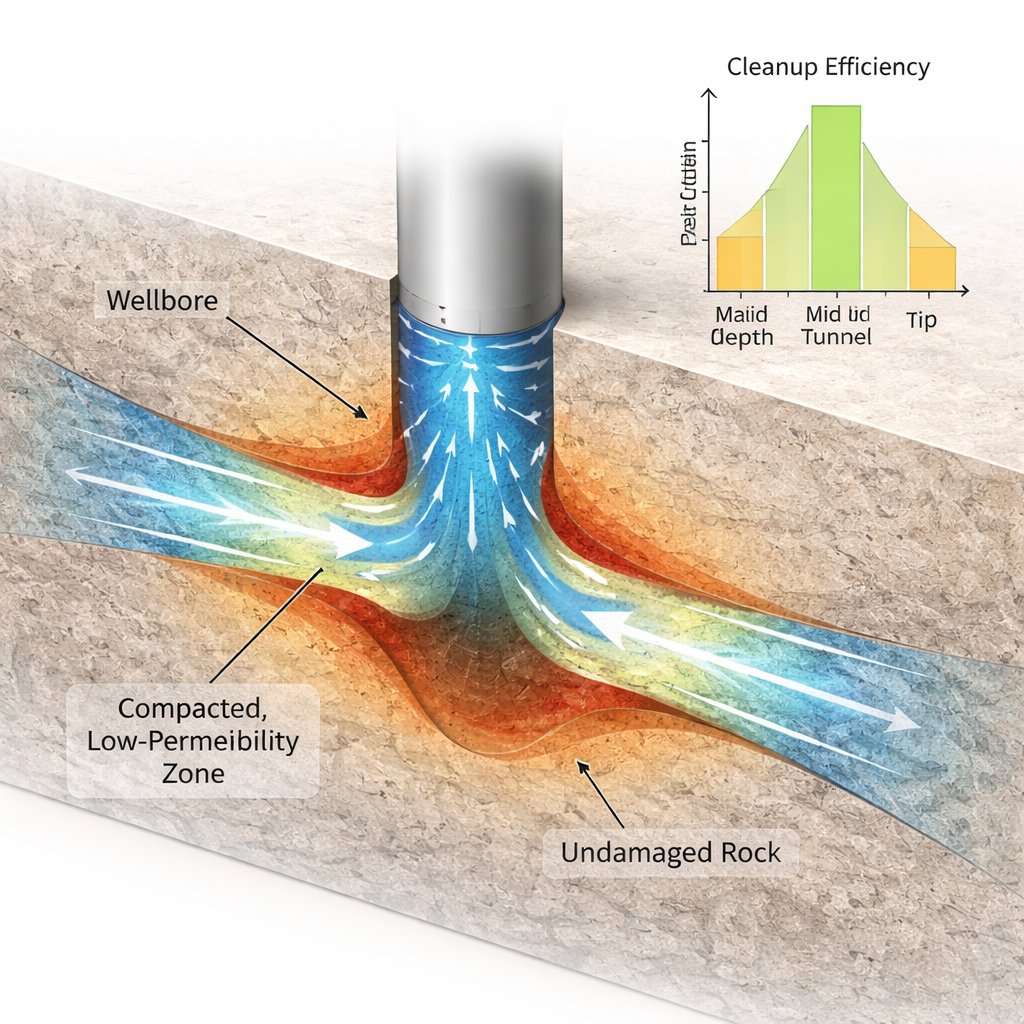
Finding the knobs that matter for design
To move from understanding to prediction, the authors systematically varied nine factors: the shape and duration of the negative pressure pulse, in‑situ stresses, and rock properties such as porosity, permeability, cohesion and internal friction angle. Using an orthogonal experimental design and stepwise regression, they found that only four parameters really dominate cleanup efficiency: peak dynamic negative pressure, the initial static underbalance before detonation, rock cohesion (how strongly grains stick together), and internal friction angle (how easily grains slide past each other). Higher peak and initial underbalance improve cleaning, while higher cohesion makes cleanup harder; a larger internal friction angle helps. From these relationships they built a simple linear formula that predicts cleanup efficiency and explains about 80% of the variation seen in their simulations, with prediction errors of only a few percent when compared to physical model tests.
What this means for wells and beyond
In practical terms, this work shows that DNPP can meaningfully reopen clogged perforation tunnels, especially around their mid‑section, and that engineers can use a compact formula to choose perforating gun designs and operating pressures that maximize cleanup in a given rock type. Although the study focuses on oil and gas wells in relatively brittle, homogeneous rocks, the same ideas—short‑lived underpressure, coupled rock‑fluid response, and data‑driven prediction—could help optimize near‑well cleanup in fields such as carbon storage, underground energy storage, and geothermal systems. For more complex rocks like shales or clay‑rich formations, the authors suggest extending the model to include swelling and other chemical effects, but the core message is clear: with a well‑timed suction pulse and the right rock properties, much of the hidden damage around perforation tunnels can be reversed.
Citation: Li, F., Li, Y., Zhang, Z. et al. Investigation into the mechanism of damage removal in the compaction zone using dynamic negative pressure perforation. Sci Rep 16, 7608 (2026). https://doi.org/10.1038/s41598-026-38667-5
Keywords: dynamic negative pressure, well perforation, compaction zone cleanup, oil and gas wells, reservoir permeability