Clear Sky Science · en
Novel synthesis of MoS2 nanoparticles via pulsed laser ablation in liquid for high-performance photodetection applications
Turning Light into Signals
From phone cameras to fiber‑optic internet, modern life depends on devices that turn light into electrical signals. Many of these sensors are built from silicon, a workhorse material whose performance is now being pushed to its limits. This study explores a new way to boost light detection by coating silicon with ultra‑small particles of molybdenum disulfide (MoS₂), a layered material already famous for use in next‑generation electronics. The researchers also show how a common soap‑like additive can make these particles more orderly and, in turn, make the detector more sensitive.
Making Tiny Particles with a Laser in Liquid
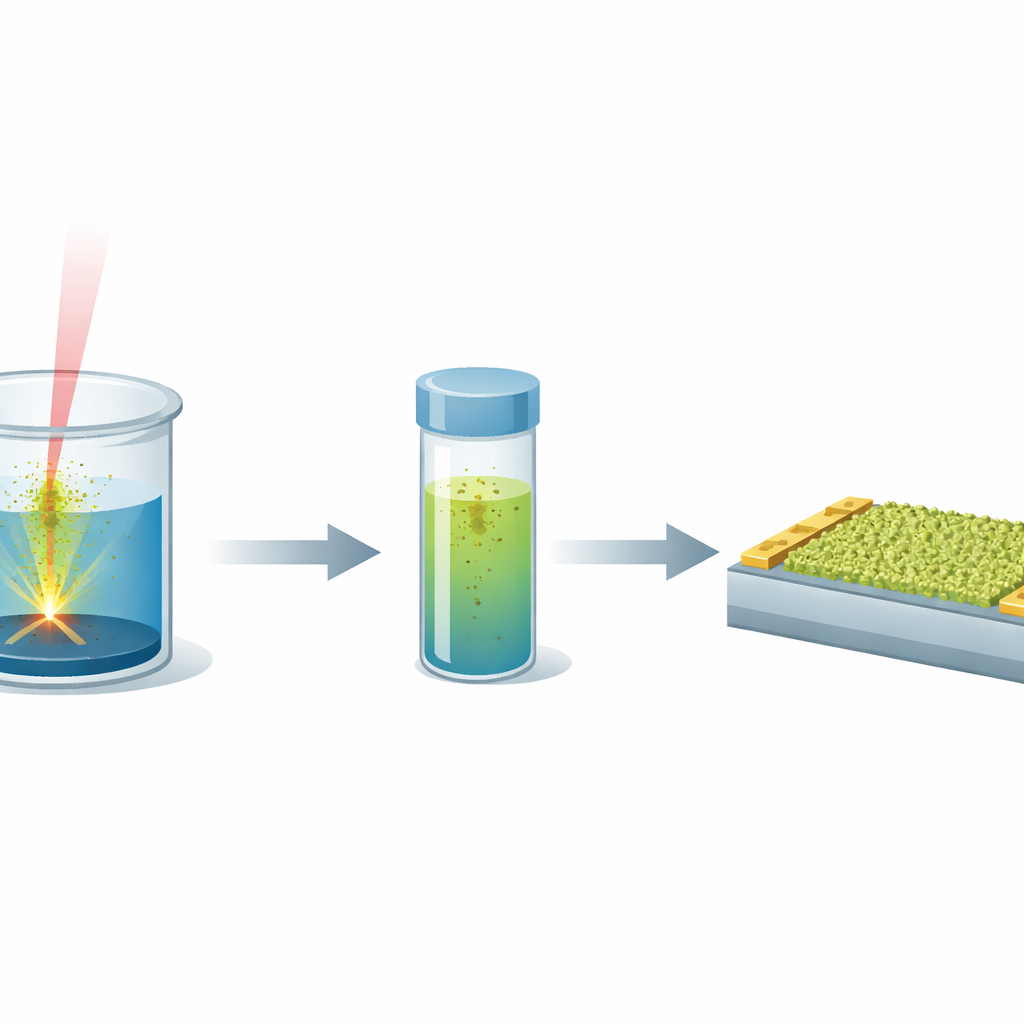
Instead of using complex chemical recipes, the team produced MoS₂ nanoparticles by firing short, powerful laser pulses at a solid molybdenum metal disk sitting at the bottom of a beaker filled with liquid. Each laser pulse blasts off a tiny plume of hot metal atoms into the surrounding solution. The liquid contains thiourea, a sulfur‑bearing compound. Under the intense conditions near the laser plume, thiourea breaks apart and releases sulfur, which quickly reacts with molybdenum to form MoS₂ particles dispersed in the liquid. In a second version of the recipe, they added sodium dodecyl sulfate (SDS), a surfactant similar to ingredients found in household detergents, so that its molecules could wrap around the forming particles and keep them from clumping together.
How a Soap‑Like Additive Shapes the Nanoworld
By examining the products with X‑ray diffraction, electron microscopes, and vibrational spectroscopies, the researchers confirmed that both routes produced crystalline MoS₂ with a hexagonal atomic arrangement. Yet the liquids left a clear fingerprint on the particle shapes. Without SDS, the particles tended to stick together, forming rough, cauliflower‑like clusters tens of nanometers across. With SDS present, the negatively charged ends of the surfactant molecules attached to the particle surfaces while their tails pointed into the liquid, creating a barrier that kept the particles apart. This yielded more uniform, well‑defined MoS₂ grains with cleaner surfaces and fewer defects. Optical measurements showed that the particles made with SDS had a slightly larger effective band gap, a sign that they were smaller and better separated, which changes how they absorb light.
Building a Better Silicon Light Sensor
To test whether these nanoscale differences matter in real devices, the team deposited thin films of the MoS₂ nanoparticles onto polished p‑type silicon wafers, forming what engineers call a heterojunction: two different semiconductors joined together. Metal contacts were then added so that current could be measured. When no light was present, the junction acted like a diode, allowing current to pass mainly in one direction, which is essential for stable detector operation. Under illumination, incoming photons created electron–hole pairs near the junction. The built‑in electric field at the boundary between MoS₂ and silicon pulled these charges apart, generating a measurable photocurrent.

Sharper Vision from Cleaner Nanoparticles
Comparing the two device versions revealed the power of the surfactant‑assisted route. The detector made from MoS₂ synthesized with SDS delivered higher responsivity—about 1 ampere of current per watt of incoming light around 650 nanometers, a deep red color—compared with roughly 0.9 ampere per watt without SDS. It also showed better detectivity, a measure of how well it can pick out weak signals from noise, and higher external quantum efficiency, meaning more of the incoming photons were successfully converted into charge carriers. These improvements were traced to a cleaner, less clumped MoS₂ layer, which reduced unwanted recombination of charges and widened the region over which light‑generated carriers can be separated and collected.
Why This Matters for Future Optoelectronics
In plain terms, the study shows that a green, relatively simple laser‑in‑liquid method can make high‑quality MoS₂ nanoparticles that, when paired with silicon, act as highly sensitive eyes for visible and near‑infrared light. Adding a soap‑like surfactant during growth makes the particles more uniform and better dispersed, which in turn sharpens the detector’s vision—allowing it to respond strongly and predictably to red light while remaining competitive with other advanced silicon‑based designs. This combination of straightforward fabrication, environmentally friendly processing, and strong performance suggests a promising path toward next‑generation cameras, optical communications hardware, and other light‑sensing technologies.
Citation: Shaker, S.S., Rawdhan, H.A., Ismail, R.A. et al. Novel synthesis of MoS2 nanoparticles via pulsed laser ablation in liquid for high-performance photodetection applications. Sci Rep 16, 9147 (2026). https://doi.org/10.1038/s41598-026-38647-9
Keywords: molybdenum disulfide, nanoparticles, laser ablation in liquid, silicon photodetector, surfactant engineering