Clear Sky Science · en
A cross-sectional survey of myopia prevalence and its influencing factors among school children and adolescents under the double reduction policy
Why this matters for kids’ eyes
More and more children around the world are becoming nearsighted, meaning they can see nearby objects clearly but distant ones appear blurry. This study looks closely at schoolchildren in one urban district of Hangzhou, China, at a time when the government has tried to ease academic pressure through a “double reduction” policy that cuts back homework and after-school tutoring. The researchers wanted to know: Are children’s eyes actually benefiting, and which everyday habits still push vision toward or away from myopia?
A closer look at students’ daily lives
The team surveyed 1,584 students aged 9 to 14 from three primary schools and three junior high schools. Each child had a standard eye exam to check how clearly they could see distant targets and to measure how their eyes focused light. The students then filled out a detailed computer-based questionnaire about their daily routines, including time outdoors, screen use, homework, sleep, eating and drinking habits, and where and how they usually read and write. By combining precise measurements of vision with rich lifestyle information, the researchers could tease apart which common behaviors were most strongly linked with myopia.
How common myopia is and who is most affected
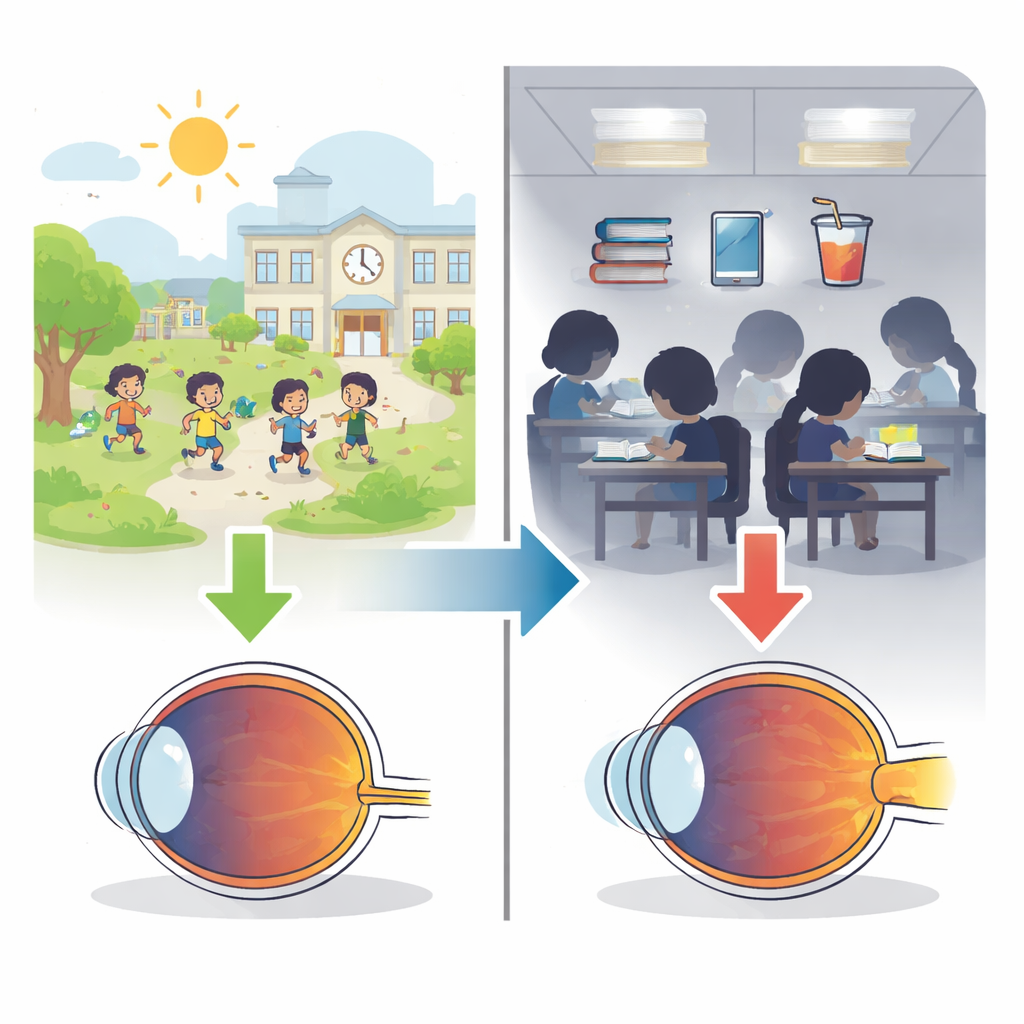
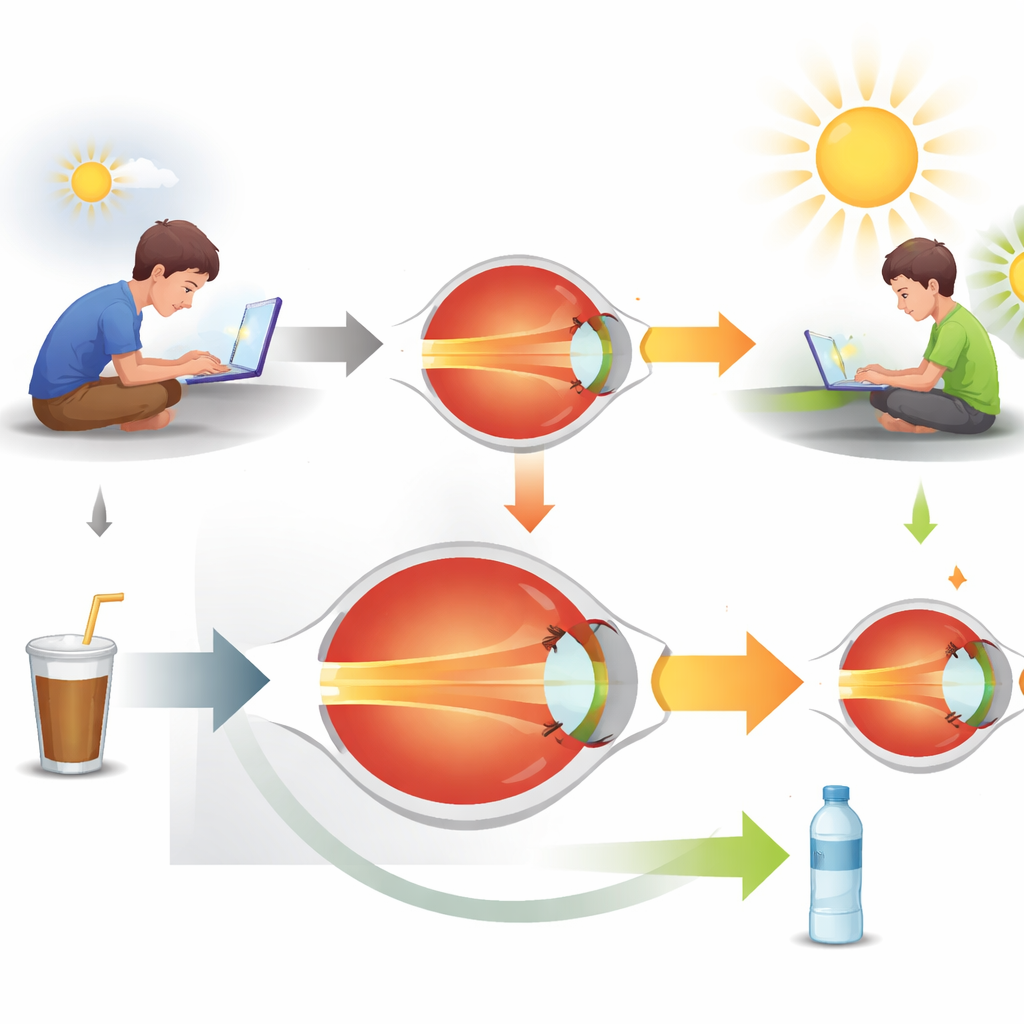
The findings were sobering: nearly two out of three students (64.2%) were nearsighted, and the problem worsened rapidly with age. About four in ten nine-year-olds had myopia, climbing to more than eight in ten by age 14. Girls were more likely to be myopic than boys. Children with one or two nearsighted parents had a notably higher chance of being myopic themselves, reflecting both inherited tendencies and shared habits at home. The researchers also found that students who drank sugary beverages more often, spent more time on homework, or used screens for two or more hours per day were more likely to have myopia, even after accounting for age and family background.
Everyday habits that help protect young eyes
Not all results were gloomy. Several simple behaviors were linked with a lower chance of myopia. Children who spent more time outdoors each day—especially those reaching two or more hours—were less likely to be nearsighted. Having recess outside on the playground rather than inside the school building also appeared protective. Good lighting mattered as well: students who used both a ceiling light and a desk lamp while studying at night had healthier vision than those relying on only one type of light. A classic rule taught in Chinese classrooms—keeping about a “one-foot” distance between eyes and book—also showed up as helpful. Children who always maintained this reading distance had lower myopia risk, suggesting that how close we hold our work can matter as much as how long we look at it.
Turning numbers into a practical risk score
To make their findings useful in the real world, the researchers built a simple scoring tool, called a nomogram, that blends the strongest factors into a single risk estimate for each child. Age, sex, whether parents are myopic, daily outdoor time, homework load, screen use, lighting, reading distance, and where recess is spent all contribute points. Adding these gives a total score that corresponds to the chance that a student is nearsighted. When the team tested this tool on different subsets of their data, it reliably separated higher-risk from lower-risk students, suggesting it could help school doctors and eye specialists quickly flag children who would most benefit from closer follow-up and early intervention.
What this means for families and schools
Even under a policy that aims to lighten schoolwork, myopia remains very common among Chinese schoolchildren, and it is tightly bound to everyday choices. The study suggests that encouraging more outdoor play, balancing screen time, ensuring bright and well-placed lighting, and keeping books at a healthy distance can all work together to protect young eyes. At the same time, limiting sugary drinks and unnecessary homework may help reduce strain. Because no single group can solve the problem alone, the authors call for long-term cooperation among families, schools, health workers, and policymakers to build daily routines that support both learning and clear vision.
Citation: Zhang, C., Shen, L., Cai, Y. et al. A cross-sectional survey of myopia prevalence and its influencing factors among school children and adolescents under the double reduction policy. Sci Rep 16, 9155 (2026). https://doi.org/10.1038/s41598-026-38643-z
Keywords: myopia in children, screen time and eyesight, outdoor activity and vision, homework load and eye health, double reduction education policy