Clear Sky Science · en
Symmetry driven altermagnetic spin splitting in hexagonal CrTe from first principles
Why this hidden magnet matters
Modern electronics mostly uses the charge of electrons, but their spin—a tiny built‑in magnet—can also carry information. Devices that harness spin, a field known as spintronics, promise faster, cooler, and more energy‑efficient technologies. However, the usual magnetic materials create stray fields that interfere with neighboring components. This study explores a surprising magnetic state in a common compound, chromium telluride (CrTe), that can generate strongly spin‑polarized currents while having no overall magnetization, making it an appealing platform for future spin‑based devices. 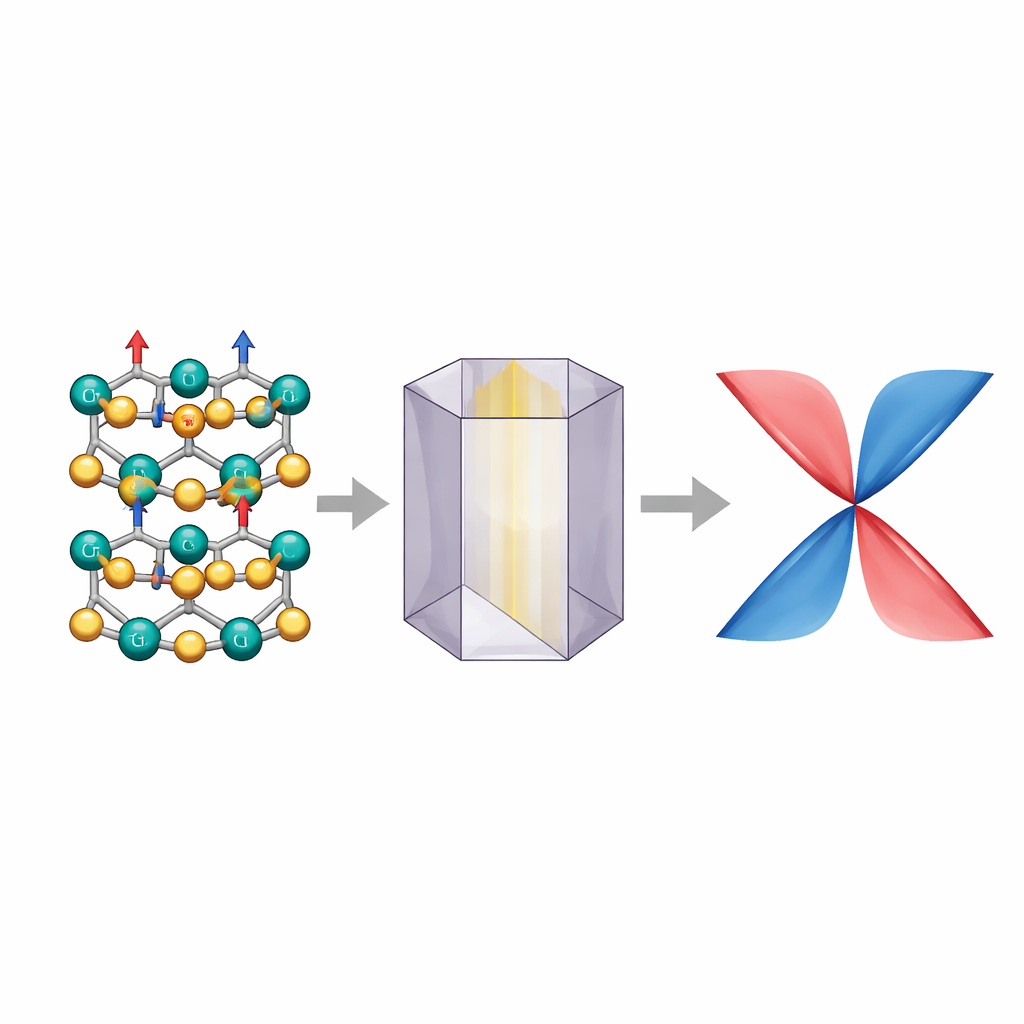
A new kind of magnet without a north pole
Traditional magnets, like fridge magnets, are ferromagnets: their atomic spins line up, giving a clear north and south pole. Antiferromagnets, by contrast, have neighboring spins pointing in opposite directions so their magnetization cancels out, usually leaving little spin signal to work with. The recently proposed class of “altermagnets” breaks this dichotomy. In altermagnets, spins still alternate and cancel globally, but the underlying crystal symmetry causes electrons with opposite spins to occupy very different energy paths. The result is a band structure split strongly by spin—resembling that of a ferromagnet—yet with zero net magnetization, more like an antiferromagnet. This unusual combination allows robust spin currents without disruptive stray fields.
Revisiting chromium telluride’s magnetic identity
CrTe is a well‑known material whose magnetism changes with temperature: it is paramagnetic (disordered) at high temperature, ferromagnetic at moderate temperature, and commonly labeled antiferromagnetic at low temperature. Using advanced quantum‑mechanical simulations based on density functional theory, the authors re‑examined the low‑temperature hexagonal phase of CrTe. They modeled the positions of chromium and tellurium atoms in the crystal and imposed a collinear spin pattern where neighboring chromium layers carry opposite spins. Despite the overall cancellation of magnetization, they found large spin‑dependent splittings in the electronic bands along a specific path in momentum space, labeled L′–Γ–L. This splitting, about 1 electron‑volt in size, is comparable to that of established altermagnets such as CrSb and MnTe, signaling that CrTe belongs in the same family.
Where the spin splitting comes from
To uncover the microscopic origin of this effect, the researchers dissected which atomic orbitals contribute near the energy range most relevant for conduction. They showed that chromium’s d‑orbitals dominate the states just below and above the Fermi level, with tellurium’s 5p‑orbitals also playing a notable supporting role. Detailed maps of the band structure reveal that the spin‑up and spin‑down branches are mirror images across the center of the Brillouin zone: bands with spin‑up character on one side are matched by spin‑down bands on the other. At the same time, the total number of spin‑up and spin‑down electrons remains equal, so the macroscopic magnetization is zero. The authors further visualized charge and spin densities in real space, finding tri‑lobed, d‑orbital‑like spin patterns on chromium atoms that rotate and change sign between neighboring layers. This rotation‑plus‑inversion symmetry directly ties the crystal’s geometry to the unusual spin behavior in momentum space. 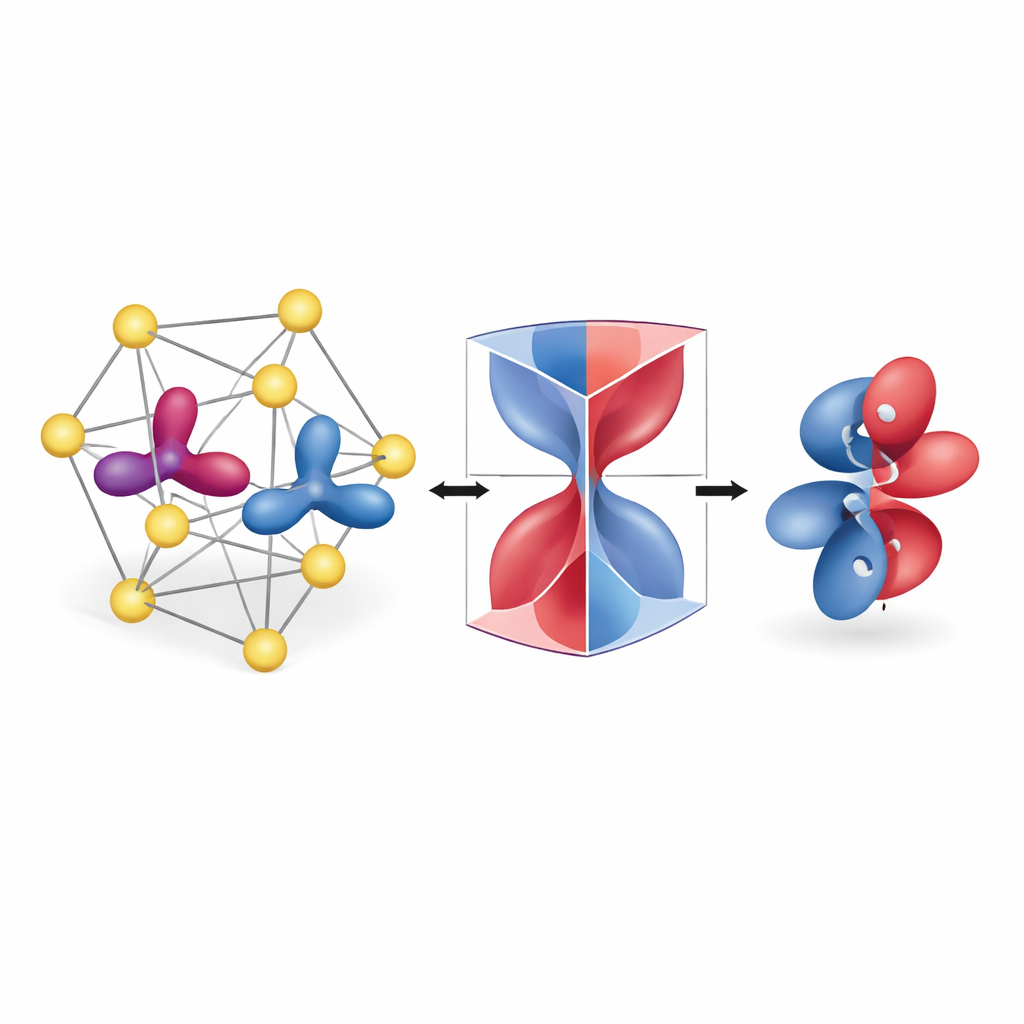
Spin‑selective highways on the Fermi surface
Beyond individual bands, the team analyzed CrTe’s Fermi surface—the set of states that conduct electricity. Even without including spin‑orbit coupling, they found a striking pattern: along one direction in momentum space, the Fermi level is crossed more often by bands of one spin than the other, and this imbalance is reversed along the opposite direction. In three dimensions, the Fermi surface shows a clover‑like, so‑called g‑wave spin texture, where the dominant spin character alternates as one moves around the crystal directions. This momentum‑dependent spin texture is a defining fingerprint of altermagnetism and implies that electric currents flowing along different directions can naturally become spin‑polarized, without any external magnetic field.
What this means for future devices
Putting these pieces together, the study shows that hexagonal CrTe is not just an ordinary antiferromagnet but an altermagnet: it hosts large, symmetry‑protected spin splitting in a state with no net magnetization. The key conducting states are built mainly from chromium d‑orbitals hybridized with tellurium p‑orbitals, and they form spin‑selective channels on the Fermi surface. Because CrTe remains metallic in this phase, it can in principle carry robust spin currents whose direction and character are encoded in the crystal symmetry rather than in a macroscopic magnetic field. These properties make CrTe a promising platform for spintronic technologies that aim to use pure spin currents for information processing, reducing unwanted magnetic interference while still harnessing strong spin effects inside an apparently “field‑free” material.
Citation: Singh, R., Huang, HL., Lai, CH. et al. Symmetry driven altermagnetic spin splitting in hexagonal CrTe from first principles. Sci Rep 16, 10458 (2026). https://doi.org/10.1038/s41598-026-38641-1
Keywords: altermagnetism, chromium telluride, spintronics, spin splitting, antiferromagnetic materials