Clear Sky Science · en
Four genetically distinct types of rabies virus exist in Vietnam, including the SEA1 and SEA3 subclades within the Asian clade
Why rabies in Vietnam matters to everyone
Rabies is almost always deadly once symptoms appear, but it is also completely preventable. Vietnam, like many countries in Asia and Africa, still struggles with dog‑borne rabies, leading to human deaths each year and forcing hundreds of thousands of people to seek emergency vaccination after dog bites. This study takes a deep look at the rabies viruses circulating in Vietnam and how they move across borders with neighboring China, Laos, and Cambodia. By decoding the viruses’ genetic fingerprints, the researchers show that there are several distinct types spreading through the region, and that dog and human infections are tightly linked. Their findings point to where control efforts should focus if the world is to meet the goal of ending dog‑mediated human rabies deaths by 2030.
Dog bites, fear, and lifesaving shots
Vietnam has been officially working to control rabies since 2009, following a global plan that aims for “Zero by 30” — zero human deaths from dog‑mediated rabies by 2030. Yet the country still reports dozens of human deaths every year, and around half a million people receive post‑exposure prophylaxis (PEP), the series of shots that can stop rabies after a bite. Vaccination of dogs is the cornerstone of prevention, but coverage is uneven and still too low overall, especially in rural areas. The COVID‑19 pandemic added a twist: strict lockdowns reduced travel and outdoor activity, which temporarily lowered reported dog bites and PEP use. When border crossings and routine life resumed, PEP numbers climbed again, suggesting that changes in human and animal movement strongly influence when and where rabies risk spikes.
Reading the virus’s genetic fingerprints
To understand how rabies is spreading, the researchers examined virus samples from both people and dogs across northern and central Vietnam between 2011 and 2025. They focused on two levels of genetic detail. First, they analyzed a key viral gene, the nucleoprotein gene, which is widely used to compare rabies strains worldwide. Second, for a subset of samples, they sequenced the entire viral genome, providing a much sharper picture of how closely related individual viruses are. This allowed them to place Vietnamese viruses onto the global family tree of rabies and to see whether the viruses infecting humans were the same as those circulating in dogs.
Four main virus families and busy borders
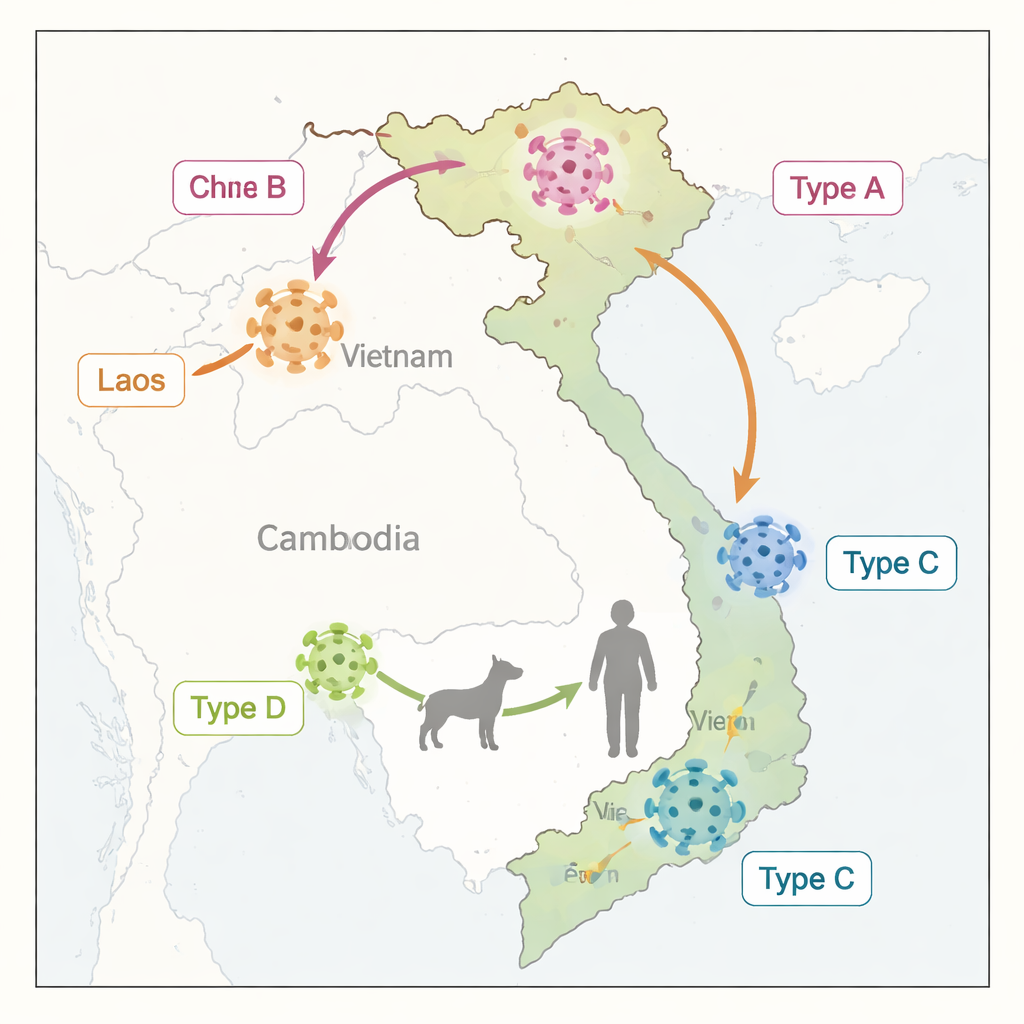
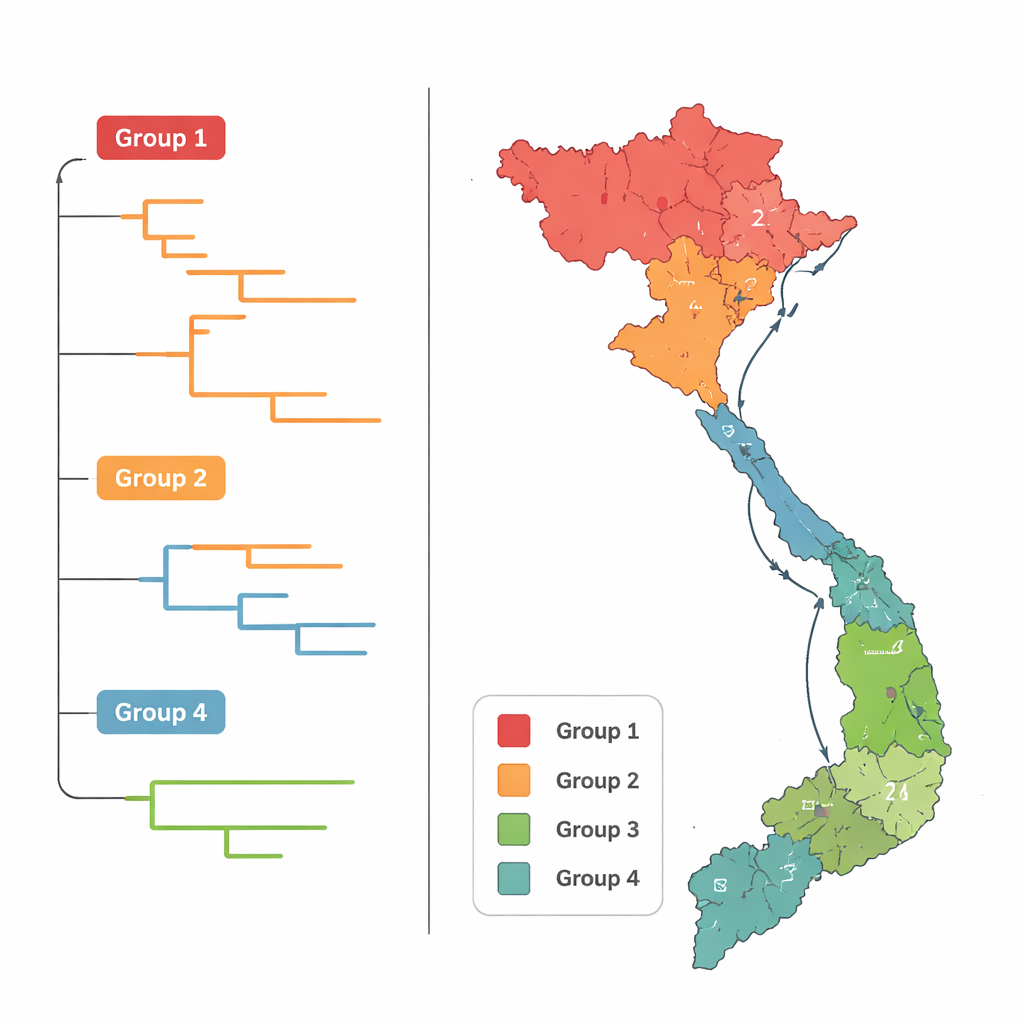
The genetic analyses revealed that all Vietnamese rabies viruses belonged to the broader Asian branch of the rabies family, but within that branch they fell into four clearly distinct genetic groups. Most belonged to a subgroup called SEA1 and a smaller fraction to SEA3, a pattern shared with neighboring countries. Some Vietnamese strains were nearly identical to viruses previously found just across the border in China’s Yunnan and Guangxi provinces, indicating that rabies does not respect political boundaries. These cross‑border‑related strains tended to be found along major transport routes, such as highways and rail lines linking border provinces to Hanoi and further south, hinting that the movement of dogs and their owners may be carrying the virus along these corridors. Other strains appeared to be unique to Vietnam and were scattered across multiple provinces, suggesting that they have become established within the country’s own dog populations.
Dogs and people share the same viral threats
By comparing viruses from dog brains with those from human saliva and spinal fluid, the team found very high genetic similarity, sometimes even identical sequences, between canine and human cases in the same areas. This confirms what public health officials have long suspected: in Vietnam, dogs are the main source of rabies in people. The full‑genome data also showed that viruses from different provinces tended to cluster together, revealing subtle, region‑specific patterns that are invisible if only a single gene is examined. However, the number of full genomes available from Vietnam and neighboring countries is still limited, so the authors stress that more widespread sequencing would help track outbreaks and detect newly imported or emerging strains more quickly.
What this means for stopping rabies
To a non‑specialist, the key message is straightforward: Vietnam is grappling with several closely related families of rabies virus, some shared with neighboring countries and some home‑grown, but all moving mainly through dogs and the people who live and travel with them. Because these viruses cross borders and follow transport routes, no single province — or even single country — can control rabies on its own. The study supports a “One Health” approach, in which human health, animal health, and environmental agencies coordinate surveillance, share genetic data, and strengthen dog vaccination campaigns, especially in border regions. If those efforts are expanded and sustained, both the human toll and the economic burden of rabies — from emergency shots, medical care, and lost livestock — could be sharply reduced, bringing the world closer to making rabies deaths a thing of the past.
Citation: Harada, M., Nguyen, T.T., Nguyen, D.V. et al. Four genetically distinct types of rabies virus exist in Vietnam, including the SEA1 and SEA3 subclades within the Asian clade. Sci Rep 16, 7357 (2026). https://doi.org/10.1038/s41598-026-38638-w
Keywords: rabies, Vietnam, dog vaccination, cross-border disease, viral genomics