Clear Sky Science · en
Influence of land-use types on soil microbial communities and nutrient changes in Xinyang City, China
Why the life beneath our feet matters
When we look at a field, a forest, or a patch of wild grass, we usually notice the plants and animals above ground. But hidden just a few inches below the surface lives an immense community of microbes—bacteria and fungi—that quietly power food production, carbon storage, and clean water. This study from Xinyang City in central China asks a deceptively simple question with big implications: how do different ways of using land—plantation forest, natural grassland, or intensively managed cropland—change the tiny life in the soil and the nutrients those microbes depend on?
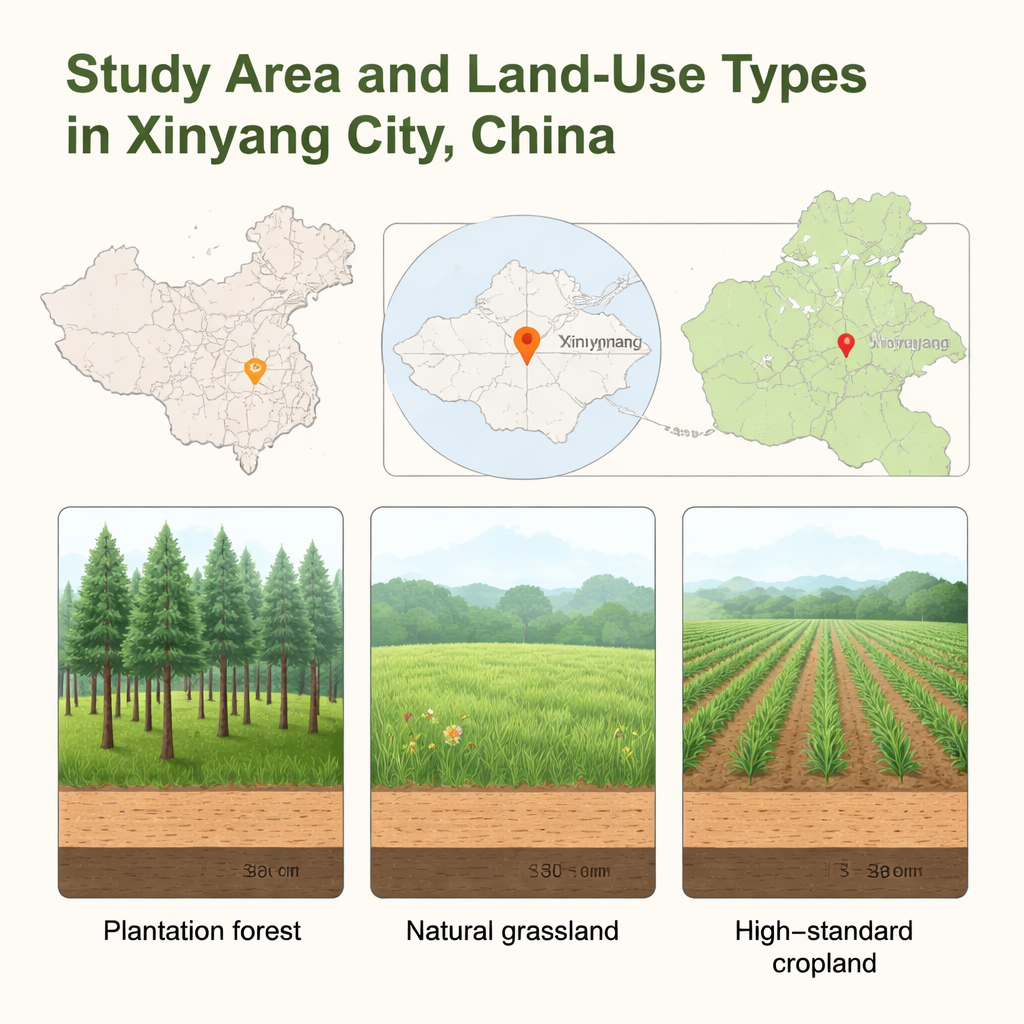
Three neighboring landscapes, one living laboratory
The researchers focused on three common land types that sit side by side in Miaoshan Village: a mature pine plantation, a nearly unmanaged natural grassland, and a high-standard maize cropland fertilized and tilled each year. Because these sites share the same climate and underlying soil, differences in their underground life can largely be traced back to how people use the land. In each area, the team collected soil from two layers: the top 15 centimeters, where roots and organic debris are most abundant, and the 15–30 centimeter layer beneath, which is darker, denser, and usually poorer in fresh organic matter.
Testing soil like a health checkup
To understand soil “health,” the scientists measured moisture, acidity, and key nutrients such as nitrogen, phosphorus, potassium, and organic matter. They then extracted DNA from the soil to profile bacterial and fungal communities, using high-throughput sequencing to identify which groups were present and how diverse they were. Finally, they used statistical tools and network diagrams to see how strongly different microbial groups were connected to one another and which soil conditions best explained these patterns. In essence, the study combined a chemical checkup of the soil with a census of its microscopic residents and a social-network analysis of who interacts with whom.
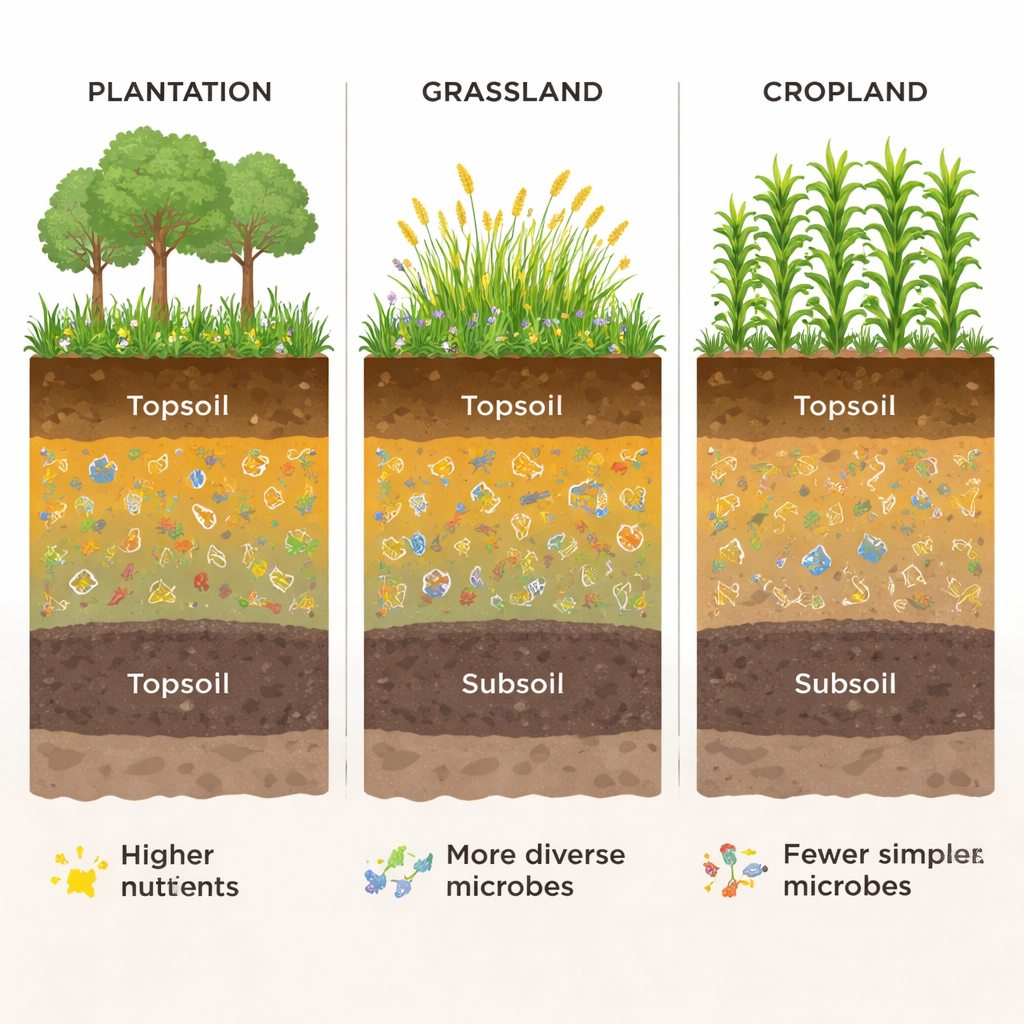
Forests feed soil life; deep soil lags behind
The results show a clear winner for underground biodiversity. Plantation soils held the richest supply of organic matter and nutrients, followed by grassland, with cropland lagging far behind. The same ranking appeared in the diversity of both bacteria and fungi: highest in the pine plantation, moderate in the grassland, and lowest in the intensively managed maize field. In all three land uses, the upper soil layer was moister, more nutrient-rich, and home to more varied microbial communities than the subsoil below. Certain broad groups of bacteria and fungi dominated across all sites, but their relative importance shifted: nutrient-loving microbes flourished in cropland, while forest soils favored groups adapted to acidic conditions and wood decay.
Complex underground societies in the forest
Beyond simple counts of species, the team examined how strongly different microbes tended to appear together, a clue to cooperation, competition, and shared niches. Here again, plantations stood out. Their microbial “social networks” were the most densely connected, suggesting a web of interactions that may help stabilize ecosystem functions such as decomposition and nutrient cycling. Grassland networks were somewhat less intricate, and cropland networks were the sparsest and simplest. Topsoil harbored more complex interaction networks than subsoil in every land type, reflecting the richer and more dynamic environment near the surface where roots, litter, and changing moisture constantly reshape microbial habitats.
Nutrients as the hidden link between land use and microbes
Using path analysis, the researchers showed that land use and soil depth did not influence microbial life directly so much as they altered nutrient availability. Forests and topsoil layers boosted stores of phosphorus and potassium, both in total form and in forms that plants and microbes can readily use. These nutrient gains, in turn, supported higher microbial diversity. In croplands and deeper layers, repeated disturbance and lower organic inputs depleted nutrients, which coincided with poorer and less connected microbial communities. Overall, land-use type emerged as the single most important driver of microbial diversity, with soil depth and nutrient levels playing supporting but significant roles.
What this means for land management
For non-specialists, the message is straightforward: how we use land above ground strongly shapes the invisible communities that keep soils fertile and resilient. Forest-like systems with thick litter layers and minimal disturbance act as nutrient banks that foster rich, well-connected microbial life. Grasslands offer an intermediate level of support, while heavily tilled and fertilized croplands tend to lose both nutrients and underground biodiversity over time. By recognizing that soil microbes respond to land management through changes in nutrients, farmers, foresters, and planners can design practices—such as reduced tillage, residue retention, and restoration plantings—that help rebuild the living fabric of soil rather than slowly wearing it down.
Citation: Huang, G., Rong, Y., Song, C. et al. Influence of land-use types on soil microbial communities and nutrient changes in Xinyang City, China. Sci Rep 16, 7564 (2026). https://doi.org/10.1038/s41598-026-38635-z
Keywords: soil microbiome, land use change, forest vs cropland, soil nutrients, ecosystem restoration