Clear Sky Science · en
Effect of CaO content in Class C fly ash on the deformation properties of fully-graded concrete
Turning Power-Plant Waste into Stronger Dams
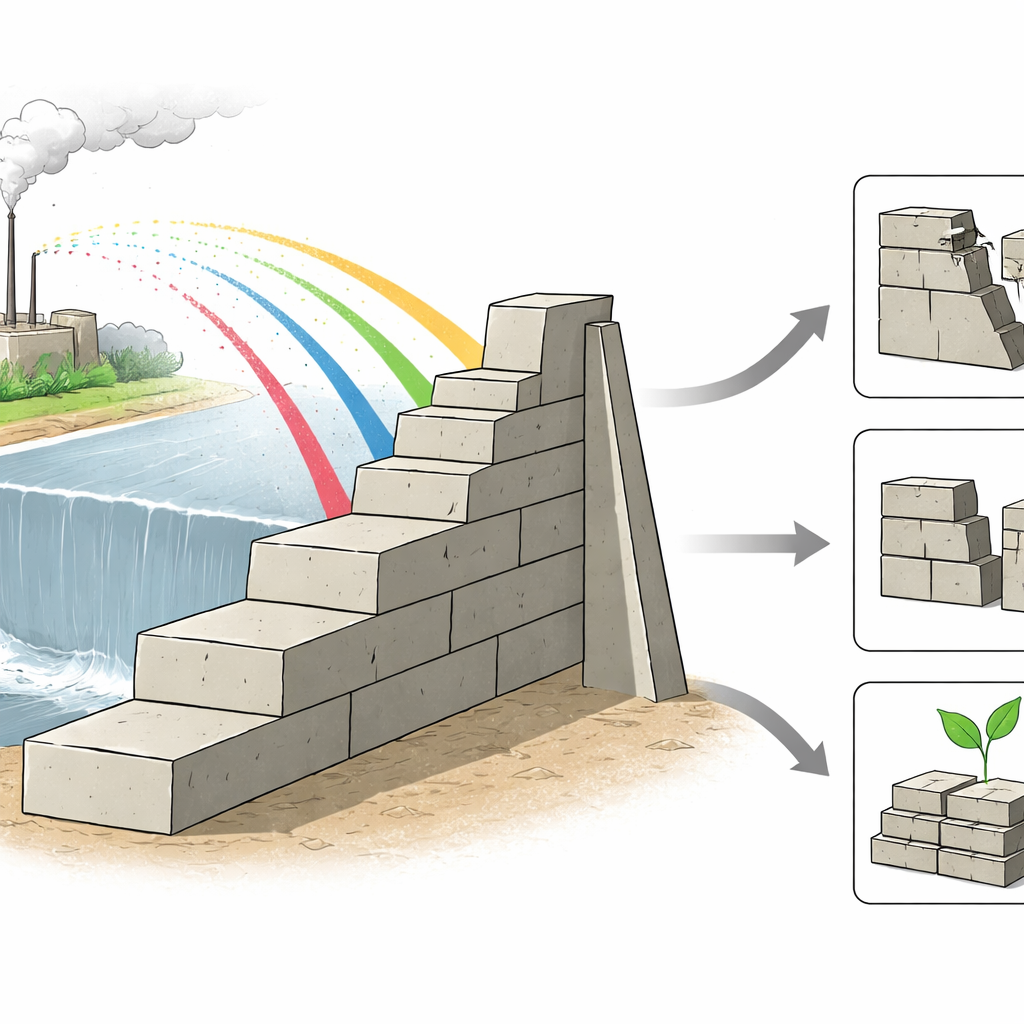
Modern dams and other massive concrete structures consume enormous amounts of material. At the same time, coal-fired power plants generate mountains of fly ash, a fine gray powder usually treated as waste. This study explores whether a calcium-rich form of fly ash can safely replace part of the cement in concrete for large dams, helping cut costs, reduce environmental impact, and still keep structures resistant to cracking over decades of use.
Why This Ash Matters for Big Concrete Structures
Fly ash forms when coal burns and mineral particles fuse into tiny glassy spheres. Engineers already use one common type, known as Class F fly ash, to improve concrete and reduce cement use. In parts of China such as Xinjiang, however, most available ash is rich in calcium. This Class C fly ash behaves differently: its extra calcium can help it react more strongly with cement, but it can also hide unstable forms of lime that may cause the concrete to swell or crack over time. To make good use of this local resource in huge dam projects, its effect on how concrete stretches, shrinks, and stays stable has to be understood in detail.
How the Team Put the Concrete to the Test
The researchers collected fly ash from several power plants with calcium oxide (CaO) contents ranging from very low to about 16.5 percent, and also tracked how much of that calcium was present in a particularly reactive “free” form. They mixed these ashes into two kinds of dam concrete: one with four sizes of stone and gravel, and another with three sizes. These fully graded mixes are designed to pack the aggregate particles together tightly, which is important for reducing internal voids and cracks. The team then carried out a series of laboratory tests to track volume stability (soundness), how far concrete can stretch before it cracks (ultimate tensile strain), stiffness (elastic modulus), natural volume change with no drying (autogenous deformation), and volume change when the concrete dries out (drying shrinkage).
What They Learned About Stability and Cracking
One key concern was whether higher calcium content would cause unstable expansion. The study found that when Class C fly ash has a CaO content between about 5.1 and 16.5 percent, and even when it replaces up to 70 percent of the cement, the concrete still meets standard limits for soundness. In mechanical tests, concrete with more CaO in the fly ash showed slightly higher tensile strain capacity and a higher elastic modulus, meaning it became somewhat better at resisting cracking while also a bit stiffer. At the same time, the self-driven volume change that occurs as cement and ash react internally tended to become more shrinkage-prone as CaO increased, especially in the concrete with four aggregate sizes. Despite these trends, the overall influence of CaO level on deformation remained modest.
Why Aggregate Grading Makes a Difference
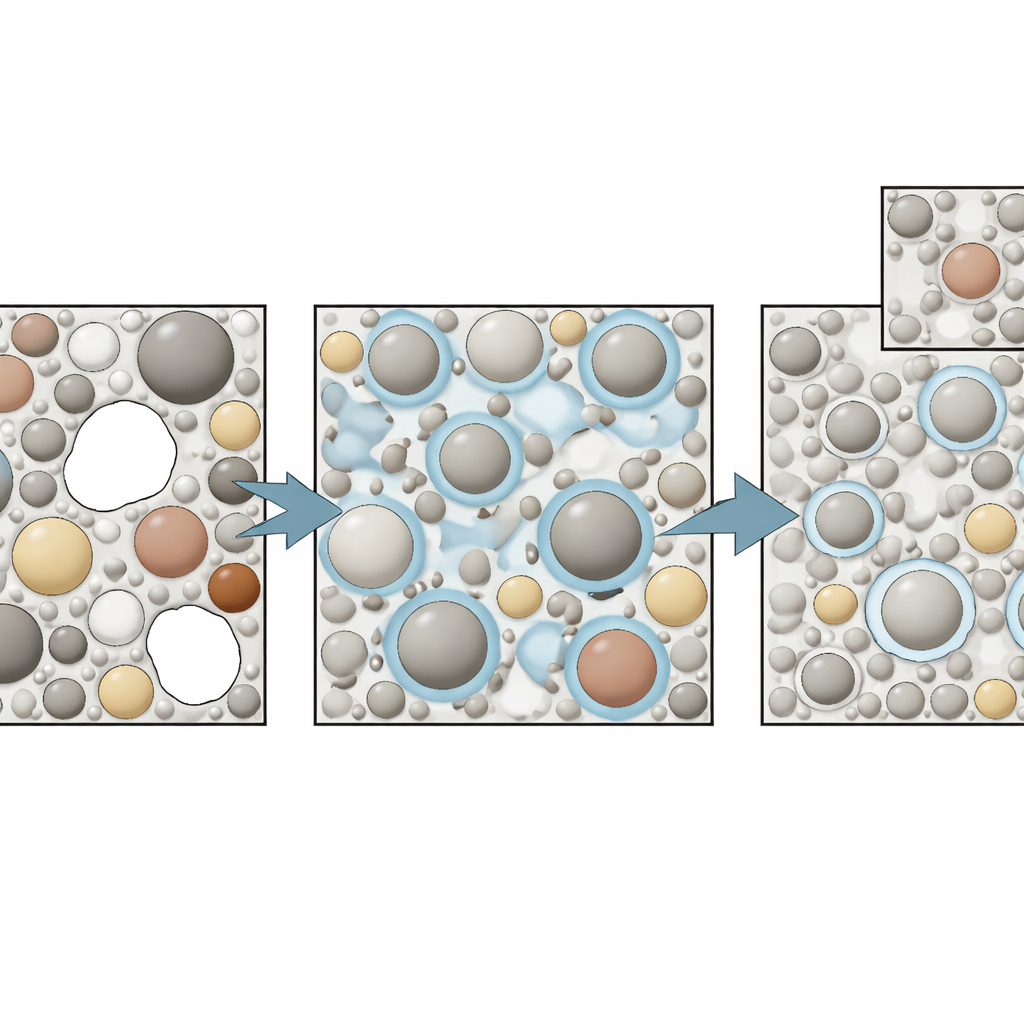
The comparison between four-graded and three-graded concrete revealed that how the stones are sized and blended can matter as much as the ash composition. The four-graded mixes, with a broader spread of particle sizes, tolerated higher tensile strain before cracking and showed slightly smaller drying shrinkage than the three-graded mixes. Their stiffness changed more steadily over time, suggesting a more stable internal structure. For autogenous volume change, however, the four-graded concrete shrank a bit more than the three-graded version, particularly when the CaO content in the fly ash was higher. Microscopic images confirmed that higher-calcium ashes can produce denser reaction products but may also create tiny flaws around unreacted particles if the calcium content is too high.
What This Means for Future Dams
For non-specialists, the main message is reassuring: within a well-defined calcium range, the local Class C fly ash studied here can safely replace a large share of cement in dam concrete without causing dangerous expansion or excessive cracking. Carefully chosen CaO levels, coupled with well-designed aggregate grading, allow engineers to build massive, stable structures while making better use of industrial by-products and lowering the demand for fresh cement. The work also highlights the need for further tests under more realistic temperature, humidity, and loading conditions, but it points toward a future in which what was once coal waste becomes a reliable ingredient in long-lasting hydraulic infrastructure.
Citation: Qin, L., Gong, M., Zhang, H. et al. Effect of CaO content in Class C fly ash on the deformation properties of fully-graded concrete. Sci Rep 16, 8122 (2026). https://doi.org/10.1038/s41598-026-38630-4
Keywords: fly ash concrete, dam construction, shrinkage and cracking, cement replacement, calcium-rich industrial waste