Clear Sky Science · en
A quantitative energy dissipation model for predicting permeability evolution in gas-containing coal under cyclic loading
Why shaking coal matters underground
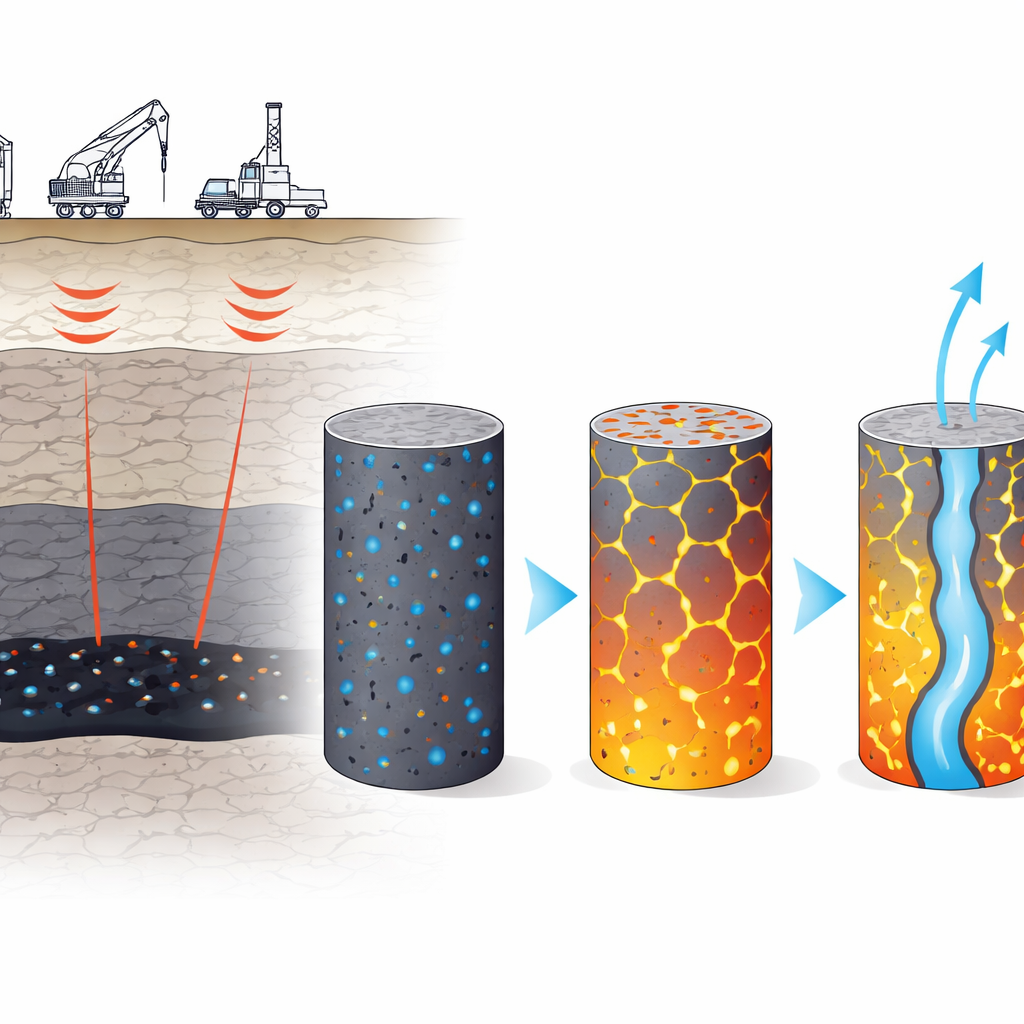
Deep coal mines are no longer just about digging rock; they are also vast, pressurized gas reservoirs. Repeated blasting, drilling and roof movements send pulses of stress through coal seams that already hold compressed gas such as methane or injected carbon dioxide. These vibrations can weaken the coal and change how easily gas escapes, which in turn affects both accident risk and the efficiency of energy recovery. This study asks a practical question with big safety and economic stakes: can we predict how the internal damage from repeated loading will change the ease with which gas moves through coal?
How the team recreated life in a deep mine
The researchers collected hard, low-porosity coal from a mine in Inner Mongolia and cut it into carefully prepared cylinders. They placed each specimen inside a sophisticated triaxial loading system that can squeeze the coal from all sides, add a steady background load, and then superimpose rapid oscillations to mimic repeated mining disturbances. Before loading, the samples were saturated with carbon dioxide gas at controlled pressures to imitate gas-bearing seams. During each test, the machine varied four main factors: how fast the load cycled, how large each stress pulse was, how high the steady axial load was, and how much gas pressure filled the coal. At the same time, sensors continuously tracked deformation and a separate system measured how easily gas flowed through the sample.
What repeated shaking does to coal strength
Across all test conditions, coal passed through three recognizable stages: an initial linear stage where it behaved elastically, a disturbance stage where each load cycle left a small permanent imprint, and finally a failure stage where large cracks suddenly linked up and the sample broke. As cycling became faster, pulses larger, or the steady axial load higher, the peak strength of the coal dropped and its ability to deform before breaking shrank. Higher gas pressure made matters worse by pushing on tiny internal pores and helping to pry them open, so gas-bearing coal became weaker than otherwise identical dry coal. Measurements of the elastic modulus—a measure of stiffness—showed a consistent decline with harsher loading and more gas, signalling that the material was quietly losing its internal integrity long before visible failure.
How damage turns into new gas pathways
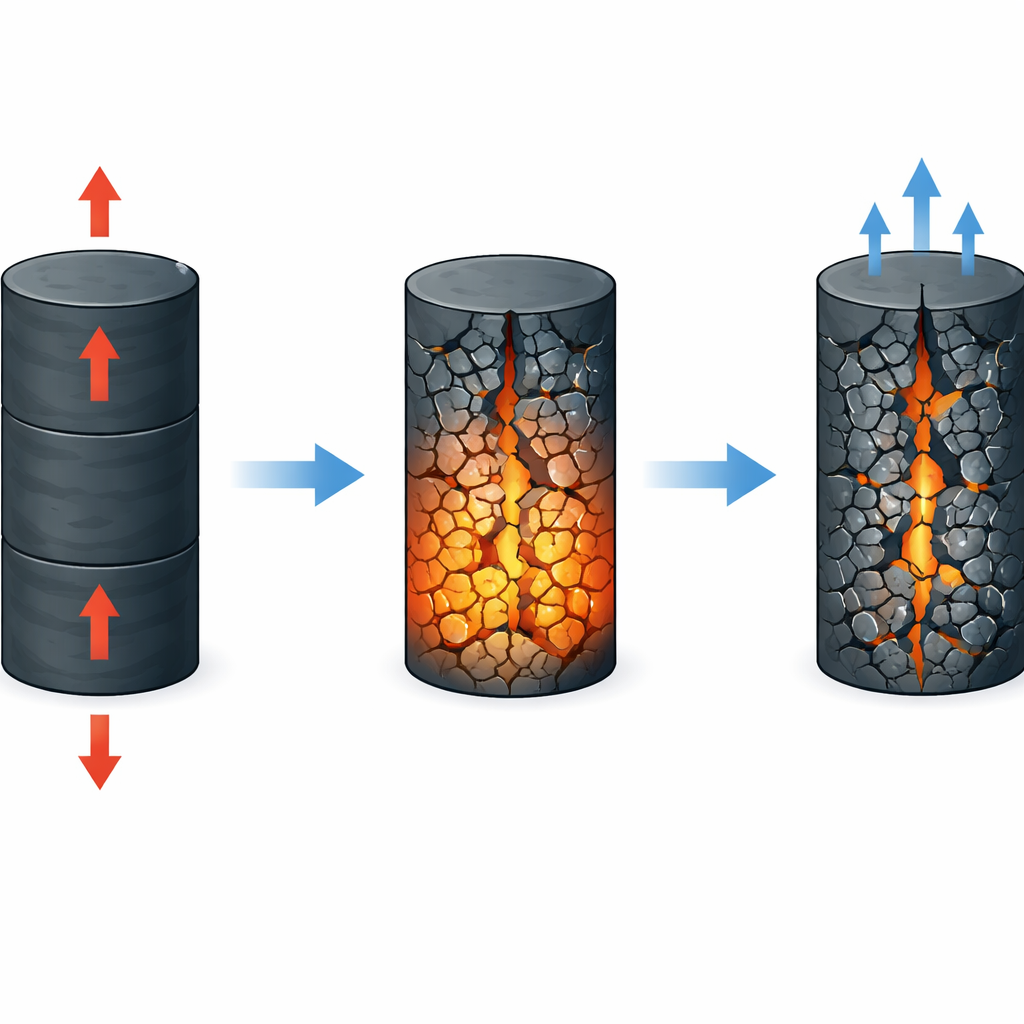
At first glance, one might expect higher gas pressure to clog pathways as the coal matrix swells. Under steady loading this can happen, but under repeated disturbance the picture changes. In these experiments, permeability—the ease with which gas passes through—rose steadily as the number of load cycles increased. Faster cycling, larger stress swings, higher background load and higher gas pressure all promoted more rapid growth of permeability. Microscopic cracks and pores, originally isolated, were jostled open and gradually linked into connected networks. In effect, repeated shaking both damages the coal and carves out new channels through which gas can migrate and escape.
A single hidden dial that controls gas flow
To make sense of this complex behavior, the authors built a model based on how much mechanical energy the coal dissipates during each loading cycle. By comparing the total energy put into the sample with the portion that is not recovered when the load is removed, they defined a cumulative damage factor, D, that grows as microcracks form and spread. Remarkably, regardless of whether the coal was stressed faster, harder, under more gas, or at different background loads, the observed change in permeability could be captured by a single mathematical relationship between D and the ratio of final to initial permeability. In other words, all those different disturbance patterns effectively act through one internal state variable—the accumulated damage stored in the coal’s fabric.
What the findings mean for mines and methane
For non-specialists, the key message is that repeated mechanical disturbances in a gassy coal seam do not just threaten sudden failures; they also systematically reshape the underground plumbing of gas flow. This study shows that the ease of gas escape can be predicted from a single, energy-based measure of internal damage that unifies many different loading scenarios. Such a universal dial offers mine engineers a way to assess when a seam is edging toward dangerous outburst conditions, and it can also guide controlled stimulation strategies that deliberately use cyclic loading to open up pathways for safer, more efficient coalbed methane recovery and related technologies.
Citation: Bao, R., Zhang, Y., Cheng, R. et al. A quantitative energy dissipation model for predicting permeability evolution in gas-containing coal under cyclic loading. Sci Rep 16, 9106 (2026). https://doi.org/10.1038/s41598-026-38629-x
Keywords: coal permeability, cyclic loading, gas-bearing coal, energy dissipation, coal mine safety