Clear Sky Science · en
Development and simulation of a novel mathematical model for an intelligent tire system toward predictive maintenance
Smarter tires for safer, cleaner driving
Modern cars are packed with computers, yet the four palm-sized patches of rubber that keep them on the road are still mostly blind. This study explores how to turn ordinary tires into "intelligent" partners that feel exactly how they are deforming on the road and translate that information into early warnings about wear, grip, and safety—crucial for heavy electric cars and self-driving vehicles that push tires harder than ever.

Why tire behavior matters
When a car moves, everything from braking distance to cornering stability is governed by the interaction between tire and road. That interaction depends on how the tire flexes, stretches, and squashes as it rolls. Electric and autonomous vehicles intensify these demands: battery packs add weight, motors deliver instant torque, and regenerative braking repeatedly tugs on the tread. These factors can boost tire wear by 20–30% compared with traditional cars, raising costs, energy use, and the risk of sudden loss of grip. To manage all this, engineers need models that can reliably predict how a tire behaves in real time, not just in controlled lab tests.
From pressure warnings to truly intelligent tires
Most drivers are familiar with tire pressure warning lights, but that technology only scratches the surface. The paper surveys a new generation of embedded sensors—tiny accelerometers, strain gauges, piezoelectric films, conductive rubber pads, acoustic wave devices, and optical fibers—placed inside or near the tire. Contact sensors mounted on the inner liner directly feel deformation and vibration as the tire rolls; non-contact sensors, like cameras and ultrasonic probes, watch the tire from a distance. Together, these devices can sense load, slip, contact patch size, road roughness, and even friction level. The key challenge is turning the raw signals from these sensors into clear physical quantities such as forces and moments that vehicle control systems can use immediately.
A new way to model what a tire feels
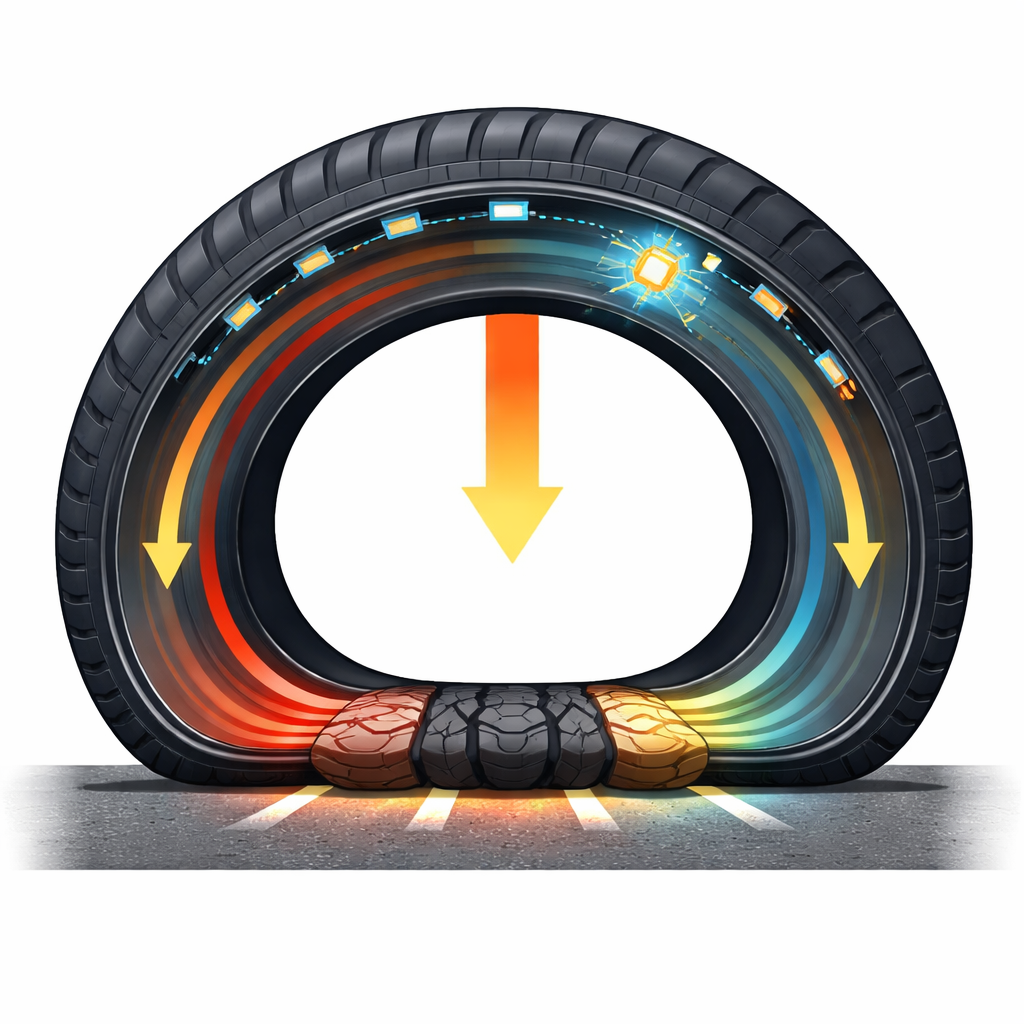
The authors propose a mathematical model that treats the tire tread as a flexible circular ring supported by springs and dampers that stand in for the sidewalls and inflated carcass. This "rigid–flexible ring" framework links how the tire bends and stretches in its plane to the forces it transmits to the road. Using advanced but analytically solvable equations, the model provides closed-form expressions for tread displacement and the circumferential strain that embedded sensors would measure. By assuming a realistic pressure pattern in the contact patch and accounting for slip and friction, the model can estimate how vertical load, driving or braking, and speed combine to shape the strain pattern around the tire.
What the simulations reveal about wear and load
With the model in place, the researchers run simulations to see whether it reproduces intuitive tire behavior. They show that the largest strain occurs near the center of the contact patch, and that increasing the number of mathematical modes refines the predicted strain curve without changing its main features. When the tire is driven with different levels of slip, the strain pattern becomes asymmetric, echoing how real tires behave under acceleration or braking. The model also captures how higher vertical loads not only change the size of the contact patch but skew the deformation pattern, which ties directly to rolling resistance and energy loss. Crucially, by varying the effective thickness of the tire carcass to mimic wear, the authors find a distinctive change in the strain signal at the trailing edge of the contact patch—a potential built-in fingerprint for how worn the tire has become.
Toward self-reporting, self-protecting tires
In plain terms, the study shows that it is possible to predict, with relatively light computation, exactly how a smart tire will flex and strain under real driving conditions, and how those signals evolve as the tire wears out. This gives car makers and fleet operators a physics-based shortcut for turning sensor readings into estimates of grip, load, and remaining life, paving the way for predictive maintenance that schedules tire replacement before problems arise. Combined with embedded sensors and future machine-learning refinements, such models could help cars quietly adjust braking, stability control, and energy use in the background—making everyday driving safer, more efficient, and more sustainable.
Citation: Hijry, H., Mohsen, S., Albalawi, O. et al. Development and simulation of a novel mathematical model for an intelligent tire system toward predictive maintenance. Sci Rep 16, 7982 (2026). https://doi.org/10.1038/s41598-026-38625-1
Keywords: intelligent tires, tire wear, vehicle safety, predictive maintenance, embedded sensors